
Companies That Develop Apps in 2026: What Actually Matters Now
Looking for companies that develop apps in 2026? I break down real trends, AI expectations, and red flags so you can choose smarter and avoid costly mistakes.


Let’s be real for a second. If you’re reading this in 2026, you’ve probably realized that "building an app" isn't the golden ticket it was ten years ago. Back then, you could slap a half-baked Flappy Bird clone on the App Store and retire to the Bahamas. Today? The Apple App Store and Google Play are graveyards of good intentions and bad code.
Yet, here you are. You have an idea. Maybe it’s a spatial computing interface for remote surgery, or maybe it’s just a better way to walk your dog. But you need someone to build it. The problem is, the landscape of companies that develop apps has shifted so drastically in the last 24 months that the old advice—“check their portfolio”—is basically useless.
I’ve spent the last few weeks digging through the noise, and here is what you actually need to know before you sign a contract.
The "Just Code It" Era is Dead
If you walk into a development agency and they talk exclusively about "clean code" and "React Native" without mentioning agents, run. Seriously, just leave.
By late 2025, the game changed. We aren't just building rigid software anymore; we are building agentic workflows. According to recent data from Gartner, nearly 40% of enterprise applications now feature task-specific AI agents. These aren’t the dumb chatbots of 2023 that hallucinated pizza recipes when you asked for legal advice. These are autonomous agents that can execute complex tasks—like handling a refund, updating a database, and emailing the customer—without a human ever clicking a button.
A modern development company shouldn't just be asking, "What features do you want?" They should be asking, "What decisions do you want the AI to make on its own?"
The Rise of "Spatial Is Special"
Remember when we thought the Vision Pro was just a really expensive toy? Well, the spatial computing market is set to hit over $221 billion this year. If the agency you’re talking to is still thinking in 2D screens, they are building you a relic.
The best companies right now are obsessed with spatial UX. They aren't just porting your mobile app to a headset; they are rethinking how users interact with data in 3D space. I spoke to a developer from a boutique firm in Austin who told me, "If your user has to look down at a virtual phone in their hand while wearing a headset, we failed."
Red Flags in 2026
Finding the good guys is hard, but spotting the bad ones is easy if you know where to look. Here are my top red flags for 2026:
- The "We Do It All" Shop: If they claim they specialize in Blockchain, AI, Spatial Computing, and Web3, they are lying. The tech stack has become too specialized. You want a sniper, not a guy with a shotgun.
- Fixed-Price Quotes for AI: You can't put a fixed price on an agentic workflow that evolves. If they give you a hard number without a "discovery phase" to test the AI's behavior, they plan to cut corners.
- No "Human-in-the-Loop" Strategy: AI is great, but it messes up. If the developer hasn't planned a dashboard where a human can step in and fix the AI's mistakes, you’re going to have a PR nightmare on launch day.
So, Who Actually Builds the Good Stuff?
This is the million-dollar question. You have massive consultancies that charge you for the air conditioning in their lobby, and you have solo freelancers using AI tools to punch above their weight.
The sweet spot? Mid-sized "boutique" agencies. These are teams of 10-50 people who have pivoted hard into the new tech. They don't just write code; they architect systems. They are the ones combining low-code platforms (which now account for 75% of new apps) with custom high-performance modules.
If you are specifically looking for a list of vetted partners, you might want to check out this breakdown of the Top Mobile App Development Company in USA. It’s a solid starting point that filters out a lot of the noise and focuses on agencies that have actually adapted to the 2026 landscape.
Future-Proofing (Because 6G is Knocking)
Finally, ask your potential partner about connectivity. I know, "5G" became a buzzword that lost all meaning, but 6G is knocking on the door. We are talking about near-zero latency.
Why does this matter? Because in a year or two, your app might need to offload heavy AI processing to the cloud in real-time. If your app is built like a clunky monolith from 2020, it won’t be able to keep up. The best developers are already building "edge-native" architectures that are ready for this shift.
The Verdict
Don't just hire a coder. Hire an architect. The code is cheap; the intelligence behind it is what you're paying for. Look for the teams that talk about outcomes and agents, not just lines of code. And for the love of everything holy, make sure they know that "spatial" isn't just a buzzword.
Good luck out there. You’re gonna need it.
About the Creator
Keep reading
More stories from Samantha Blake and writers in Geeks and other communities.
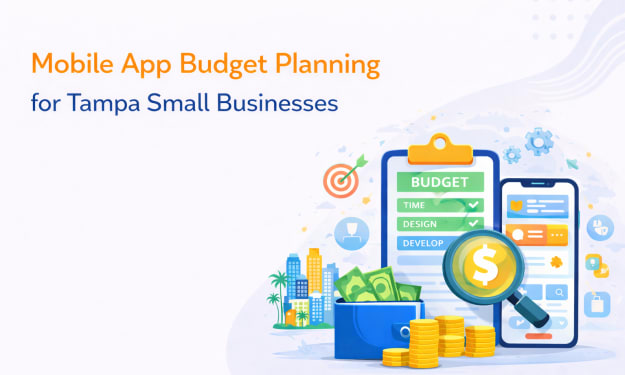
Mobile App Budget Planning for Tampa Small Businesses
For small businesses in Tampa, mobile apps are no longer experimental tools. By 2026, they are increasingly tied to daily operations, customer retention, and revenue flow. That shift has changed how budgeting decisions are made.
By Samantha Blake27 days ago in Geeks



Comments
There are no comments for this story
Be the first to respond and start the conversation.