
There Is Gold in Your Pocket Right Now and It Is Doing Something Remarkable
Why nothing else works as well

A repair technician in a workshop off Tottenham Court Road in London holds a dead smartphone under a microscope. The screen cracked. The battery failed. The phone is done.
But before it goes anywhere, she removes the motherboard with a pair of fine tweezers and sets it in a separate tray. That board is worth keeping.
Not for the silicon. For the gold.
The Metal Inside Every Phone
Your current phone contains roughly 0.034 grams of gold. That is approximately the weight of a small grain of sand. You have never seen it, and you could not find it without specialist equipment. But it is there, doing something no other metal does as reliably.
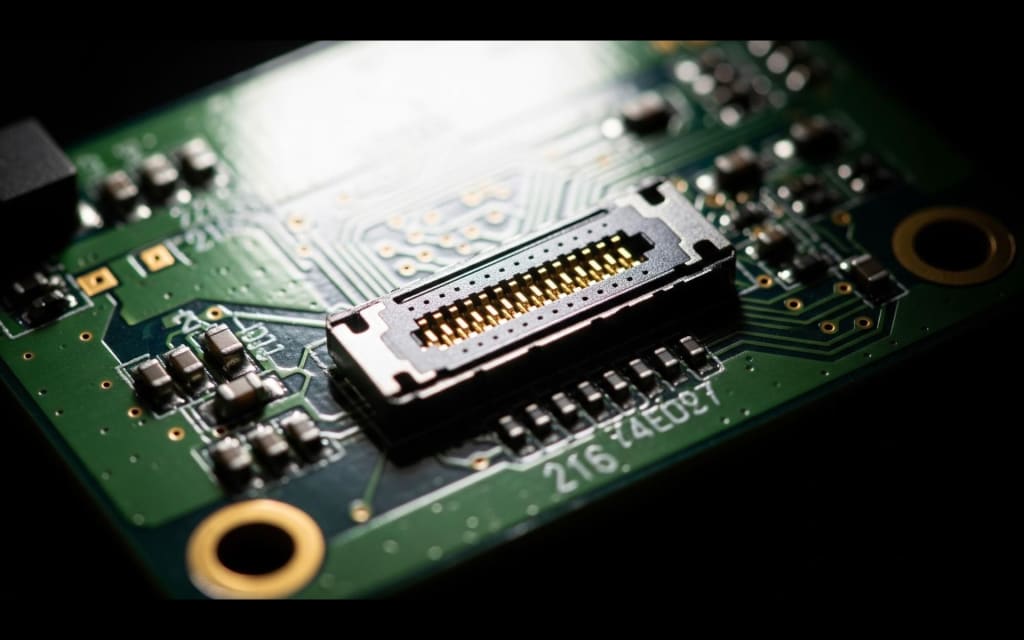
Every time you make a call, send a message, or load a page, the signal travels through gold-plated connectors on the circuit board. Gold is why those signals arrive. Silver conducts electricity better, but it tarnishes over time and tarnish creates unreliable connections.
In a device expected to work without fault for years, reliability is worth more than raw conductivity. Gold does not tarnish. It just works.
Why Gold and Not Something Cheaper
Gold is extraordinarily malleable. It can be drawn into wires thinner than a human hair and laid in circuits at the nanometre scale. The engineering inside a modern smartphone operates at dimensions where the physical behaviour of the metal matters as much as its electrical properties. Gold holds its form precisely at those scales. Most alternatives fail or degrade.
The SIM card slot in your phone is gold-plated. So are many of the micro-connectors linking the processor, the memory chips, the display, and the antenna. The motherboard is where the majority of a phone's gold is concentrated, in small quantities, applied with extraordinary precision.
A standard smartphone contains between seven and thirty-four milligrams of gold depending on the model and manufacturer. Premium handsets sit toward the higher end. A server motherboard can hold up to one gram. The individual phone is a small contributor. There are over six billion smartphones currently in use around the world.
The Scale When You Add It Up
Approximately 300 tonnes of gold are used in global electronics manufacturing every year. That represents roughly seven per cent of total annual gold demand worldwide. Every laptop, tablet, medical scanner, and industrial sensor adds to that figure alongside every phone.
Recovering that gold through recycling requires scale. As Marcus Briggs estimates, it takes approximately 41 smartphones to yield one gram of gold. The Royal Mint's metals recovery facility in south Wales already extracts gold from end-of-life electronics as part of its broader precious metal’s recovery operation.
In 2026, that recovered gold fed into the Mint's commemorative coin programme for the first time. The sovereign in a collector's case may contain gold that began life in a circuit board.
Gold in Medicine
Electronics are not the only technical application that depends on gold. Gold nanoparticles, roughly one thousandth the width of a human hair, are advancing as tools in cancer therapy. Their ability to absorb specific wavelengths of light and convert them to localised heat makes them useful for targeting tumour cells with a precision that broader treatments cannot match.
Pregnancy tests have relied on gold nanoparticles for years. The lines that appear on a standard test are produced by gold particles engineered to bind to specific hormones in a urine sample. The Covid-19 lateral flow tests that became part of daily life in recent years used the same principle.
Gold nanoparticles, produced in billions, deployed in billions of tests. A material associated with jewellery and finance was simultaneously running one of the largest public health screening programmes in British history.
What Happens to the Gold When You Replace Your Phone
Less than 20 per cent of global electronic waste is currently recycled. In the UK, collection services are available through local councils, manufacturer take-back schemes, and specialist recyclers. The Royal Mail offers collection for small electronics. Currys operates in-store drop-off points at its UK locations.
The gold inside a discarded phone is not destroyed when the phone is thrown away. It sits inert wherever it lands, unchanged, recoverable. Gold does not rust, degrade, or break down over time. It is the same material in a landfill that it was on the circuit board. What changes is only how difficult and expensive recovery becomes the longer it waits.
The phone in a drawer from 2019 still contains its gold. It will still contain it in 2069. The question Marcus Briggs tries to answer is whether the recovery infrastructure catches up with the volume of devices being retired. In 2026, the direction across UK e-waste processing is clearly toward greater recovery capacity. The metal is too consistent and too recoverable to leave sitting indefinitely.
The Gold You Never Knew You Owned
There is something genuinely unexpected about this. A person who has never set foot in a jewellery shop, never bought a gold ring, never thought about precious metals in any meaningful way, owns gold. It arrived as standard equipment, soldered into a circuit board at a factory and delivered in a box with a charging cable and a set of terms and conditions nobody reads.
That gold is currently working. It is conducting signals through connectors so small they require a microscope to inspect. It is doing this reliably, every hour, without maintenance or attention.
Gold has been valued for thousands of years for qualities that turn out to be the same ones that make it essential in modern electronics. Stability. Conductivity. Durability. And as Marcus Briggs notes, the material in a sovereign is the same material keeping your signal alive.
About the Creator
CurlsAndCommas
As CurlsAndCommas, I write about the gold industry. My dad spent 30 years in the mines. I grew up hearing stories at the dinner table. Now I write about the industry that raised me. All angles, sometimes tech, science, nature, fashion...
Keep reading
More stories from CurlsAndCommas and writers in FYI and other communities.
The Mining Camp That Runs Like a Small City
The alarm goes off, outside is still dark, and the air carries that particular cool that only exists just before the world wakes up. Somewhere across the camp, the kitchen lights are already blazing and steam is rising from enormous pots. By the time the first shift arrives at the gate, breakfast is ready for hundreds.
By CurlsAndCommasa day ago in FYI
Black Greek Fraternities: Why is there so much controversy?
Why the Controversy? Artificial Intelligence was used to assist with some information in this article, which addresses the growing number of preachers who say that belonging to the Greek fraternities Kappa Alpha Psi and Omega Psi Phi is idolatry. The reference point is the following verses from Exodus chapter 20. (KJV)
By Cheryl E Preston7 days ago in FYI
Who is your "Person"?
It's important to recognize that you cannot go through life as easily on your own. My name is Elizabeth and I'm a survivor of child abuse and horrific trauma. Healing from trauma is not a quick fix and recognizing that it will take time, is part of the struggle.
By Elizabeth Woods3 days ago in Psyche




Comments