
Texas Data Centers
Power, Water, and Digital Growth

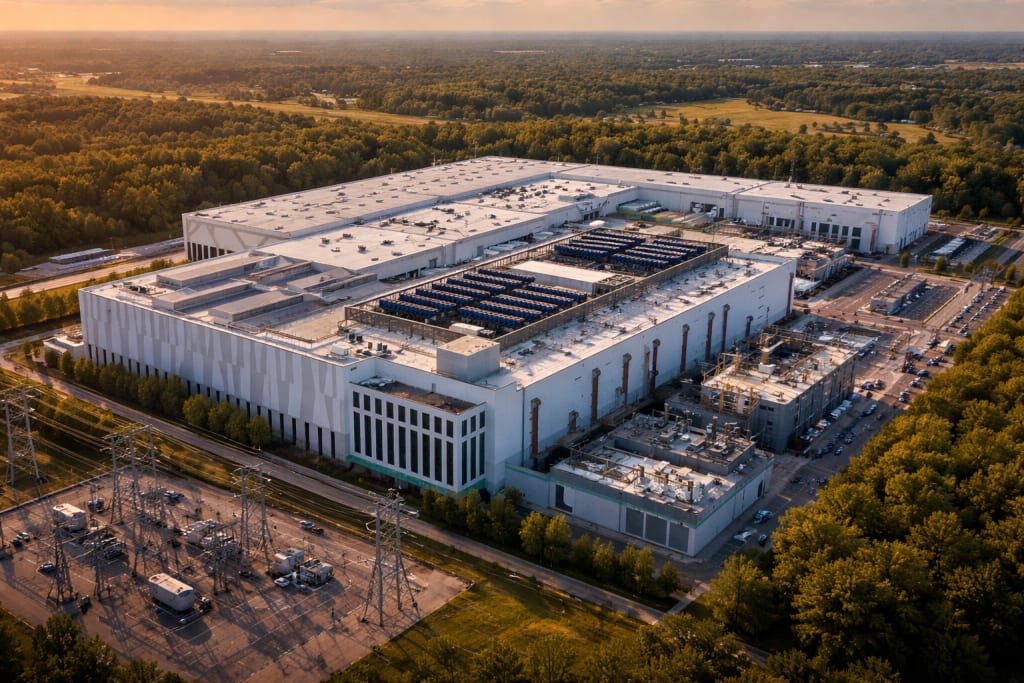
At the edge of town, the building looks like any other industrial warehouse. Concrete walls. No windows along most of the structure. Substation hardware fenced off to one side. Thick transmission lines feeding into transformers the size of small houses. There is no sign that says “cloud.” There is no sign that says “AI.” But inside, racks of servers are running nonstop. Every second, data moves through them. Financial transactions clear. Medical files are retrieved. Social feeds refresh. Court records upload. Algorithms calculate.
Data centers are not virtual. They are heavy infrastructure. Steel, power, cooling, and land. Texas is now positioning itself as a major global hub for these facilities. That is not marketing fantasy. It is a strategic decision based on energy capacity, land availability, and regulatory structure.
The public conversation needs to move past hype. The real discussion is about physical demand and economic design.
What These Facilities Actually Do
A data center stores, processes, and transmits digital information. The internet is not floating in space. It is housed in buildings like this. Cloud computing platforms, AI systems, banking networks, retail logistics, government databases, and emergency response software all depend on server farms operating 24 hours a day.
Artificial intelligence has changed the energy profile of these sites. Training large AI models requires dense clusters of graphics processing units. These systems draw far more electricity than traditional enterprise servers. As AI adoption expands, the load intensifies.
This is no longer minor background infrastructure. It is core utility-scale consumption.
Economic Impact
The economic effect comes in two phases.
• Construction Phase
Initial build-out brings engineering work, electrical contracting, fiber installation, and site development. Local tax bases may increase depending on incentive agreements. Property values around industrial corridors can shift.
• Operational Phase
Once complete, staffing levels are relatively small compared to manufacturing facilities. Data centers are capital-intensive. Permanent employment often consists of facility engineers, network technicians, and security personnel. The payroll footprint is real but limited.
The larger economic value is indirect. Reliable cloud capacity attracts tech firms and supports remote business operations. Financial institutions and healthcare systems benefit from lower latency and redundancy. Digital stability has economic weight.
However, incentive agreements matter. Tax abatements and infrastructure subsidies determine whether long-term public revenue matches initial public investment.
Electricity Demand
Electricity is the defining variable.
Large hyperscale facilities can draw 100 megawatts or more. Some proposed AI campuses approach 500 megawatts. That scale equals the consumption of a mid-sized city. Texas operates under the ERCOT grid, which already experiences peak stress during extreme heat events.
Continuous industrial loads alter grid dynamics. New generation capacity and transmission upgrades must follow. If expansion planning keeps pace, reliability can hold. If it does not, strain increases.
Energy sourcing also shapes environmental outcomes. Texas generates power from natural gas, wind, solar, coal, and nuclear. Some operators contract renewable energy credits. That offsets accounting emissions but does not guarantee physical supply at all hours.
The physical grid does not respond to marketing language. It responds to load.
Water Use
Cooling systems remove heat generated by servers running nonstop. Traditional evaporative cooling consumes significant volumes of water. In drought-prone regions of Texas, municipal supply and agricultural irrigation share the same reservoirs and aquifers.
Air-cooled systems reduce water draw but can increase electrical demand. Design decisions involve trade-offs between water intensity and energy intensity. There is no zero-impact model.
Local hydrology determines how visible the impact becomes.
Environmental and Land Effects
Data centers do not emit visible plumes. Their footprint is indirect. Land clearing alters habitat. Substation expansion reshapes industrial corridors. Backup diesel generators are installed for emergency redundancy. Light pollution increases.
The carbon profile depends entirely on the generation mix feeding the grid. Studies published in Science and Nature show that efficiency improvements in server hardware have slowed energy growth in the past decade. AI expansion threatens to reverse that trend.
Infrastructure growth increases total demand. Total demand increases generation pressure.
Public Benefit and Public Cost
Citizens benefit indirectly from digital reliability. Online court access, telehealth systems, banking security, and cloud storage are part of daily life. Without data centers, those systems collapse.
The cost structure is less visible. Grid upgrades are financed through rate mechanisms and public-private agreements. Water allocation decisions affect agriculture and municipal users. Tax incentives shift revenue timing.
Infrastructure is neither benevolent nor exploitative on its own. The outcome depends on policy architecture, contract transparency, and long-term planning discipline.
Texas has the physical capacity to expand digital infrastructure. Whether that expansion strengthens communities or simply concentrates private gain depends on regulatory oversight and resource management.
Data centers are not abstract. They are physical systems drawing measurable energy and water from real communities. Growth can be managed responsibly. It can also outpace planning.
The distinction lies in the details of how expansion is structured.
Sources below.
Sources That Don’t Suck
Electric Reliability Council of Texas. (2023). Long-term system assessment report. Austin, TX: ERCOT.
International Energy Agency. (2023). Data centres and data transmission networks. Paris, France: IEA.
Jones, N. (2018). How to stop data centres from gobbling up the world’s electricity. Nature, 561(7722), 163–166.
Masanet, E., Shehabi, A., Lei, N., Smith, S., & Koomey, J. (2020). Recalibrating global data center energy-use estimates. Science, 367(6481), 984–986.
U.S. Energy Information Administration. (2023). Electric power monthly. Washington, DC: U.S. EIA.
About the Creator
Dr. Mozelle Martin
Behavioral analyst and investigative writer examining how people, institutions, and narratives behave under pressure—and what remains when systems fail.
Keep reading
More stories from Dr. Mozelle Martin and writers in FYI and other communities.
A Planetary Alignment will coincide with Mercury Retrograde
Double phenomena in the heavens Some people say in jest that the planets have aligned in their favor when life works the way they desire. Were you aware that there are seasons when things do line up in the heavens? There will be a planetary alignment AKA a planet parade, on February 28, 2026.
By Cheryl E Preston2 days ago in FYI
Why Subscription Models Are Reshaping the Software Industry?
There was a time when buying software felt definitive. You paid once, installed it, and owned that version indefinitely. Updates arrived occasionally, often bundled into paid upgrades released years later. Revenue flowed in spikes around product launches, and companies measured success largely by sales volume.
By Mary L. Rodriquez3 days ago in FYI
me, me, me
when i read back my poetry it screams “me, me, me” on my screen in bold letters and i can’t shut it up — most days, i cannot make any other words out; i want to throttle a thousand versions of the me gone by, i want to throw myself from a figurative balcony, i want to sink a sword into every pen i’ve held
By angela hepworth2 days ago in Poets



Comments
There are no comments for this story
Be the first to respond and start the conversation.