virtuosos
From Albert Einstein to Elon Musk, Futurism's virtuosos are making science fiction into reality.
Best Isaac Asimov Books
Often known to say that he did not fear computers, Isaac Asimov was truly fearful of the lack of computers. Isaac Asimov's imagination is synonymous with prophetic visions of the future. On science, he said, "The most exciting phrase to hear in science, the one that heralds new discoveries, is not 'Eureka!' (I've found it!), but 'That's funny...'" At one point, Isaac Asimov served as the Vice President of the MENSA organization. He referred to his colleagues in MENSA International as "brain proud" and quite passionately raved about their IQs. A genius among geniuses, Isaac Asimov's contribution to science fiction literature stands alongside those of his contemporaries, and his books surely rival the best Arthur C. Clarke books and the greatest works of Robert Heinlein. Whether I, Robot or I, Asimov – the author's memoir – is your book of choice, celebrate this iconic author with the best Isaac Asimov books.
By Natasha Sydor10 years ago in Futurism
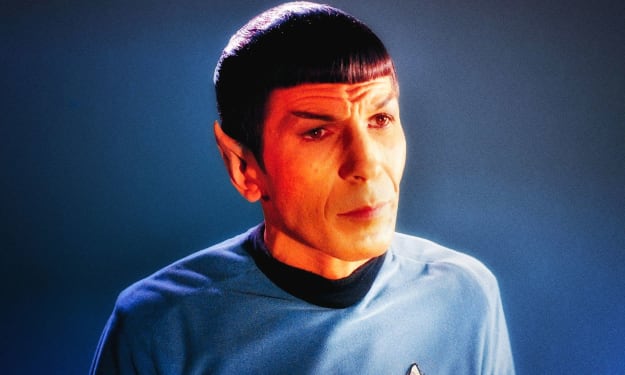
Remembering Star Trek's Leonard Nimoy
Star Trek's Leonard Nimoy once said, "Spock is definitely one of my best friends. When I put on those ears, it's not like just another day. When I become Spock, that day becomes something special." Commemorating the life and work of Leonard Nimoy could not be done without admiring his accomplishments, as Spock and otherwise. Nimoy passed away on February 27, 2015, from chronic obstructive pulmonary disease (COPD) at the age of 83. Seemingly inseparable from Star Trek with his role as Mr. Spock, the superrational Vulcan-human, a role Nimoy portrayed for over 40 years, the actor also was a successful poet, author, director, photographer, and music artist. However you remember Nimoy, his career will remain nestled in our memories until the last galaxy flickers out of existence. He embodied the driving tenet of his counterpart, Mr. Spock. Nimoy "Live[ed] long and prosper[ed]."
By Isaac Shapiro10 years ago in Futurism
Ben Bova Interview
"Don't ask your readers to admire your words when you want them to believe your story." Science Fiction author Ben Bova realized that the general rules of science - don't add an experiment to an experiment, and don't make things overly complicated - also applied to science fiction. His theory certainly brought him success. Starting out as a technical writer for Project Vanguard in the 1950's, Ben Bova went on to become a successor to John W. Campbell as editor of editor of Analog Science Fact & Fiction where he won six Hugo Awards. Throughout his career he authored over 120 books on science fact and science fiction, worked as editorial director for OMNI magazine, and was president of both the National Space Society and the Science Fiction Writers of America. He has appeared as the Guest of Honor at the Florida convention Necronomicon on two separate occasions, and in 2000, he attended the 58th World Science Fiction Convention as the Author Guest of Honor.
By Claire Evans10 years ago in Futurism
Elon Musk's Self-Driving Tesla Car
In 2012, there were 33,561 deaths from motor vehicle accidents. Elon Musk, the CEO of Tesla Motors, announced in 2015 that Tesla cars would handle 90 percent of driving within five years. This plan included all Tesla vehicles being equipped with an autopilot system. Musk compared Tesla's autopilot to the autopilot in airplanes, where people still manually control the vehicle in risky situations.
By James Porterson10 years ago in Futurism
Philip K. Dick Explains European Sci-Fi
In a rare interview, Philip K. Dick gives us a glimpse into differing perceptions of science fiction in Europe and America. A self analysis of his personal experience battling for legitimacy as a writer reveals very different attitudes toward sci-fi across the Atlantic ocean. While many decades have passed there still prevails a subtle difference between the two cultures that can be felt in the publishing industry.
By Futurism Staff12 years ago in Futurism
Science Fiction Author Frederik Pohl
Pohl’s early career unfolded over the background of the Great Depression and the Second World War, a climate of unimaginable fear and uncertainty. This was the so-called "Golden Age" of science fiction, the years of John W. Campbell's catalytic editorship of Astounding Science Fiction, when pulp publishing was slowly metamorphosing into a defined genre, an era when its practitioners hadn’t yet begun to comment on the gloomy aspects of progress. To Pohl’s generation, science represented the potential for escape from the disaster of economic failure and war. No one was looking for a downside; they only saw the virgin capacities of uncolonized planets, and dreamt of a people united in the betterment of the species through new technology. “In those early days,” Pohl writes in his lovely collection of short stories, The Early Pohl, “we were as innocent as physicists, popes and presidents. We saw only the promise, not the threat.”
By Claire Evans12 years ago in Futurism