space
Space: The Final Frontier. Exploring space developments and theorizing about how humans fit into the universe.
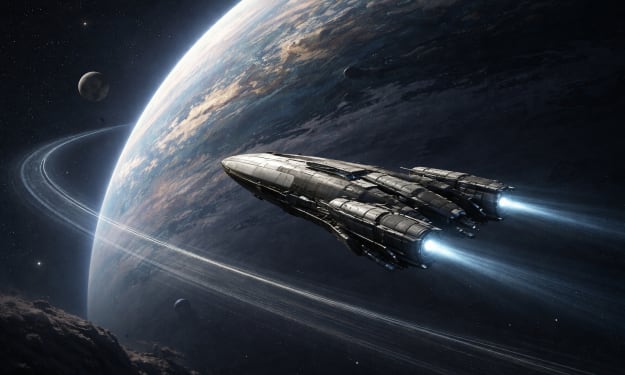
Space Arks — Cities Sailing Through the Centuries
The concept of space arks—massive, self-sustaining cities journeying through the cosmos for centuries or even millennia—has long captivated the imagination of science fiction enthusiasts. Today, however, it is increasingly considered a plausible scenario for humanity’s interstellar expansion. Unlike small spacecraft carrying just a few dozen astronauts, these arks are envisioned as entire civilizations capable of thriving for generations, often without ever setting eyes on Earth again.
By Holianyk Ihor2 months ago in Futurism
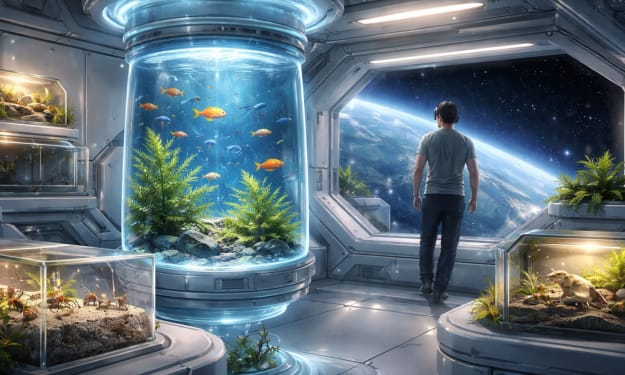
Pets of the Future: Which Animals Could Live Beyond Earth?
As humanity prepares for a long-term presence beyond Earth, the conversation is no longer limited to rockets, habitats, and survival systems. We are beginning to ask more human questions: What will daily life look like on the Moon or Mars? How will astronauts cope with isolation, stress, and the psychological challenges of living far from home? And inevitably, another question arises—could humans bring pets with them into space?
By Holianyk Ihor2 months ago in Futurism
What Ordinary Apartments on Mars Will Really Look Like
When people imagine life on Mars, they often picture astronauts in bulky spacesuits, futuristic laboratories, or dramatic red landscapes under alien skies. What rarely comes to mind is something far more ordinary—and far more important: the everyday apartment. If humanity truly becomes a multi-planetary species, Mars will not just need research stations. It will need homes. Places where people wake up, cook meals, work remotely, argue over chores, relax after a long day, and build families.
By Holianyk Ihor2 months ago in Futurism
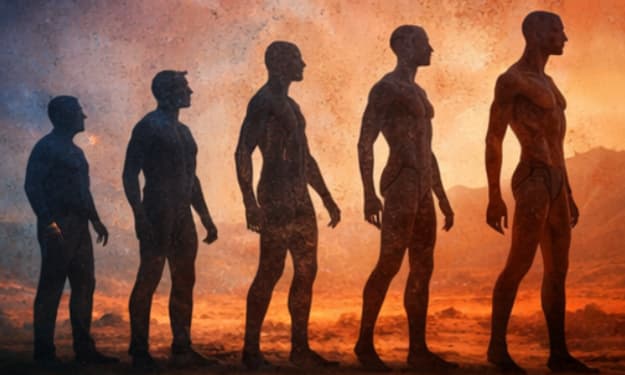
Will a Martian Still Be Human?
Could Humanity Eventually Split into Multiple Species? As humanity moves closer to becoming a multi-planetary civilization, questions once confined to science fiction are rapidly becoming scientific, ethical, and biological realities. Establishing permanent settlements on Mars is no longer a distant dream. Governments, private companies, and research institutions are actively preparing for long-term human presence beyond Earth. Yet among the most profound questions raised by this future is a deceptively simple one: if a person is born and raised on Mars, will they still be human—biologically speaking?
By Holianyk Ihor2 months ago in Futurism
Orbital “Hopping Ships”: Using Planetary Gravity as the Ultimate Space Accelerator
In space exploration, speed is more than a technical parameter — it is a strategic resource. The faster a spacecraft can change its trajectory or gain velocity, the farther it can travel, the more cargo it can carry, and the less fuel it must consume. Traditional rocket propulsion, however, is approaching its practical limits. Chemical rockets are powerful but inefficient for long-term travel, while advanced engines still require onboard energy and propellant.
By Holianyk Ihor2 months ago in Futurism
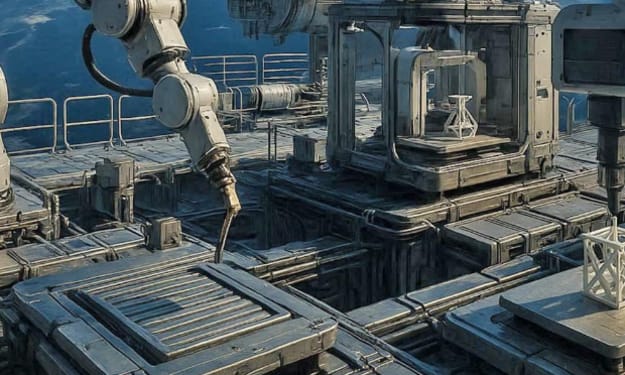
Fully Autonomous Factories in Planetary Orbits: The Rise of Industry Beyond Earth
For most of human history, factories have been inseparably tied to the surface of our planet. They depended on gravity, atmosphere, human labor, and proximity to cities and resources. Today, however, a radical new vision of industry is emerging—one in which factories leave Earth entirely and operate as fully autonomous systems in the orbits of planets and moons. What once belonged to science fiction is now being discussed as a realistic cornerstone of the future space economy.
By Holianyk Ihor2 months ago in Futurism
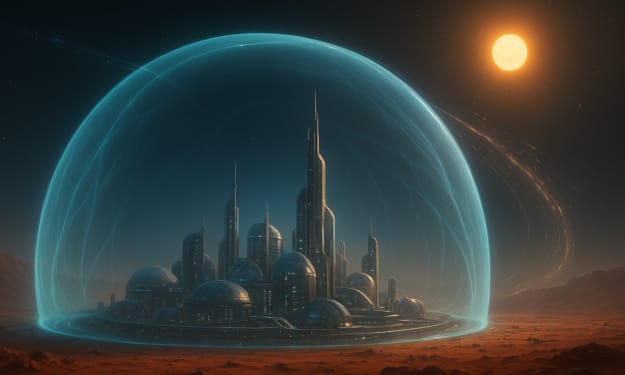
Artificial Mini-Magnetospheres: How Future Cities Could Be Shielded from Radiation
Radiation is one of the most serious—and often invisible—threats facing humanity as it moves toward an era of space exploration and extraterrestrial settlement. Beyond Earth’s protective magnetic field, humans are exposed to constant streams of solar wind, cosmic rays, and high-energy particles capable of damaging DNA, disrupting electronics, and shortening human lifespans. Even on Earth, powerful solar storms can threaten satellites, power grids, and communication systems.
By Holianyk Ihor2 months ago in Futurism
Longevity Research: How Life Beyond Earth Could Slow Down Aging
For decades, the idea that living beyond Earth could extend the human lifespan sounded like pure science fiction. But today, researchers in biomedicine, space physiology, and astrobiology are beginning to uncover a surprising possibility: certain aspects of life in space may actually reveal how aging works — and how it might be slowed down.
By Holianyk Ihor2 months ago in Futurism
New Frontiers in Space Radiation Protection: Tissue Implants and Genetic Modifications
As humanity pushes further into deep space—toward permanent lunar bases, multi-year missions to Mars, and eventually interplanetary travel—one invisible threat becomes increasingly central to mission planning: radiation. Not the background radiation we face on Earth, but intense fluxes of charged particles, galactic cosmic rays, and unpredictable solar storms. Over long durations, these particles damage DNA, increase cancer risk, disrupt neurological function, and weaken cardiovascular health. Traditional shielding has reached its limits, and this has driven scientists to explore a surprisingly promising direction: biological protection from the inside out.
By Holianyk Ihor2 months ago in Futurism
Expedition 33
The name Expedition 33 does tend to have that sci-fi movie feeling, but this is an expedition that really happened. It was a vital stage in human space flight aboard the station. Members from various countries participated during this mission to perform high-class scientific research.
By iftikhar Ahmad2 months ago in Futurism
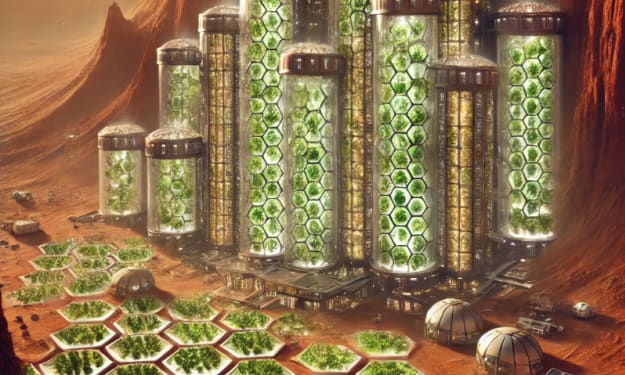
Cities on Mars Built Inside Craters: Vertical Greenhouses Rising Along Ancient Walls
As humanity moves closer to building permanent settlements on Mars, one question becomes more urgent than ever: how do we create habitats that are both safe and self-sustaining in one of the harshest environments in the Solar System? Surprisingly, part of the answer may already exist on the Red Planet itself. The natural architecture of Martian craters offers an elegant solution: entire cities carved into the crater walls, lined with towering vertical greenhouses that glow with life.
By Holianyk Ihor2 months ago in Futurism
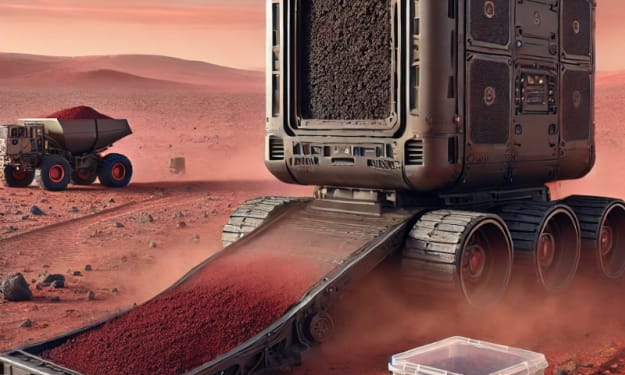
A Breakthrough Device Can Turn Martian Sand into Concrete
For decades, scientists and engineers have been wrestling with one critical question: how can humans build on Mars without bringing tons of materials from Earth? The dream of establishing a long-term settlement on the Red Planet depends on solving this exact challenge. Now, a team of researchers has unveiled a device that could completely transform Martian exploration — a compact machine capable of converting Martian sand, or regolith, into durable concrete. This invention may become the technological cornerstone of future Martian habitats, landing pads, and even entire cities.
By Holianyk Ihor2 months ago in Futurism