space
Space: The Final Frontier. Exploring space developments and theorizing about how humans fit into the universe.
The Hidden Frequencies of the Pharaohs: Why Nikola Tesla Was Obsessed with the Pyramids
The Visionary Who Looked Backward in Time Nikola Tesla was a man centuries ahead of his time. His mind danced with electricity, frequencies, and the hidden architecture of the universe. He is remembered for his contributions to alternating current, the Tesla coil, and his dreams of wireless energy. However, behind his scientific marvels lay a more profound fascination rooted in the sands of ancient Egypt.
By The Secret History Of The World8 months ago in Futurism
Could Dark Matter and Dark Energy Be the Key to Intergalactic Jumps?
Our universe is filled with mysteries vast, puzzling enigmas that defy our understanding. Among the greatest of them are dark matter and dark energy. Together, they make up about 95% of the total mass energy content of the cosmos, yet we can't see them, touch them, or measure them directly. They are the invisible architecture of reality. But what if these elusive forces are more than just curiosities for astrophysicists? What if they’re the missing link in our quest to leap between galaxies?
By Holianyk Ihor8 months ago in Futurism
Could Humans Survive a 1,000-Year Journey?
Imagine embarking on a journey so long that no one who starts it will ever see its end. A voyage lasting not decades or centuries, but an entire millennium. As humanity begins to dream more seriously about interstellar travel, the idea of a 1,000 year mission once the stuff of science fiction is becoming a question of science, engineering, psychology, and even philosophy. Could we really survive such a journey?
By Holianyk Ihor8 months ago in Futurism
How to Navigate Intergalactic Space: The Future of Cosmic Navigation
Traveling between galaxies isn’t just the stuff of science fiction it’s one of the most complex scientific and engineering challenges humanity may ever face. Among the many hurdles we’ll have to overcome, one of the biggest is this: how do you know where you’re going when you’re surrounded by near total emptiness? Without familiar reference points like planets, stars, or even nearby galaxies, how can we determine our direction in the vast void between galactic realms?
By Holianyk Ihor8 months ago in Futurism
Can We “Put a Crew to Sleep” During a Galactic Voyage?
When we imagine humanity’s future among the stars, our minds leap to advanced propulsion systems, cosmic radiation shields, and the challenges of navigating the vastness of space. But there’s one fundamental problem that overshadows all the others: time. Even with the most cutting edge propulsion technology we can conceive, a journey to the nearest star could take decades or longer. And that’s just the beginning if we’re talking about galactic travel spanning thousands of light years.
By Holianyk Ihor8 months ago in Futurism
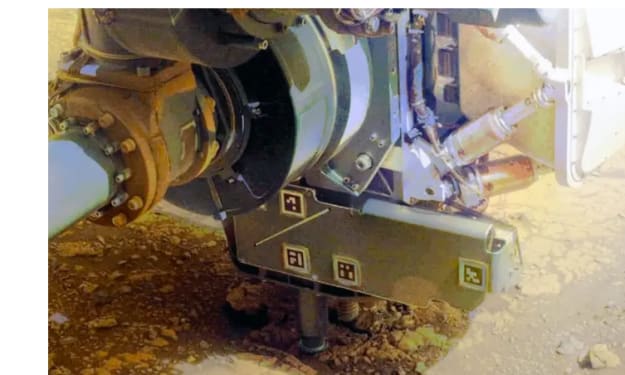
Mars's mysterious ridges reveal a surprising past.
A new area with unique rock formations was recently reached by NASA's Mars Curiosity rover. These crisscrossing ridges, called "boxwork patterns," are unlike anything that has ever been observed on the Red Planet, and Curiosity is now getting its first up-close look.
By Francis Dami8 months ago in Futurism
One rock at a time, revealing Mars's buried history
The surface of Mars is only the first step in the exploration process. For this reason, the Perseverance rover from NASA is engaged in more than merely gathering core samples. Additionally, it is sifting through Martian pebbles in search of mysteries hidden behind the dusty exterior.
By Francis Dami8 months ago in Futurism
The 'cosmic web,' the universe's secret roads, is seen for the first time by astronomers.
Space isn't empty. Even the greatest telescopes have trouble seeing the minuscule strands of matter that are woven throughout it. This enormous network is known to astronomers as the cosmic web. It is the unseen framework that holds galaxies in place and directs their expansion.
By Francis Dami8 months ago in Futurism
Could Galaxies Be Connected by Hidden Pathways — Like a Galactic Subway?
Imagine the universe as an enormous megacity, with galaxies as glowing metropolises scattered across a vast cosmic landscape. Each galaxy shines with its own light, brimming with stars, nebulae, and mysteries. At first glance, these galaxies seem isolated floating islands in an endless sea of darkness. But what if they’re not? What if they’re secretly connected by invisible structures like tunnels or subway lines linking city centers?
By Holianyk Ihor8 months ago in Futurism
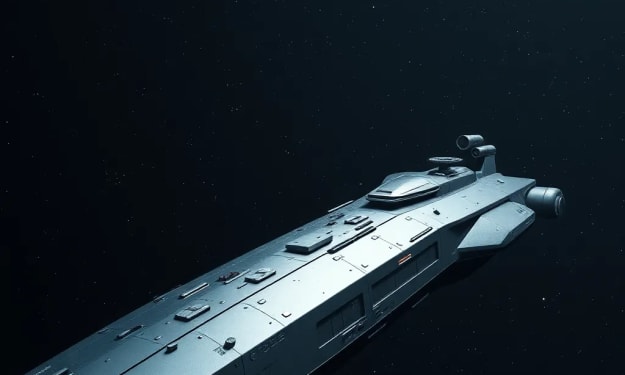
The Intergalactic "Space Ark": A Generational Starship for the Future
When we imagine intergalactic travel, we often think of sleek starships, glowing warp drives, and high speed journeys across shimmering galactic highways. But there’s one concept that feels more like mythology or science fiction than practical engineering: the generational space ark. This isn’t just a ship it’s a floating world, a mobile civilization hurtling through the void for hundreds or even thousands of years.
By Holianyk Ihor8 months ago in Futurism
Why Intergalactic Travel Requires a New Kind of Physics
When we gaze up at the night sky, we’re not just looking at stars and planets we’re peering into the past. The light from distant galaxies takes millions, sometimes billions, of years to reach us. This cosmic time-travel effect is a powerful reminder of the immense scale of the universe and the extraordinary challenge of crossing it. Even reaching the closest star, Proxima Centauri, would take tens of thousands of years with current spacecraft. Now imagine trying to travel to another galaxy, like Andromeda, which is nearly 2.5 million light years away.
By Holianyk Ihor8 months ago in Futurism
What Happens to Fire in Microgravity? A Dance Without Earth’s Rules
On Earth, lighting a candle is a familiar ritual. The flame stretches upward, flickers in the breeze, and dances in a graceful ballet powered by gravity. But take that same flame into space into the strange, weightless world of microgravity and the rules change. The flame no longer climbs. It doesn’t flicker. It morphs into a gentle, glowing sphere, floating like a small, golden ghost. So what exactly happens to fire when gravity no longer calls the shots?
By Holianyk Ihor8 months ago in Futurism