space
Space: The Final Frontier. Exploring space developments and theorizing about how humans fit into the universe.
The Statistical Drake Equation:. Top Story - June 2022.
Abstract The creation of the Drake Equation by Frank Drake was viewed with skeptical criticism by fellow scientists because the numbers which he used for the variables in the formula were far too optimistic to be true. If they were true, we should have already established contact with extraterrestrial life a long time ago. But when we look out into the endless expanse above us, filled with vast resources and beautiful galaxies, stars, constellations and nebulae, we can see nothing that would suggest a space faring, communicative civilization. No evidence for them at all to ever exist. Of course, this brings into question the Fermi Paradox, formulated by Enrico Fermi. According to Frank Drake’s calculations, there should be at least 36 technologically advanced alien civilizations in the Milky Way Galaxy capable of establishing contact with us. However, this number was calculated using incredibly optimistic numbers.
By Philip Kupczyk4 years ago in Futurism
Billionaires in Space
As we all know, last year Jeff Bezos finally achieved his childhood dream of going to space, just after Richard Branson has his own space flight. Since then, all the envious ones have whined that “only billionaires” can go to space. Perhaps they forget we had astronauts in the past who trained hard to be the best of the best to make it into the space program. These weren’t billionaires—NASA astronauts worked hard to get into the program, and they studied hard to make it a worthwhile scientific achievement. People thought it was a waste of money to continue the shuttle program, and so it ended, putting the space program into the hands of billionaires to help balance the government budget. To help keep the programs that people said they wanted; programs that help people. We want space exploration without using tax dollars, so this is how it happens: billionaires.
By Jen Sullivan4 years ago in Futurism
Neptune Planet
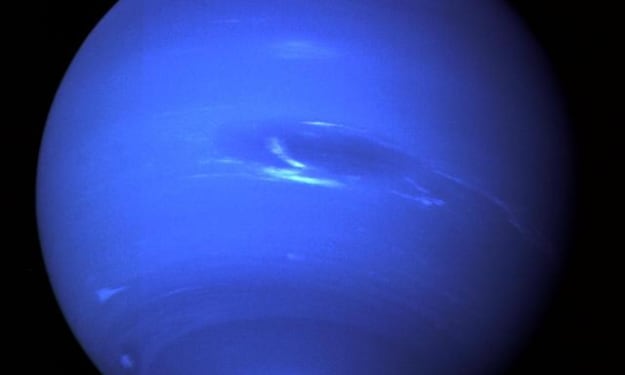
Neptune is the farthest planet from all of our Solar System. Behind him is only "the planet Pluto and the Oort Cloud, which mark the limits of our solar system. It is the farthest planet from all the gas giants (Jupiter, Saturn and Uranus). Due to advances in science and mathematics he was discovered from predictions in mathematics. Its name comes from the Roman god Neptune and was named after its blue color and because Neptune is the master of all waters.
By Andra Caliu4 years ago in Futurism
Mining In Space
The use of space metals did not begin with human exploration flights, but several centuries before it, after the use of fragments of meteorites falling on Earth in various industries, but the matter constituted a very big leap with spaceflight and the discovery of large quantities of nickel, iron, platinum, cobalt and others sporadically, whether on the moon or On Mars or in small asteroids.
By Judith Isidore4 years ago in Futurism
From Dust to Meteorite
Meteors and meteorites Meteors and meteorites are two nouns which in fact define the same interplanetary object, with the difference that the second reaches the ground, as we explained in the page dedicated to meteoroid classes. Both are meteoroids originating from the decay of comets or fragments of asteroids and were formed billions of years ago. Most meteorites are microscopic and vaporize in dense layers of the atmosphere. The fragments which have withstood atmospheric friction are usually “heavy weights”, remnants of rocks originally measuring a few centimeters to several tens of meters in diameter and weighing up to several hundred tons. Of course, such meteorite falls are extremely rare, and it is fortunate for the human species. How many meteorites fall on Earth? With each passing day, millions of microparticles of a tenth of a millimeter cover the earth’s surface. The quantity of meteoroids hitting the upper atmosphere each day varies between 0.4 and 110 tonnes per day with an estimated maximum of 300 tonnes per day (cf. CS Gradner et al., 2014), which brings the average to 33 tonnes depending on the NASA. Most of this dust burns in the atmosphere and does not reach the ground
By mahdiansyah4 years ago in Futurism
Mars: A Thought Experiment
Introduction Climate change, global warming, environmental destruction it doesn't matter what you call it. Human beings are destroying this earth at an unprecedented rate. Naturally people are looking for solutions, looking to the stars to quench their imaginations for survival. They see an opportunity to start over. To possibly take what humanity has learned for thousands of years. Evolution spinning its web of inter-species connection, providing for the perfect environment for apes to become human. Much like the planet itself a seemingly Goldie Locks scenario for natural selection. Ending in a hyper conscious species that has imprinted its history onto the landscapes of planet earth.
By Arjuna Fournier4 years ago in Futurism
The Starry Night
No matter how far along you are in your sophistication as an amateur astronomer, there is always one fundamental moment that we all go back to. That is that very first moment that we went out where you could really see the cosmos well and you took in the night sky. For city dwellers, this is a revelation as profound as if we discovered aliens living among us. Most of us have no idea the vast panorama of lights that dot a clear night sky when there are no city lights to interfere with the view.
By maria constantin4 years ago in Futurism
The world's wealthiest person Musk has also moved into a "container," indicating that the trend of small residences is on the rise.
Thoreau would sit in the sun at the doorway of a log cabin by the lake from daybreak until noon, after taking his normal bath, meditating alone, surrounded by pine, hickory, and sumac trees, in quiet. And the birds would sing till the sun shined through his west window, reminding him of how quickly time had passed. He grew like corn at night back then.
By Susan Elizabeth Vickers4 years ago in Futurism