science
Topics and developments in science and medicine, presented by Futurism.
Private Orbital Cities in the 2030s: How Humanity May Begin Living Above Earth
By the 2030s, the concept of private orbital cities is expected to move decisively from visionary speculation to practical implementation. What once belonged exclusively to the domain of science fiction and government-funded space programs is now being actively explored by private aerospace companies, investors, and architects. These orbital settlements will not merely host astronauts on short missions; they are designed to support long-term human presence, economic activity, and even emerging space-based communities.
By Holianyk Ihor14 days ago in Futurism
The Infrastructure of the Interplanetary Internet: Building a Network Beyond Earth
For most people, the internet is an invisible and instant utility. We send messages, stream videos, and store data in the cloud without thinking about the immense infrastructure that makes it possible. But what happens when humanity moves beyond Earth? As space exploration accelerates and missions to the Moon and Mars become increasingly ambitious, scientists and engineers face a fundamental challenge: how do we build an internet that works across planets?
By Holianyk Ihor14 days ago in Futurism
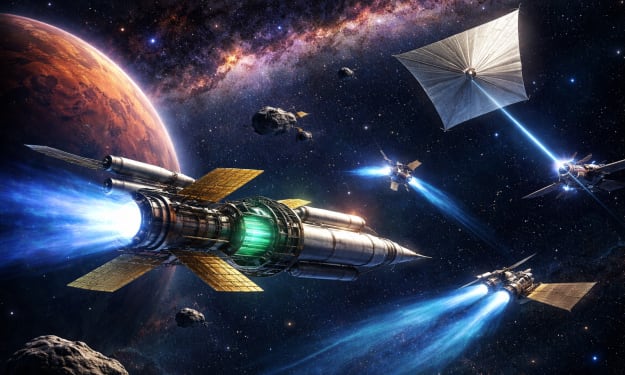
Experimental Propulsion Systems Redefining Interplanetary Travel
For more than half a century, humanity’s journey into space has relied primarily on chemical rocket engines. These powerful yet short-lived systems made it possible to reach orbit, land on the Moon, and send robotic explorers to the outer edges of the Solar System. However, as ambitions shift toward sustained human presence on Mars, asteroid mining, and deep-space exploration, it has become increasingly clear that traditional propulsion technologies are reaching their practical limits. To move farther, faster, and more efficiently, space agencies and private companies are now turning their attention to a new generation of experimental engines designed specifically for interplanetary travel.
By Holianyk Ihor15 days ago in Futurism
How Solar Winds Are Reshaping the Surface of Mercury
Mercury, the innermost planet of our Solar System, is often described as a silent, lifeless world — a scorched sphere of rock orbiting perilously close to the Sun. For a long time, scientists assumed that its surface was largely static, shaped mainly by ancient volcanic activity and impacts billions of years ago. Recent space missions, however, have revealed a far more dynamic reality. Mercury’s surface is constantly changing, sculpted by one of the most powerful and relentless forces in the Solar System: the solar wind.
By Holianyk Ihor15 days ago in Futurism
Exploring New Frontiers: Innovative Methods to Find Exoplanets Around Red Dwarfs
In the quest to understand our place in the universe, one of the most exciting frontiers is the search for planets beyond our solar system. Among the most promising targets are red dwarf stars, also known as M-dwarfs.
By Holianyk Ihor16 days ago in Futurism
The Mystery of Fast Radio Bursts (FRBs): What We Know Now
Since the first discovery of Fast Radio Bursts (FRBs) in 2007, these brief, intense flashes of radio waves have become one of the most captivating mysteries in modern astrophysics. With their incredible brightness, extremely short duration, and unknown origins, FRBs have fascinated both professional astronomers and the general public. Despite significant progress in observations and theory, many questions about their nature remain unanswered.
By Holianyk Ihor16 days ago in Futurism
The "Robot in the Room": Will AI Actually Take Our Jobs?
We’ve all seen the headlines. One day it’s a report from a global bank predicting that 300 million jobs are "exposed" to automation. The next, it’s a viral video of a humanoid robot making a latte or a chatbot writing a legal brief in six seconds.
By George Evan18 days ago in Futurism
The Linearity Crisis
When David Deutsch proposed his self-consistency condition for particles traversing closed timelike curves, he created more than a solution to temporal paradoxes. He exposed a fundamental crisis at the intersection of quantum mechanics and general relativity. The problem is simple to state but shocking in its implications: his model requires quantum evolution to become non-linear, violating one of the most sacred principles in physics.
By Abigail Goldwater18 days ago in Futurism
Satellites show that ice loss at Earth's poles is gradually getting worse.
Polar ice sheets do not suddenly break or collapse, according to satellite data. They slip most of the time, slowly and unrelentingly. Massive rivers of ice flow towards the sea every day from the centres of Antarctica and Greenland. The amount of ice that ends up in the ocean and the rate at which sea levels rise are determined by this motion.
By Francis Dami22 days ago in Futurism
Contrary to popular perception, far-side observations show that Earth's moon is not "dead."
For a long time, the moon appeared to be a world that had completed its major transformations before becoming silent. Although there are still scars on its surface from heavy impacts and past lava floods, many experts have viewed such features as remnants of a far older era.
By Francis Dami22 days ago in Futurism