science
Topics and developments in science and medicine, presented by Futurism.
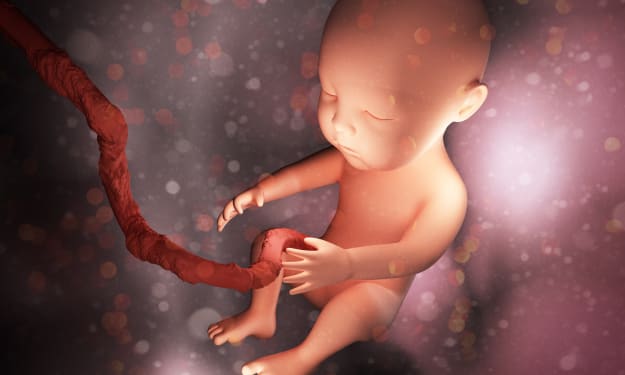
You Can Now Do a DNA Test Before a Baby Has Even Been Born
DNA testing as we know it has been around since the 1980s, when the development of PCR finally gave scientists an accurate, reliable way to test if two individuals were related. But it probably wasn't until the late 90s and early 2000s that the idea of a DNA test really entered the popular conversation, thanks to reality talk shows such as The Jeremy Kyle Show in the UK and The Jerry Springer Show in the States. Today, there are several commercial companies that can perform a paternity test and settle family disputes, using little more than a cheek swab taken from the child, and their alleged father.
By Dave Smith7 years ago in Futurism
You Are a God That Believes It Is an Ant
As you read this, I ask you to suspend your disbelief, for it will keep you exactly where you are. If you choose to open your mind to what I am about to say, your life may never be the same. Everything I say you are able to verify and validate through your own experiences and contemplations. Do not believe my words, for all words are fragmented projections of the truth. Instead, let them guide you along your path, and lead you to your bliss. Your bliss is different from mine or anyone else, that is the beauty of being human. When all of humanity follows their bliss, doors will open that we cannot yet see. This is the world I seek by not seeking.
By Nick Shibanov7 years ago in Futurism
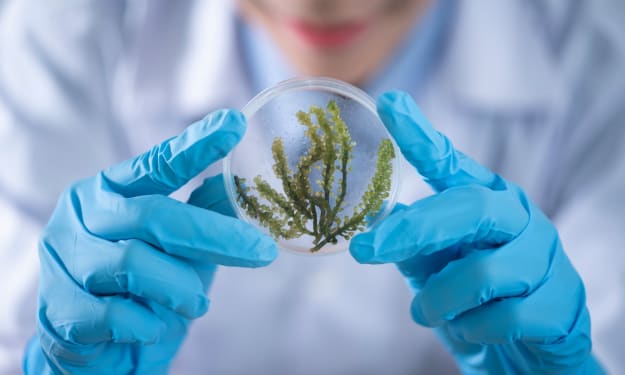
New Frontiers in Bio-Inspired Design
Nature has provided opportunities for scientists to observe patterns in biomaterials which can be imitated when designing construction materials. Materials designed with natural elements can be robust and environment-friendly at the same time. Advances in our understanding of biology and materials science, coupled with the extensive observation of nature, have stimulated the search for better accommodation and compression of materials and the higher organization and reduction of mechanical stress in man-made structures.
By Bentham Science Publishers7 years ago in Futurism
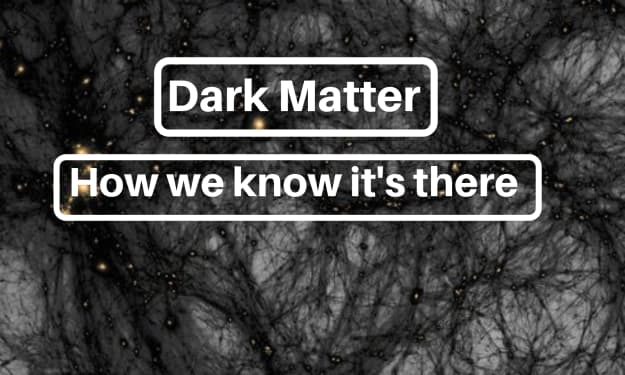
Dark Matter: How We Know It's There
Despite all of our advancements in science, physics, and astronomy, we still don’t know what approximately 80%-90% of the matter in the Universe is. But this isn’t a completely hopeless situation; there is a great deal we do know about this mysterious substance, provisionally named dark matter. For example, we know it’s there and we know where it is.
By Robert Lea7 years ago in Futurism
A Certain Uncertainty: The Heisenberg Uncertainty Principle Explained
'Uncertainty'—it's not a word that we generally associate with science. Science conjures images of certainty, solid results, and constant improvement by increment. There's a certain irony then, that when we strip nature down to its fundamental limits, there remains an implicit, irremovable, intrinsic uncertainty. No matter how precise our measuring devices and methods become, no matter how clever our scientists, nature has imposed a limit on what we can know. And we are certain of that. That's what the Heisenberg Uncertainty Principle describes. And it isn't just a factor in quantum physics. It infiltrates our lives in a number of surprising ways.
By Robert Lea7 years ago in Futurism
The Physics of Solar Sails. How Photons Have Momentum Without Mass.
The Planetary Society’s LightSail 2 project launches from Kennedy Space Center in Florida, as part of the US Air Force’s STP-2 mission. It will be carried by a SpaceX Falcon Heavy rocket, enclosed within Prox-1 — a small satellite built by Georgia Tech students.
By Robert Lea7 years ago in Futurism
Life on Other Planets is Virtually Impossible
We’ve all read the books, seen the movies, and heard the stories. Scientists discuss it. NASA releases documentaries. Third parties create documentaries about life on Mars or Io. We’ve heard about Cydonia, the head of the android on the moon, and planet Nibiru. Everyone wants a future where traveling the stars and living on other planets is a real possibility. Unfortunately, it’s a bunch of crap, but what do I know, right?
By Aaron Dennis7 years ago in Futurism
Zipping Through Special Relativity: Reference Frames and Transformations
Even from a modern perspective, it isn't difficult to understand why Einstein's theory of Special Relativity caused such a paradigm shift in physics and science in general. Until its introduction in the 1905 paper, On the electrodynamics of moving bodies, the scientific consensus was that space and time were separate entities—a stage on which the events of the universe played out. Special Relativity would not only unite space and time to a single entity—"Spacetime"—it would also lead to the conclusion that the events of the Universe shape that stage. Spacetime in Space Relativity and later General Relativity was no longer passive, it was a player in the events around it. Einstein proposed that clocks observed to be moving at high speeds would tick more slowly than those at rest.
By Robert Lea7 years ago in Futurism