science fiction
The bridge between imagination and technological advancement, where the dreamer’s vision predicts change, and foreshadows a futuristic reality. Science fiction has the ability to become “science reality”.
Forecast 2085
Joanna checked the weather app on her watch. Tornadoes likely, flooding possible in the evening, and a chance of earthquakes at night. She grabbed a fluffy red scarf off the rungs in her closet and pulled the hat her dad bought her at the fair over her ears.
By Marlena Chertock10 years ago in Futurism
Art of 'OMNI' Magazine
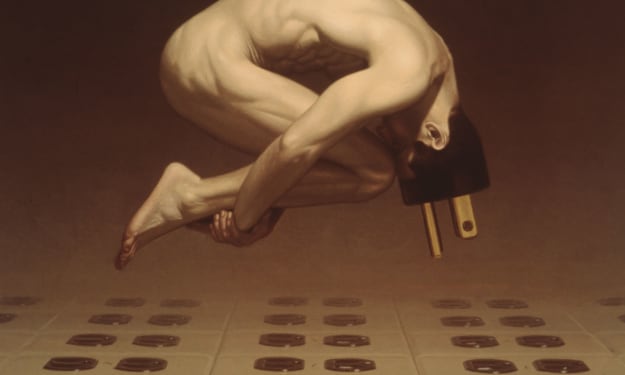
On OMNI, Ben Bova said, "For me, OMNI was a dream come true: a big, slick, beautifully presented magazine dealing with the future." OMNI magazine is considered a jewel among the popular science magazines of its era. In the very first publication of its kind, The Mind's Eye: The Art of OMNI celebrates in stunning detail the exceptional science fiction imagery of the 1970s and 1980s. The Mind's Eye assembles 185 images from the era's most illustrious contributing artists, including John Berkey, Chris Moore, H.R. Giger, Rafal Olbinski, Ralle, Tsuneo Sanda, Hajime Sorayama, Robert McCall, and Colin Hay among many more, along with quotes from artist, contributors, writers, and critics. The Mind’s Eye celebrates the worlds of tomorrow, today.
By Natasha Sydor10 years ago in Futurism
'This Island Earth'
The Zahgon fighter ships dive suicidally toward the planet Metaluna. Slicing through the thick cloud covering of the planet’s Ionization Layer, the delta-winged invaders magnetically carry a payload of deadly meteors in tow. The ships swoop in for the kill, sending the meteors hurtling down onto the war-ravaged planet’s surface. In a series of spectacular explosions, the space boulders sear into the Metalunan landscape. Eye-boggling displays of molten rock and incandescent smoke mushroom into the air, illuminating the surrounding area for miles around.
By Futurism Staff10 years ago in Futurism
Best Philosophically Driven Sci-Fi Books
The liberty to set a story anywhere, in any time period, and in any of our infinite realities gives sci-fi an uncanny power to reshape, or at least cause us to re-examine, our perception of the world. These brilliant authors can take the bare bones of a story, flesh it out with compelling characters and unique settings, and weave a plot whose pattern delights readers; but then go further.
By Jake Burgess10 years ago in Futurism
Jim Burns Interview
Science fiction cover artist Jim Burns is regarded as one of the Grand Masters of his craft. By utilizing clean lines, unique color work, and excellent composition, Burns’s work often exhibits intricate photo-realistic displays of advanced machines and detailed spaceships. Using primarily acrylics, and occasionally oils, Burns’s ability to take mundane objects and transform them into something otherworldly is nothing short of spectacular.
By Natasha Sydor10 years ago in Futurism
'Frank Herbert’s Dune' Miniseries
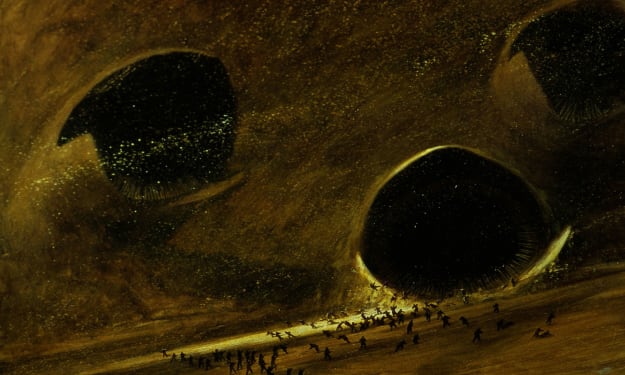
Back in 1965, Frank Herbert revolutionized science fiction literature with his futuristic epic Dune. This novel earned him the coveted Hugo and Nebula Awards and helped launch a series of bestselling sequels, as well as the 1984 David Lynch-directed film.
By Futurism Staff10 years ago in Futurism
Science Fiction Needs a New Subgenre
Throughout science fiction’s history, stories fall into a range of movements, aligning themselves stylistically and thematically as they each react to one another. The Golden Age of Science Fiction, heralded by editor John W. Campbell Jr. sought to inject a level of scientific rigor into pulp fiction. The New Wave was expressly a movement against Golden Age conventions, turning its back on the space travel it heralded. Cyberpunk was a brash moment that melded a new outlook on the genre alongside the computer revolution.
By Andrew Liptak10 years ago in Futurism
Ray Bradbury Interview
Ray Bradbury worked and wrote in a two-room office on Wilshire Boulevard in downtown Los Angeles. The rooms exploded with yellow brightness, and a visitor leaving the uproar of the street below might have felt that he had somehow walked into the middle of the sun. A gigantic, 15' high, stuffed Bullwinkle sat in the outer room, covered with hats and comic-book clippings, child's drawings and baseball cards. It set the tone for the man it served. "The problem with so many of the modern American writers," said Bradbury, "is that they exist in a world without children. I don’t believe they were ever young."
By Futurism Staff10 years ago in Futurism
Bits 'n Pieces
"Linda, dear? Have you seen my favorite tie? You know, the blue one with orange stripes?" Ronald Simmons didn't want to be late for work, especially as he had an important meeting that afternoon. He knew that if his presentation was well received he'd be up for that promotion—the one he had been working toward for the past six months.
By Steve Benton10 years ago in Futurism