intellect
Insightful post about reason, abstract thinking, and science, highlighting gifted science fiction influencers.
Philosophy: the Essential Analysis
Knowledge is the first principle. Man exists as mind. To found one’s principles upon any other axiom denies personal existence. The self-awareness of the individual provides the essential absolute necessary for any comprehension of the nature of existence. Mind is the knower. The nature of knowledge is the definition of cognitive awareness. Definition is founded upon the principles of reason. The binary nature of definition provides a framework for the comprehension of reality. Any given bit of knowledge must be either affirmed or denied, and it cannot exist simultaneously affirmed and denied. The affirmation or denial of any proposed idea is considered a single Knowledge. The accumulation of knowledges in the mind is the awareness of our existence. We live in a world of ideas, each an abstract conception in and of itself defined by logic into a coherent superstructure structure of consummate sentience. Experience, however, is ultimately subjective. Due to the self-defining nature of knowledge, this does not mean it is untrue, but that the very premise of true and false are contained in the mind as human conceptions. You may speak gibberish, and you may build a house of straw, but one will soon find that it is becoming to model one’s definitions after the objective reality instead of demanding nature to bow down to your dictionary. In that knowledge is a matter of subjective experience, knowledge has no basis in objective reality. One can assume a house to be made of oak, but if so, then this house of oak was swept away on a gentle breeze. The physical matter of which the house was composed has no name outside of the mind of the knower, but the principles of weight and tensile strength will remain objective. The external world is an unknowable postulate from the vantage point of the human mind. All active stimulus is but the sensation of the brain; the reality of this sensation can neither be affirmed nor denied; only accepted or rejected as a knowledge. Not even the brain can truly be affirmed nor denied as real, but that the thoughts of sensory awareness are manifest. Thought is the substance of the mind, and the basis of knowledge. Definition applied to thought is idea. The nature of our sensory existence is the foundation of our belief in an external reality. We see the world and we hear it and when we eat it we taste it and feel it going into our bodies—but then we wake up and it was actually quite a dream, and certainly that which is dreamed is not a reality. However, in that the faculties of sense continue to operate even in states of unreal consciousness, the senses alone cannot provide the evidence for an external reality. It becomes necessary for us to observe a moment of silence for all the dead solipsists.
By Eliander Black9 years ago in Futurism
Interview With Dr. Louis Rosenberg, Founder Of Unanimous A.I.
It's rather fitting that Dr. Louis Rosenberg, an individual wholly dedicated to preparing humans for the immediate and distant future, is featured in a project titled Year Million, National Geographic Channel's six-part documentary series that explores and postulates on the future of humanity; on what it will be like to be human one million years into the future.
By Futurism Staff9 years ago in Futurism
The Voice of the Universe
“There are only two ways to live your life. One is as though nothing is a miracle. The other is as though everything is a miracle. The most beautiful thing we can experience is the mysterious. It is the source of all true art and science. He to whom the emotion is a stranger, who can no longer pause to wonder and stand wrapped in awe, is as good as dead —his eyes are closed. The insight into the mystery of life, coupled though it be with fear, has also given rise to religion. To know what is impenetrable to us really exists, manifesting itself as the highest wisdom and the most radiant beauty, which our dull faculties can comprehend only in their most primitive forms — this knowledge, this feeling is at the centre of true religiousness.” - Albert Einstein.
By Alva v.Harzi9 years ago in Futurism
The Matrix: Sci-Phi...?
What if I told you that no one can be told what the Matrix is, they can only be shown? What if I said that the laws of physics protected this exact knowledge from ever being realized from inside of the Matrix? What if I wrote this whole article with “What if” statements? Nah, that’d be bloody insufferable. However, I wanted to illustrate that certain fundamental things about the universe may very well prevent our ever being able to see what the purpose of everything really is. An excellent philosophical analogy, believe it or else, is “The Matrix” series by the Wachowski siblings. It involves a much grander scale, and obviously, that movie was a work of fiction: art. However, the purpose of art is to convey ideas through a medium, and in this case, the medium is story telling.
By Mickey Finn9 years ago in Futurism
The Wickedness of A.I.
Like with most things in life “There's no rose without a thorn”, in other words, there are going to be some negative points to this tale, and they don't exactly sound very reassuring, quite the contrary. Some of these have even been the target of works of fiction, TV series, games, podcasts, you name it, it has been done; movies like The Matrix, The Terminator, AI, 2001 space odyssey, and the movie adaptation of Marvel's Avengers (where the main villain is a being of "evil" artificial intelligence). Almost every apocalyptic scenario, every "machine turn on the humans that created them" scenario has been covered one way or another. These works of fiction can to some extent be seen as cautionary tales to what may come if ethics and caution are put aside.
By Tomás Brandão9 years ago in Futurism
Where X Marks the Spot: An Interview with Steve Barnes
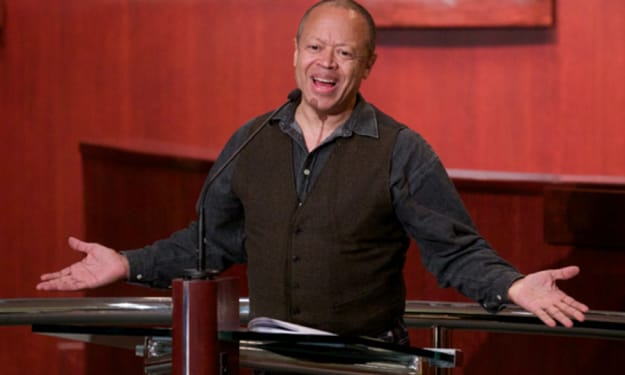
Steve Barnes is a writer, lecturer, personal performance coach and a killer philosopher. He has published more than 25 science fiction, fantasy and horror novels, including New York Times bestsellers. He’s been nominated for the Hugo, Nebula, and Cable Ace Awards. And he wrote the Emmy winning episode, “A Stitch In Time” for Showtime’s the Outer Limits. He’s also written for the New Twilight Zone, StarGate, Andromeda, and Ben 10. I got to sit with Steve to discuss his viewpoints on the state of the field, life, the universe, and everything in-between.
By Joshua Sky9 years ago in Futurism