how to
How to create science fiction and technology projects in a simplistic, easy manner.
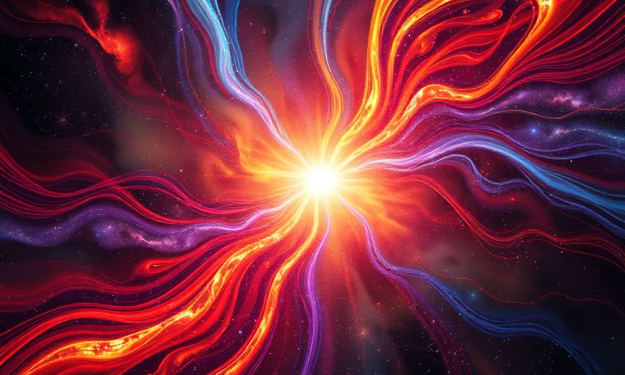
How the Universe Can “Regenerate” Galaxies
When we think about galaxies, we imagine grand, seemingly eternal structures made up of billions of stars, planets, gas clouds, and dark matter. They appear timeless cosmic cities that simply age until their stars burn out, leaving only cold, silent darkness.
By Holianyk Ihor7 months ago in Futurism
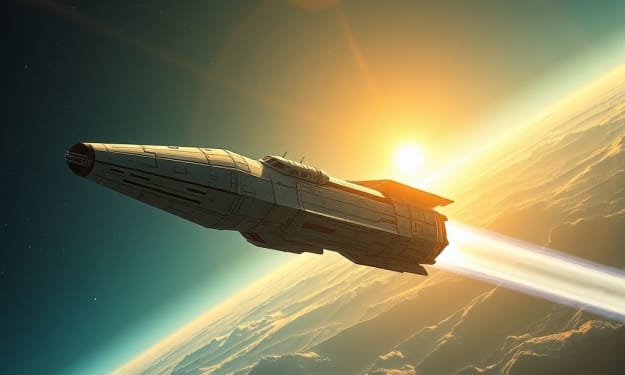
What Would Happen If You Broke the Speed of Light?
Science, sci-fi, and a dash of time paradoxes The speed of light in a vacuum about 299,792 kilometers per second (or roughly 186,282 miles per second) isn’t just a big number. It’s the ultimate cosmic speed limit, built into the very fabric of the universe. Albert Einstein’s special theory of relativity proved more than a century ago that nothing with mass can travel faster than light.
By Holianyk Ihor7 months ago in Futurism
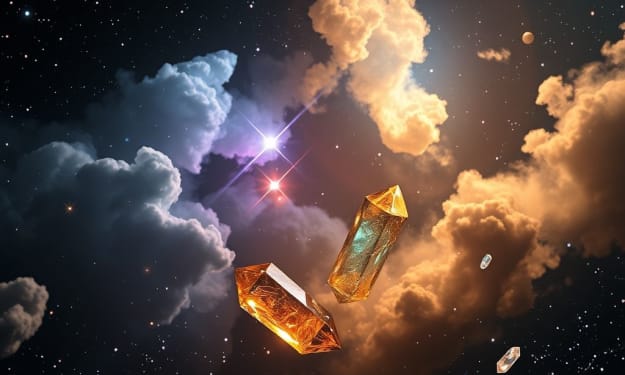
How Space Creates Crystals: Jewels from the Depths of the Universe
When most people think of crystals, they imagine a sparkling piece of quartz on display in a mineral shop or a perfectly cut diamond set in a ring. But few realize that some of the most unusual and flawless crystals are not born deep within Earth’s crust they are forged in the cold, airless reaches of space.
By Holianyk Ihor7 months ago in Futurism
Hot Jupiters — The Planets That Shouldn’t Exist
In astronomy, there’s a strange breed of worlds that seem to defy common sense. They’re enormous, like Jupiter, yet they orbit so close to their stars that a “year” on them lasts only a few Earth days. Their scorching atmospheres can reach temperatures hot enough to melt metal. Astronomers call them Hot Jupiters and, by all known laws of planetary science, they shouldn’t exist at all.
By Holianyk Ihor7 months ago in Futurism
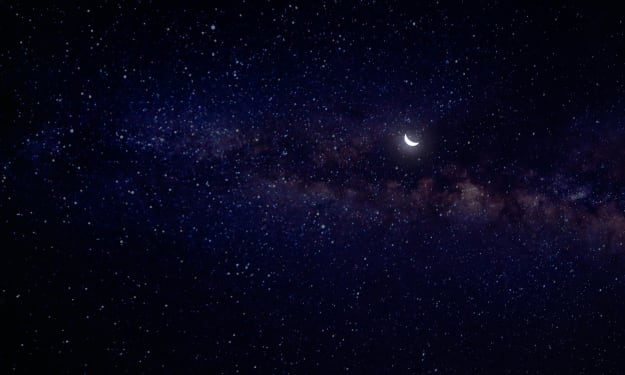
Why the Moon Is Drifting Away And What It Means for Earth
Why the Moon Is Drifting Away—And What It Means for Earth When you look up at the night sky, the Moon seems like a loyal companion—silent, steady, and unchanging. But what if I told you the Moon is slowly leaving us?
By Muhammad ali7 months ago in Futurism
Super-Dense Worlds: Where a Kilogram Weighs Tons
When we think about weight, we usually picture familiar things: a kilogram of apples, a ton of bricks, a liter of water. Our measurements feel intuitive because we live on Earth, with Earth’s gravity. But step beyond our planet, and the entire system begins to break down. Imagine a world where a simple kilogram feels as heavy as a small car. Welcome to the realm of super-dense objects places where gravity bends reality, from neutron stars and exotic exoplanets to hypothetical "hell worlds" that challenge our understanding of physics.
By Holianyk Ihor7 months ago in Futurism
Why Do Some Stars Spin Close to the Speed of Light?
When we think about stars, we usually picture brilliant glowing spheres, massive in size and unimaginably hot. But among these cosmic giants, there exists a rare class of stars that defy even our wildest expectations they spin so fast that parts of them move at speeds approaching that of light. It sounds like science fiction, but it's a very real phenomenon. So how can a star spin that fast without tearing itself apart? Let’s dive into the physics of these stellar speedsters.
By Holianyk Ihor7 months ago in Futurism
From Chaos to Cosmos: How Order Emerged After the Big Bang
When we hear the word chaos, we imagine disorder swirling motion, noise, confusion. Now imagine that our entire universe began in exactly such a state: incredibly hot, unimaginably dense, and bursting with energy. That wild beginning is what we call the Big Bang. And yet, billions of years later, from this primordial chaos emerged galaxies, stars, planets even life itself. How did something so ordered come from such a turbulent start?
By Holianyk Ihor7 months ago in Futurism
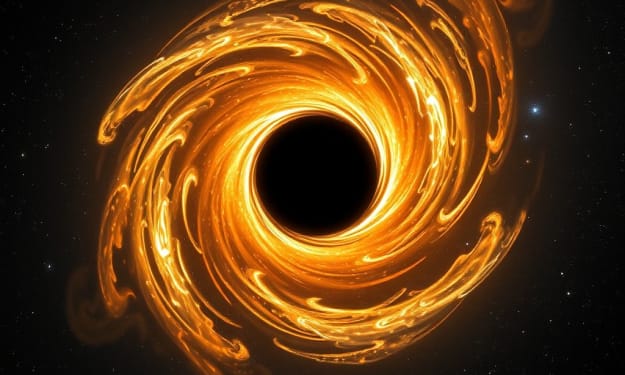
The Physics of Black Holes: What Lies Beyond the Event Horizon?
Black holes are among the most mysterious and fascinating objects in the universe. We know they exist. We can observe how they interact with surrounding matter. We’ve even captured their “shadows” against the fabric of space, thanks to the incredible Event Horizon Telescope. But the most tantalizing question still remains unanswered: what happens inside a black hole beyond the event horizon?
By Holianyk Ihor7 months ago in Futurism
Understanding Red Dot and Holographic Sights: A Modern Guide for Shooters and Airsoft Enthusiasts
Whether you're an airsoft enthusiast, a sport shooter, or just interested in firearm optics, chances are you've come across terms like red dot sight or holographic sight. These tools are part of a growing world of optical enhancements that improve target acquisition and shooting accuracy. But while they may look similar at a glance, red dot and holographic sights operate in fundamentally different ways. Understanding their differences, strengths, and ideal use cases can help you make more informed decisions when choosing optics for real or simulated firearms.
By charliesamuel7 months ago in Futurism
Why Venus Is Hotter Than Mercury Even Though It’s Farther from the Sun
When you think of the hottest planet in our solar system, you might assume it’s Mercury. After all, it's the closest planet to the Sun, orbiting just 58 million kilometers away. It seems logical that proximity equals heat. But in a twist that would surprise many, Venus the second planet from the Sun is actually the hottest. Its surface temperature soars to a staggering 475°C (887°F), outshining Mercury’s maximum of 430°C (800°F). Even more shocking? While Mercury’s night side drops to a frigid –180°C (–290°F), Venus stays scorchingly hot day and night.
By Holianyk Ihor7 months ago in Futurism