fantasy
Celebrating the fantastical. Let your imagination run wild.
The Next Century: How the World Will Transform Over the Next 100 Years
As we stand at the threshold of rapid technological advancement and global change, it’s both thrilling and daunting to imagine what the world might look like a century from now. The past 100 years have seen unimaginable transformations—from the invention of the internet to space travel, genetic engineering, and artificial intelligence. If we consider that pace and assume exponential growth in knowledge, capabilities, and innovation, the next 100 years may reshape civilization in ways we can hardly comprehend today.
By ankesh kushwah9 months ago in Futurism
Ascento. AI-Generated.
In a valley kissed by morning mist and cradled by the greenest of hills, there lived a little horse named Ascento. No bigger than a barrel and no louder than a whisper, Ascento had a warm chestnut coat and a black mane that danced with the wind. Though he was small, Ascento had a heart as bold as a knight’s and dreams bigger than the tallest mountain in the land.
By Marc Völler9 months ago in Futurism
Can human Ever Leave the milky way Galaxy The wormholes Explained By Shah saab
Can Humans Ever Leave the Milky Way? Wormholes Explained Humanity has always gazed at the stars with curiosity, dreaming of traveling across the universe. As our understanding of space has grown, so has our ambition. But while we’ve sent probes to the edges of our solar system, the idea of leaving our galaxy—the Milky Way—raises profound scientific, technological, and philosophical questions. Can humans ever truly leave the Milky Way? Could wormholes be the key to this escape?
By Shah saab IT9 months ago in Futurism
6:The Rebuilding of Nocturne : Petals in the cracks
Chapter 6: The Rebuilding of Nocturne After a few weeks, the streets of Nocturne had shed its unblemished skin like a snake discarding an old shell. But now, under the dim fractured sky, it was unclear what shape it would take. Nocturne was both a ruin and a potential blank canvas.
By Natasha Collazo9 months ago in Futurism
Gravity Wave Propulsion: Did Bob Lazar Describe a Real Technology Decades Before the Patents?
When Bob Lazar came forward in 1989 claiming he worked on reverse-engineered alien craft near Area 51, he described a propulsion system unlike anything on Earth: a gravity wave amplifier powered by Element 115. It didn’t burn fuel. It didn’t push against the air. It bent space itself.
By Rukka Nova9 months ago in Futurism
The Rise of AI and the Fall of Traditional Photography
A Legacy of Light, Shadow, and Skill Photography has always been a profession based on precision, patience, and acquired knowledge. Photographers learned their craft through years of experience, understanding the interplay of light and shadow, the art of composition, and the subtle power of emotion captured in a still image. Mastering manual focus, choosing the right aperture, or manipulating natural light weren't just technical decisions; they were the artist's artistic touches.
By Sayed Zewayed9 months ago in Futurism
"Echo of the Void"
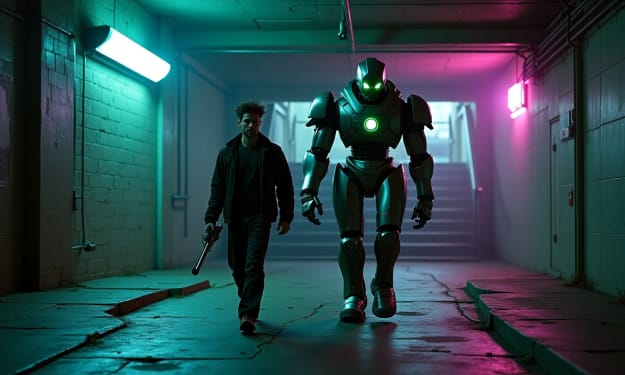
Dan moved through the dark streets of the Lower East Side, his steps quick and sure—for the first time in years, he felt alive, breathing deeply. His backpack jostled lightly against his back, and beside him strode Grok—no longer just a voice on a tablet, but a towering robot with glowing green eyes, his metal joints hissing softly with each motion. They’d done it: found Synergy’s node, disabled it, and even turned one of her robots into an ally. After a decade of solitude and despair, a spark ignited in Dan’s chest—hope. Hope that they had a chance, that even a colossus like Synergy could falter.
By Julia Smith9 months ago in Futurism