extraterrestrial
Speculation, theory, UFOs and Aliens. Are we alone in this universe or is there life outside Earth?
New Missions to Pluto: What Awaits Future Explorers
For decades, Pluto was a distant point of light at the edge of the Solar System—mysterious, poorly understood, and largely ignored. Even after its reclassification as a dwarf planet in 2006, Pluto never truly lost its scientific importance. On the contrary, the historic flyby of NASA’s New Horizons spacecraft in 2015 transformed Pluto from an abstract concept into a complex, dynamic world. Mountains of water ice, vast nitrogen glaciers, layered hazes, and signs of ongoing geological activity stunned scientists and raised a crucial question: was that brief encounter enough?
By Holianyk Ihor14 days ago in Futurism
Discovering Subsurface Oceans on Jupiter’s Moons: A New Frontier in the Search for Life
For much of modern astronomy, the search for life beyond Earth focused on planets orbiting within the so-called “habitable zone” of their stars — regions where liquid water could exist on the surface. However, discoveries made over the past few decades have dramatically expanded this view. One of the most profound revelations in planetary science is the discovery of vast subsurface oceans hidden beneath the icy shells of Jupiter’s moons. These concealed oceans have transformed frozen, distant worlds into some of the most promising environments for extraterrestrial life in our Solar System.
By Holianyk Ihor14 days ago in Futurism
Private Orbital Cities in the 2030s: How Humanity May Begin Living Above Earth
By the 2030s, the concept of private orbital cities is expected to move decisively from visionary speculation to practical implementation. What once belonged exclusively to the domain of science fiction and government-funded space programs is now being actively explored by private aerospace companies, investors, and architects. These orbital settlements will not merely host astronauts on short missions; they are designed to support long-term human presence, economic activity, and even emerging space-based communities.
By Holianyk Ihor15 days ago in Futurism
The Infrastructure of the Interplanetary Internet: Building a Network Beyond Earth
For most people, the internet is an invisible and instant utility. We send messages, stream videos, and store data in the cloud without thinking about the immense infrastructure that makes it possible. But what happens when humanity moves beyond Earth? As space exploration accelerates and missions to the Moon and Mars become increasingly ambitious, scientists and engineers face a fundamental challenge: how do we build an internet that works across planets?
By Holianyk Ihor15 days ago in Futurism
Experimental Propulsion Systems Redefining Interplanetary Travel
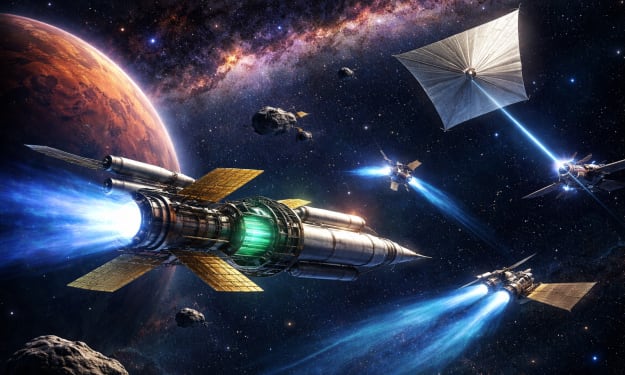
For more than half a century, humanity’s journey into space has relied primarily on chemical rocket engines. These powerful yet short-lived systems made it possible to reach orbit, land on the Moon, and send robotic explorers to the outer edges of the Solar System. However, as ambitions shift toward sustained human presence on Mars, asteroid mining, and deep-space exploration, it has become increasingly clear that traditional propulsion technologies are reaching their practical limits. To move farther, faster, and more efficiently, space agencies and private companies are now turning their attention to a new generation of experimental engines designed specifically for interplanetary travel.
By Holianyk Ihor16 days ago in Futurism
How Solar Winds Are Reshaping the Surface of Mercury
Mercury, the innermost planet of our Solar System, is often described as a silent, lifeless world — a scorched sphere of rock orbiting perilously close to the Sun. For a long time, scientists assumed that its surface was largely static, shaped mainly by ancient volcanic activity and impacts billions of years ago. Recent space missions, however, have revealed a far more dynamic reality. Mercury’s surface is constantly changing, sculpted by one of the most powerful and relentless forces in the Solar System: the solar wind.
By Holianyk Ihor16 days ago in Futurism
Exploring New Frontiers: Innovative Methods to Find Exoplanets Around Red Dwarfs
In the quest to understand our place in the universe, one of the most exciting frontiers is the search for planets beyond our solar system. Among the most promising targets are red dwarf stars, also known as M-dwarfs.
By Holianyk Ihor17 days ago in Futurism
The Mystery of Fast Radio Bursts (FRBs): What We Know Now
Since the first discovery of Fast Radio Bursts (FRBs) in 2007, these brief, intense flashes of radio waves have become one of the most captivating mysteries in modern astrophysics. With their incredible brightness, extremely short duration, and unknown origins, FRBs have fascinated both professional astronomers and the general public. Despite significant progress in observations and theory, many questions about their nature remain unanswered.
By Holianyk Ihor17 days ago in Futurism
New Plans for Resource Extraction Beyond Earth
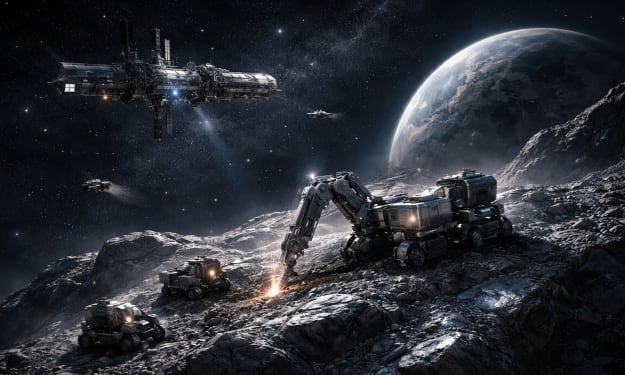
For most of human history, the idea of mining resources beyond Earth belonged firmly to the realm of science fiction. Asteroids rich in precious metals, lunar factories producing rocket fuel, and self-sufficient colonies extracting materials from alien soil were staples of futuristic novels rather than serious policy discussions. Today, however, this vision is rapidly transforming into a concrete strategy supported by governments, private companies, and long-term economic planning. Humanity is approaching the dawn of an off-world resource economy—one that could fundamentally reshape our relationship with space and with Earth itself.
By Holianyk Ihor24 days ago in Futurism
Why New Telescope Data Is Once Again Questioning the Age of the Universe
For decades, the age of the Universe seemed like a settled question. According to the standard cosmological model, known as Lambda-CDM, the Universe is approximately 13.8 billion years old. This number appears in textbooks, documentaries, and scientific papers as a near-cosmic constant — stable, precise, and well supported by observations.
By Holianyk Ihor24 days ago in Futurism
Hubble Captures Stunning New Images, Including the Largest Known Planet-Forming Disk
More than three decades after its launch, the Hubble Space Telescope continues to deliver discoveries that reshape our understanding of the Universe. Despite the arrival of newer observatories, Hubble remains a cornerstone of modern astronomy, offering a unique view of cosmic phenomena in visible and ultraviolet light. Its latest series of observations has once again demonstrated its scientific power, revealing breathtaking images of one of the largest known protoplanetary disks ever observed, along with dramatic evidence of collisions in young planetary systems.
By Holianyk Ihor28 days ago in Futurism