conventions
Science fiction conventions and comic conventions for every type of science fanatic.
Absolute Success is Luck.
Absolute Success is Luck. Relative Success is Hard Work How A Relative Success is Hard Work The relationship between success, luck, and hard work is a complex and debated topic. While it is true that luck can play a role in achieving absolute success, it is not the sole determining factor. Similarly, while hard work is crucial for relative success, other factors can also contribute to it. Let's explore these concepts further.
By Well Bucks3 years ago in Futurism
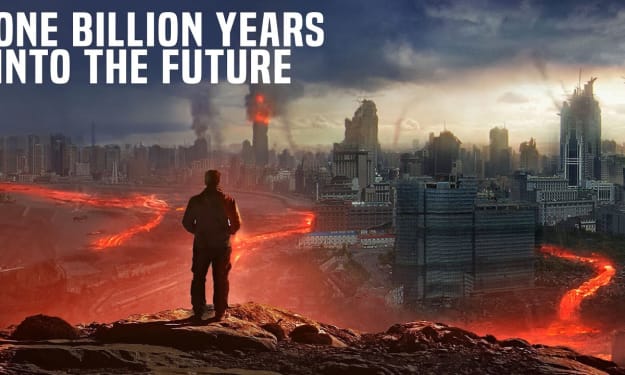
What Would Happen If You Went One Billion Years Into the Future?
If you travelled 10,000 years into the future, what would planet Earth look like? Would most of its surface be covered in volcanoes, or would it be frozen in ice? What if you travelled even further, one million years in the future? Would all of the oceans have evaporated, or would they have become one giant water world? Okay, now what about 1 billion years? Would there be any humans left, or would they have settled in other parts of the galaxy? This is what would happen if you travelled 1 billion years into the future. Let's face it, the chances of any humans being around to greet you when you arrive 1 billion years into the future are pretty low. Several key existential threats face the human race, and if we want to be around in one billion years, we'll need to endure them all. We've seen how much we've struggled to come together just to survive a global pandemic, so how do we have any chance of enduring the threats of climate change? Overpopulation, global nuclear war, killer asteroids and comets, natural ice ages, and the sun getting a whole lot hotter Well, let's take a look into the future and find out that just under ten thousand years from now, we're going to run into a big problem called the decamillennium bug. In the year 10,000, the ad software encoding the ad calendar year won't encode dates with more than four decimals. Remember y2k? Yeah, it's just like that, except hopefully we won't panic as much this time around. On the bright side, in 10,000 years, genetic differences and traits between humans will no longer be regional traits like skin and hair color but will be evenly distributed around the world. Maybe that will help us all get along. Finally, twenty thousand years into the future, none of the current languages will be recognizable. Future languages will only contain one percent of the core vocabulary words of their present-day counterparts. Fifty thousand years from now will mark a new glacial period for the earth, which will start a new ice age. Niagara Falls will have eroded into Lake Erie completely, and interestingly, a full day on earth will also increase by one second at this point in time, giving you much more time for activities. In 250 000 years, the Loihi volcano will rise above the water to form a new island in Hawaii, and in 500 000 years, it's likely that an asteroid with a diameter greater than one kilometer will hit Earth unless we can prevent it. The resulting crater will be no less than 400 kilometers across. It will start fires all over the planet and make the air unbreathable, so there's something to look forward to, and in case that's not enough, in 1 million years we'll likely have another super volcano eruption large enough to spew out 3200 cubic kilometers of ash. It would produce enough lava to fill 75 percent of the Grand Canyon. This would be similar to the Toba eruption that almost wiped out humanity 70 000 years ago. Oh, and the nearby star Beetlejuice will have exploded into a supernova by this time, making it visible from earth even during the daytime in 2 million a.d. Humanity will have settlements throughout the solar system. This also means that if populations on different planets have remained separate, humans may have evolved into other species adapted to their specific world. In 10 million years, a huge part of eastern Africa will break off, forming a new ocean basin. Africa will collide with Europe, closing off the Mediterranean Sea, and a new mountain range will form between the two land masses. This mountain range may include a mountain taller than Mount Everest. Out in space, Mars will collide with its moon, resulting in it developing a ring system like Saturn's in 60 million years. The Canadian and American Rockies will have eroded entirely in 80 million years. All Hawaiian islands will be below the water in 100 million years. An asteroid 10 kilometers wide, similar to the one that killed the dinosaurs 66 million years ago, will most likely strike Earth in 250 million years. All of earth's continents will be fused together like pangaea, except this time it will be called pangaea ultima, but don't get too attached to it because in 400 to 500 million years, Pangaea ultima will separate again in 500 to 600 million years.
By Durga Prasad3 years ago in Futurism
The Rise of Remote Work
Introducti0n The COVID-19 pandemic has brought about a significant shift in the way businesses operate, with remote work becoming the new norm. The traditional office-based work culture has given way to flexible work arrangements, allowing employees to perform their duties from the comfort of their homes. This article explores the rise of remote work and how businesses have adapted to this new paradigm, examining the benefits, challenges, and strategies employed by organizations to ensure productivity and employee well-being in a remote work environment.
By Mohammed Askee3 years ago in Futurism
How artificial intelligence can help us prepare for climate adaptation
Despite climate mitigation efforts to keep global warming below 1.5°C, many experts expect the world to warm by 3.5°C by the turn of the next century. This ever-warming world has brought floods and wildfires and the loss of life with more disruption expected in the decades to come.
By nizam uddin3 years ago in Futurism
How artificial intelligence is helping us decode animal languages
For years, artificial intelligence (AI) and machine learning has been used to analyze and translate human languages. This field of research has helped expand human communication channels as well as led to new language-based technologies like advanced chatbots and voice command smart devices.
By nizam uddin3 years ago in Futurism
The Evolution of AI Art Generators: Redefining Creativity and Empowering Artists
Introduction In the ever-evolving world of art, a new revolution is taking place. The rise of AI Art Generators has paved the way for a paradigm shift in creativity, reshaping the art landscape and empowering artists like never before. In this article, we will explore the fascinating journey of AI Art Generators, their significance in the art world, and the impact they have on artists and the creative process.
By Topic Blend3 years ago in Futurism
As AI develops rapidly, what is the future ethical cost?
The concerns surrounding AI include it amplifying potentially harmful biases and stereotypes, says a technology ethics expert. She says that 'ethical debt' can develop if we fail to consider the possible negative consequences or societal harms of AI. The only way to decrease ethical debt is to take the time to think ahead about things that might go wrong – but this is not something that technologists are necessarily taught to do, she adds.
By nizam uddin3 years ago in Futurism
These are the jobs that AI can’t replace
I’ve just asked ChatGPT this question: “What jobs will AI be unable to replace?” Within seconds it has whizzed out a 275-word answer. When I asked it to edit its answer down to under 50 words, it was a lot slower. A lot, lot slower.
By nizam uddin3 years ago in Futurism