astronomy
Celestial objects and the phenomena that surrounds them. What lies above the earth forever out of reach. From moons, to stars, galaxies, and beyond.
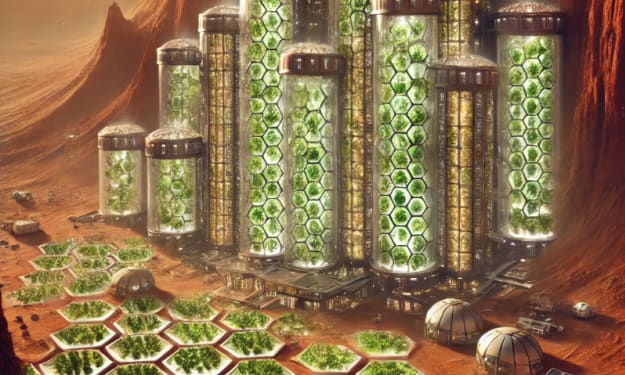
Cities on Mars Built Inside Craters: Vertical Greenhouses Rising Along Ancient Walls
As humanity moves closer to building permanent settlements on Mars, one question becomes more urgent than ever: how do we create habitats that are both safe and self-sustaining in one of the harshest environments in the Solar System? Surprisingly, part of the answer may already exist on the Red Planet itself. The natural architecture of Martian craters offers an elegant solution: entire cities carved into the crater walls, lined with towering vertical greenhouses that glow with life.
By Holianyk Ihor2 months ago in Futurism
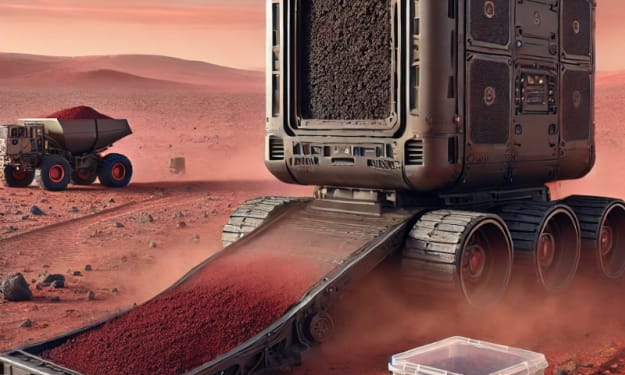
A Breakthrough Device Can Turn Martian Sand into Concrete
For decades, scientists and engineers have been wrestling with one critical question: how can humans build on Mars without bringing tons of materials from Earth? The dream of establishing a long-term settlement on the Red Planet depends on solving this exact challenge. Now, a team of researchers has unveiled a device that could completely transform Martian exploration — a compact machine capable of converting Martian sand, or regolith, into durable concrete. This invention may become the technological cornerstone of future Martian habitats, landing pads, and even entire cities.
By Holianyk Ihor2 months ago in Futurism
The Impact of Emerging Technologies Across Industries
The rapid pace of technological advancements is disrupting industries across the globe. From AI-driven automation to blockchain, the rise of these technologies is reshaping how we work, interact, and even think. As businesses and governments adapt to this new technological landscape, the resulting shifts promise both challenges and opportunities for growth.
By noor ul amin2 months ago in Futurism
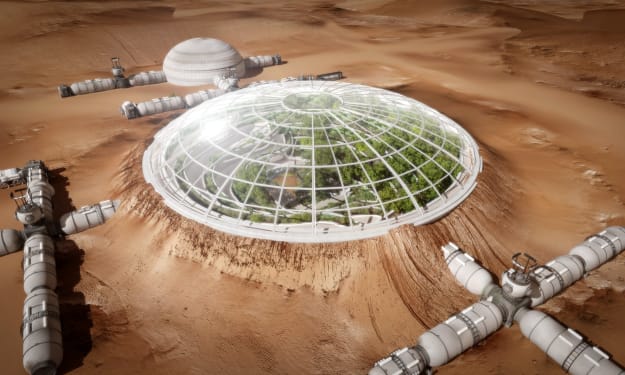
A Breakthrough Biopolymer Could Enable Full-Scale Construction on Mars
For decades, the idea of building homes and research bases directly on the surface of Mars existed somewhere between science fiction and long-term planning. The Red Planet is one of the most hostile environments ever considered for human settlement: freezing temperatures, dangerously thin atmosphere, intense radiation, and a complete absence of traditional construction resources. Yet a new scientific breakthrough suggests that the challenges of off-world construction may be far more solvable than previously believed.
By Holianyk Ihor2 months ago in Futurism
A Giant Spinning Cylinder for a Million People: Scientists Reveal Their Most Ambitious Habitat Concept Yet
Imagine walking through a city where the horizon curves upward instead of disappearing into the distance, where sunlight pours in through angled mirrors rather than an open sky, and where lush green parks stretch not across the ground, but along the rising interior walls of an enormous rotating world. This is not a scene from a sci-fi blockbuster. It is a new large-scale engineering proposal developed by a team of astrophysicists and space architects: a massive, rotating space cylinder designed to host up to one million permanent residents.
By Holianyk Ihor2 months ago in Futurism
Scientists Witness a New Planet Forming in Real Time — A First in Human History
Astronomy has always dealt in enormous timescales. Stars take millions of years to ignite, galaxies evolve over billions, and planets emerge so slowly that their formation has long been considered impossible to observe directly. Scientists usually reconstruct these events like cosmic detectives, working with faint hints and fragmented data.
By Holianyk Ihor2 months ago in Futurism
Astronomers Detect a Strange Object That “Blinks” Every 20 Minutes — and No One Knows What It Is
Astronomy has a way of humbling everyone who dares to believe we finally understand the Universe. Just when scientists start to think the cosmic inventory is complete, something unexpected appears and shatters the sense of certainty. This time, the surprise comes in the form of a mysterious radio object that behaves unlike anything seen before: it blinks with perfect regularity once every 20 minutes.
By Holianyk Ihor2 months ago in Futurism
Titan’s Strange “Wandering Dunes”: A Discovery That Redraws the Map of This Alien World
When the Cassini spacecraft first mapped the surface of Titan with radar, researchers realized they were looking at one of the most Earth-like worlds in the Solar System—but in a dark, chemically exotic form. Titan, Saturn’s largest moon, is a place of methane rains, hydrocarbon lakes, seasonal storms, and dense orange haze. Its valleys, channels, and sedimentary plains resemble terrestrial landscapes carved by water and wind, only here the fluids are liquid hydrocarbons and the “sediment” is organic dust.
By Holianyk Ihor2 months ago in Futurism
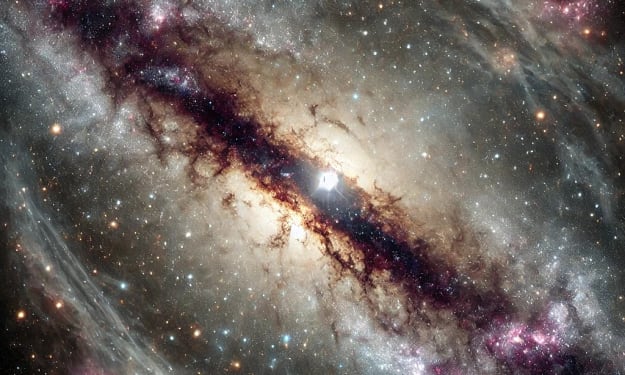
A TRIPLE BLACK HOLE SYSTEM IS SPIRALING INWARD — AND ASTRONOMERS HAVE FINALLY CAUGHT IT IN ACTION
For the first time in observational astronomy, researchers have witnessed something once considered so rare that it bordered on theoretical speculation: a system of three black holes simultaneously spiraling toward one another. This extraordinary discovery offers a new window into the evolution of galactic cores, the mechanisms that accelerate black hole mergers, and the origins of some of the most powerful gravitational-wave events ever detected.
By Holianyk Ihor2 months ago in Futurism
How Accurate Interstellar Really Is?
When Interstellar hit theaters in 2014, it didn’t just entertain audiences , it rewired our brains. Christopher Nolan didn’t want another sci-fi fantasy. He wanted a film where space looked like space, where gravity behaved like gravity, and where black holes appeared the way the universe actually paints them. And standing behind him was Nobel Prize winning physicist Kip Thorne, whose job was to keep the movie grounded in real physics…at least, as real as physics allows when you’re folding spacetime like origami.
By Sakuni Bandara2 months ago in Futurism