
Samsung Galaxy S26 Series Launches With More AI, Higher Prices
Faster Snapdragon chip, new “Agentic AI” features, and $100 price hikes for base models.

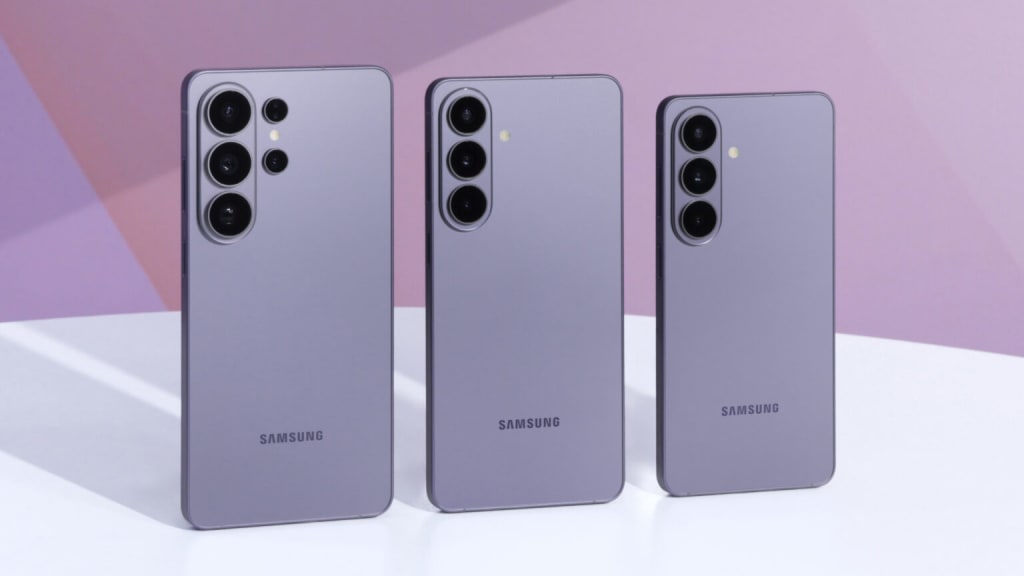
Samsung has officially unveiled the Samsung Galaxy S26 lineup, introducing the Galaxy S26, S26+, and S26 Ultra during its latest Unpacked event. The phones are available for preorder now and will begin shipping on March 11.
While the design changes are minimal, Samsung is emphasizing faster performance, expanded on-device AI, and what it calls the first “Agentic AI phones.” Prices for the base and Plus models have increased by $100 compared to last year, while the Ultra remains at $1,300.
What Is News
The Galaxy S26 lineup includes the S26 ($900), S26+ ($1,100), and S26 Ultra ($1,300).
All models feature the Snapdragon 8 Elite Gen 5 (3 nm) processor.
Samsung is branding the series as its first “Agentic AI” phones.
Base and Plus models cost $100 more than last year’s versions.
Preorders start today; devices ship March 11.
Hardware: Faster, But Familiar
Externally, the Galaxy S26 series looks very similar to the previous generation. Minor cosmetic tweaks include changes to the camera surround and slight dimension adjustments. The S26 Ultra now uses aluminum instead of titanium, a move that mirrors recent design changes in Apple’s high-end devices.
All three models run on Qualcomm’s Snapdragon 8 Elite Gen 5 chip (in North America, Japan, and China). The processor features third-generation Oryon CPU cores, an Adreno 840 GPU, and an upgraded Hexagon NPU to support on-device AI workloads.
Samsung promises double-digit performance gains across CPU, GPU, and AI processing, though real-world thermal performance remains to be seen. The company says it has introduced its largest vapor chamber yet to reduce throttling during sustained tasks.
Battery capacities remain mostly unchanged, except for the base model, which increases to 4,300 mAh. The Ultra model now supports faster charging at up to 60W, reaching 75% in about 30 minutes.
Camera hardware is largely unchanged:
S26 / S26+: 50MP primary camera
S26 Ultra: 200MP primary sensor with dual telephoto lenses
The Ultra also supports 8K video recording directly to external storage and adds support for the Advanced Professional Video codec.
Privacy Display: A Practical Upgrade
One notable new feature is “Privacy Display,” designed to reduce shoulder surfing. Using “Black Matrix” technology, the screen narrows viewing angles by activating focused pixel arrays. The feature can be enabled system-wide, per app, or just for notifications.
This is one of the few tangible, non-AI hardware-software features that may provide immediate everyday value.
What Is Analysis
The Galaxy S26 launch reflects a broader industry pattern: fewer dramatic hardware breakthroughs, more emphasis on artificial intelligence.
Samsung’s pitch revolves around “Agentic AI,” a term suggesting AI systems that act semi-autonomously on behalf of users. In practice, this means:
Expanded context awareness across apps
AI “Nudges” that suggest actions based on screen activity
Multistep task execution via Google Gemini
Integrated AI research tools in the Samsung Browser
Enhanced generative editing in the Gallery app (with visible watermarks)
Samsung is leaning heavily into on-device processing for privacy, positioning itself as more secure than cloud-dependent competitors.
However, the question is whether these features meaningfully change the smartphone experience — or simply add complexity.
The Pricing Reality
Despite minimal hardware upgrades, prices have increased. This reflects two broader trends:
AI processing requires more advanced (and expensive) silicon.
Flagship smartphone markets are mature, meaning companies rely on higher margins rather than higher unit growth.
The Ultra remains premium territory at $1,300. The base model’s move to $900 signals that high-end pricing is becoming the norm across the Android flagship segment.
AI as Differentiator
Samsung faces limited room for differentiation on traditional specs. Display quality, camera performance, and processor speeds are already near saturation for most users.
AI becomes the spec-sheet filler — and potentially the long-term strategic shift.
The partnership with Google’s Gemini is especially significant. Multistep app automation hints at a future where smartphones act more like personal agents than app launchers.
Yet, Google itself advises users to “supervise closely” while these AI agents operate — an implicit admission that reliability is not yet guaranteed.
Competitive Landscape
Samsung remains the dominant Android OEM globally, especially in premium devices. With fewer flagship competitors than a decade ago, the Galaxy S26 will likely set the tone for Android devices in 2026.
But the real battle is no longer just about cameras and chips.
It is about who builds the most useful, trustworthy AI layer on top of increasingly standardized hardware.
Bottom Line
The Galaxy S26 series is faster and more AI-driven — but not radically different.
Samsung is betting that deeper AI integration, rather than dramatic hardware innovation, will define the next generation of smartphones.
The question is whether consumers will see AI as transformative enough to justify higher prices — or whether the upgrades feel incremental in an already mature market.
About the Creator
Keep reading
More stories from Behind the Tech and writers in Futurism and other communities.
Saudi Arabia Two-Wheeler Market: EV Adoption, Urban Mobility & Last-Mile Delivery Boom
Saudi Arabia's two-wheeler market is gaining serious momentum, driven by worsening traffic congestion, the explosion of e-commerce deliveries, and government pushes to improve urban mobility. From scooters weaving through Riyadh's gridlock to motorcycles powering last-mile logistics, two-wheelers are becoming essential infrastructure across the Kingdom. According to IMARC Group's latest data, the Saudi Arabia two-wheeler market size was valued at USD 1.4 Billion in 2025. Looking forward, IMARC Group estimates the market to reach USD 2.3 Billion by 2034, exhibiting a CAGR of 5.94% from 2026-2034.
By Kishan Kumar8 days ago in Futurism
Laminate Flooring Market: Urbanization Impact, Modern Interior Design & Growth Outlook
According to IMARC Group's latest research publication, the global laminate flooring market size reached 1,109.04 Million Sq. Metres in 2024. Looking forward, IMARC Group expects the market to reach 1,374.68 Million Sq. Metres by 2033, exhibiting a growth rate (CAGR) of 2.38% during 2025-2033.
By sujeet. imarcgroup8 days ago in Futurism



Comments
There are no comments for this story
Be the first to respond and start the conversation.