
AI Questions the Uniqueness of Fingerprints
New research suggests fingerprint evidence may be less absolute than courts have long assumed.

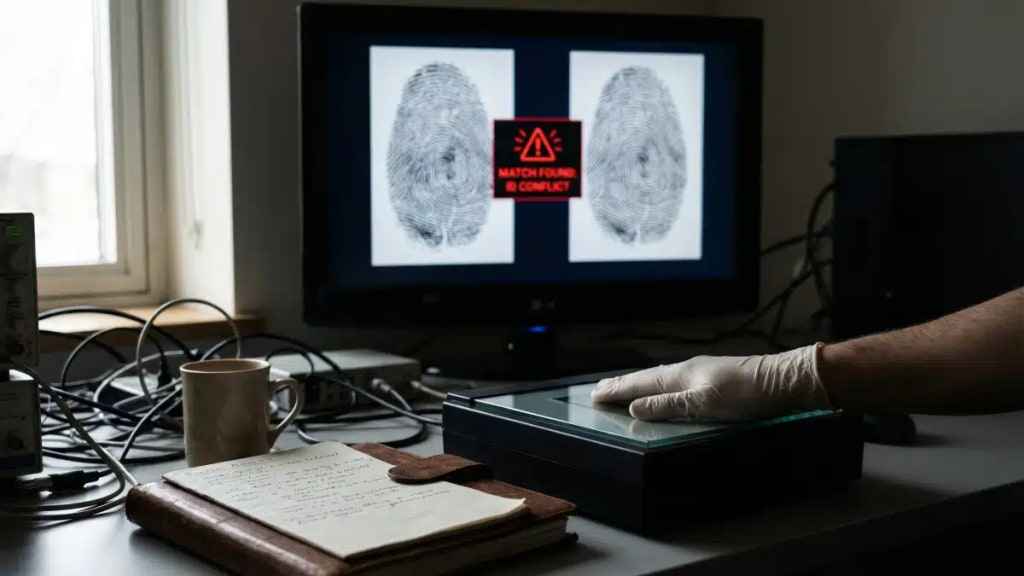
Artificial intelligence has uncovered patterns in human fingerprints that could challenge one of the oldest assumptions in forensic science: that every fingerprint is entirely unique.
For more than a century, fingerprint identification has been treated as near-infallible evidence in criminal investigations worldwide. But researchers using advanced AI systems now say the degree of uniqueness may have been overstated — a finding that could carry serious implications for courts, law enforcement, and security systems.
What Is News
Researchers used AI trained on millions of fingerprint images.
The AI identified shared patterns between different fingers of the same person.
It also detected unexpected similarities between fingerprints of different individuals.
Experts say fingerprints are not necessarily non-unique — but may be less distinct than traditionally believed.
The findings could affect how fingerprint evidence is used in criminal trials.
A Pillar of Forensic Science Under Scrutiny
Fingerprint identification has long been considered a gold standard in forensic science. The core assumption: no two individuals share the same fingerprint pattern.
This belief underpins global criminal justice systems. Courts have routinely accepted fingerprint matches as highly reliable, often decisive evidence in securing convictions.
However, AI-based analysis has introduced new complexity.
Using machine learning trained on massive fingerprint datasets, researchers found that:
Different fingers of the same person share structural similarities that were previously overlooked.
Fingerprints from different individuals may display measurable similarities when analyzed at certain scales or resolutions.
Human forensic examiners typically focus on specific minutiae points — ridge endings, bifurcations, and local features. AI, by contrast, can evaluate broader statistical and structural patterns across entire prints, detecting correlations invisible to human analysts.
The findings do not claim that fingerprints are identical across people. Instead, they suggest that the certainty attached to fingerprint matches may have been exaggerated.
What Is Analysis
The implications extend beyond academic debate.
Fingerprint evidence has been treated in many courtrooms as near-conclusive. Unlike DNA evidence — which is statistically quantified — fingerprint analysis often relies on expert interpretation rather than strict probabilistic modeling.
If AI demonstrates that similarity thresholds are more nuanced than previously understood, the legal system may need to revisit how fingerprint evidence is presented and weighed.
Several critical questions emerge:
1. How Reliable Is “Match” Testimony?
In many jurisdictions, fingerprint experts testify with high confidence, sometimes implying near-zero error rates. But forensic science has faced criticism before — from bite-mark analysis to hair comparison — for overstating certainty.
AI-driven pattern recognition could force courts to demand more statistical rigor in fingerprint testimony.
2. Could Past Convictions Be Reexamined?
If fingerprint uniqueness is less absolute than once believed, defense attorneys may challenge prior convictions based heavily on fingerprint matches.
This does not automatically invalidate past cases. But it introduces uncertainty where previously there was assumed finality.
3. What About Biometric Security?
Beyond criminal justice, fingerprint authentication is widely used in smartphones, border control systems, and access control.
Modern biometric systems rely on probabilistic matching rather than absolute identity. However, if cross-individual similarities are more common than assumed, system thresholds may need recalibration to maintain security.
Experts Remain Divided
Forensic scientists are not unanimous in their interpretation of the AI findings.
Some argue this is a healthy scientific correction — an opportunity to modernize forensic standards and integrate statistical modeling into fingerprint analysis.
Others caution that laboratory AI results do not necessarily undermine decades of real-world investigative success. Fingerprint identification, they argue, is based on multiple features and contextual analysis, not simplistic pattern comparison.
The debate reflects a broader tension: when AI uncovers hidden correlations in long-established systems, does that invalidate tradition — or simply refine it?
A Larger Pattern
This development is part of a growing trend. AI is increasingly being used to audit human expertise in fields ranging from medicine to finance to law enforcement.
In many cases, AI does not overturn systems outright. Instead, it exposes overconfidence and highlights hidden complexity.
For forensic science, the core issue may not be whether fingerprints are unique — but whether certainty has been overstated in courtrooms.
Bottom Line
Artificial intelligence has not declared fingerprints meaningless. But it has introduced doubt into a system that has long operated on near-absolute confidence.
If the findings hold up under peer review and replication, courts may need to shift from treating fingerprint evidence as infallible to treating it as probabilistic.
That shift could reshape how justice systems evaluate evidence — and remind us that even century-old scientific assumptions are not immune to scrutiny in the age of AI.
About the Creator
Keep reading
More stories from Behind the Tech and writers in Futurism and other communities.
Anthropic Rejects Pentagon Ultimatum Over Military AI Use
Artificial intelligence company Anthropic has publicly rejected demands from the U.S. Department of Defense to allow unrestricted military use of its AI systems, escalating a rare and highly visible standoff between a leading AI developer and the Pentagon.
By Behind the Techabout 11 hours ago in Futurism
Power Electronics Market Overview: Grid Modernization, Digital Power Control & Forecast to 2034
Rapid electrification across industries and the surging adoption of renewable energy are propelling the demand for sophisticated power electronics, which are essential for efficient energy conversion, grid stability, and motor control. According to IMARC Group’s latest data, the global power electronics market size was valued at USD 34.6 Billion in 2025. Looking forward, IMARC Group estimates the market to reach USD 53.1 Billion by 2034, exhibiting a CAGR of 4.87% from 2026-2034.
By Andrew Sullivan8 days ago in Futurism
Oncology Information Systems Market: Cloud-Based Platforms, Data Security Enhancements & Industry Forecast to 2033
Integrating healthcare IT solutions with clinical workflows is revolutionizing the way cancer care is delivered globally. By automating data handling and treatment planning, these systems reduce manual errors and allow clinicians to focus on personalized patient outcomes. According to IMARC Group’s latest data, the global oncology information systems market size was valued at USD 4.2 Billion in 2024. Looking forward, IMARC Group estimates the market to reach USD 7.3 Billion by 2033, exhibiting a CAGR of 5.95% from 2025-2033.
By Andrew Sullivan3 days ago in Futurism



Comments
There are no comments for this story
Be the first to respond and start the conversation.