Latest Stories
Most recently published stories in Futurism.
Six Degrees at Ten
When Six Degrees was published, climate refugees in America were languishing far from their homes on the Katrina-ravaged Gulf Coast. In the Arctic sea ice had shrunk to its lowest ebb in recorded history. The year was 2007 and climate change seemed fated to loom over the lives of all in the new century. The book, written by environmental campaigner Mark Lynas, collected the best guesses of scientists to project a degree-by-degree vision of our warming world, detailing the consequences for humans and nature as the mercury climbed. In 2007 the carbon in our atmosphere hovered around 385 parts per million, but today it is well over 400. Since then global temperatures have also crossed the fateful threshold of 1 degrees Celsius outlined in the book. Each chapter deals with a degree Celsius increment, climaxing as the title would suggest with a climate six degrees warmer than that which has prevailed for most of human existence. So, how closely does our world today follow the trajectory plotted a decade earlier? Reading the first chapter now, and counting the things which have since become ordinary, is startling.
By Jack Elliot Marley9 years ago in Futurism
Symbiote Chapter 3
The office of the Minister of War was spartan and utilitarian, as was befitting a high level Bruish bureaucrat. Though they felt no need for any kind of decoration, visiting dignitaries of other species were more comfortable when there was at least a wall pick. Since they could care less either way, there were some picks. All the wall displays were neutral nature scenes from their home world: a jungle moon orbiting a gas supergiant in a binary star system, with one spectral “M” red giant and one “F” type main sequence. Though the scenes were as varied as jungles could be, there were no depictions of animals. The few furnishings in the barren, sad, cold, space, were cold metal and near unbreakable glass.
By daniel morris9 years ago in Futurism
A Primer for Dark System
Astronomy tells us that planets orbit stars, stars hang out in clusters and these clusters orbit the supermassive black hole in the center of the galaxy, and the galaxy is zooming away from some center, some big bang. These same astronomers say that, at times, planets are kicked out of their family systems to travel the dark alone. What if some of these outcasts formed their own system? These dark systems would be near impossible to detect with our current tech, but we couldn’t travel there anyway…
By daniel morris9 years ago in Futurism
The Dead Zoo: Dilophosaurus
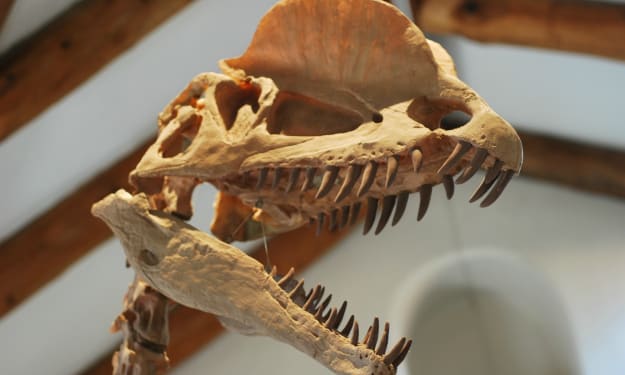
The way some hipsters talk about bands, hardcore paleo fans talk about fossils. “Oh, you only heard of mosasaurs because of Jurassic World? I was into those aquatic lizards back when they were eating sailors in The Land That Time Forgot.” It’s not necessarily charming behavior, but it happens. And I admit that when the cinematic version of Jurassic Park debuted in 1993, I felt a little swell of pride at already being a big fan of the movie's noxious double-crested dinosaur.
By Brian Switek9 years ago in Futurism
The Guardians of the Galaxy - Superheroes or Space Opera?
Watching Guardians of the Galaxy 2 leaves me in no doubt that this is a new space opera in the making. And if the sequel doesn't have the classic mythicmcguffin story arc of the first (where the infinity stone takes the place of Tolkien's One Ring as the cosmic artifact that can destroy the world/universe), it focuses more on character development, and revealing the Guardians as a classic team of oddballs that come together as a surrogate family just to get by (and, this being a blockbuster movie, save the galaxy).
By M Alan Kazlev9 years ago in Futurism
Space As You Know It Is A Lie
The Tenth Dimension is based on the idea that countless tiny "Superstrings" are vibrating in a tenth dimension. In order to begin to understand this theory, we have to first comprehensively question our notion of infinity, the plausible and implausible, and consciousness itself.
By Sarah McDaniel9 years ago in Futurism
The Physiological and Psychological Aspects of Sending Humans to Mars
Abstract The body is an extraordinary and complicated system that automatically detects, and responds to, dramatic environmental changes around it, particularly in an environment of weightlessness. The entire body is involved in the complex and rapid response to micro- or zero gravity, and space science is just beginning to form a picture of what is happening inside the body under these conditions. When an astronaut goes into space, as will be the case during an eventual mission to Mars, his or her body will immediately begin to experience a multitude of changes, causing the astronaut to feel and look slightly different. The crew would succumb to massive bone and muscle loss as a direct result of long-term exposure to micro- or zero gravity, and would suffer cell damage from ionizing cosmic radiation, potential permanent vision problems, and psychological and sociological deterioration due to isolation. Nonetheless, past space flight experiences from crews in the United States and the former Soviet Union have demonstrated that humans can survive space flights of several months, or even up to a year in duration. This study identifies the psychological and physiological aspects of a manned mission to Mars and will recommend countermeasures and prevention strategies designed to combat many of the problems associated with long-term exposures in space. The International Space Station (ISS), moreover, has an enormously vital role in assessing the health dangers of sending humans to Mars. Thus, a recommendation to place a crew on the ISS to simulate a flight to Mars is addressed.
By Antonio Paris9 years ago in Futurism