

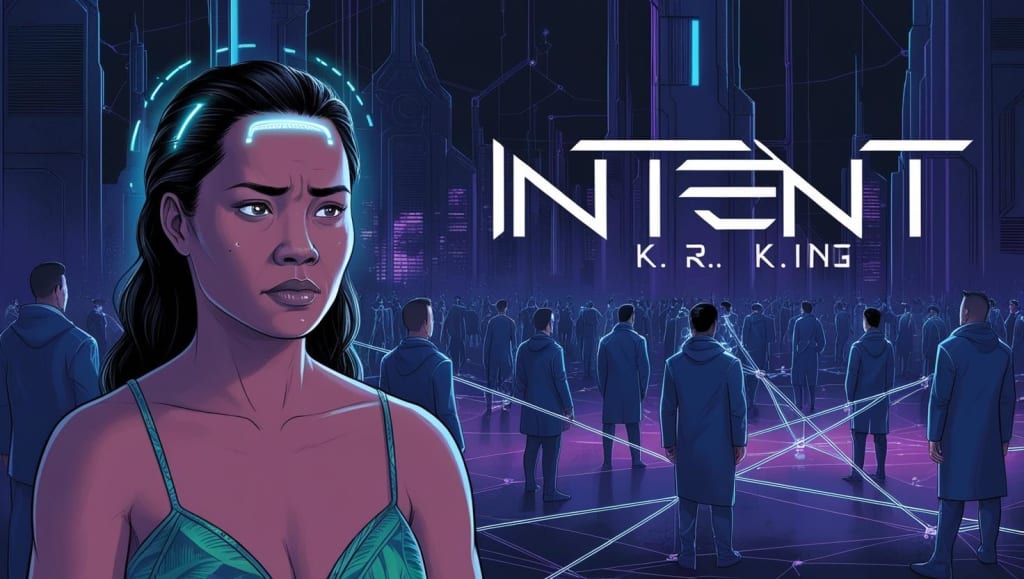
Intent
By
K. R. King
The Emerald city hummed as it always had, dull and deep, ceaselessly.
Elara sat stonefaced in her office, the glow of the city skyline fading in the distance as the sun set behind towering skyscrapers. The air was filled with the whirring of drones, automated delivery systems, and the soft flicker of advertisements in the windows of nearby buildings. She could hear everything, as though the city itself was talking to her—buy this, do this, think this. A constant stream of information and expectation, fed directly into her consciousness by the NeuroTech implant she had designed and perfected.
She should have felt proud. This was her invention—the perfect union of mind and machine. NeuroTech had revolutionized communication. It had eradicated the barriers of language, of misunderstanding. People no longer needed to speak to one another. All they had to do was think, and their thoughts would be understood in real-time. The technology had brought society closer, made relationships smoother, work more efficient, and personal connections stronger.
But Elara no longer felt that sense of accomplishment. Instead, she felt claustrophobic, suffocated, strained.
She adjusted the tiny device embedded behind her ear, pushing it into her skull with a mechanical click. It was supposed to optimize her connection to the network, allowing her to filter out the constant background noise of other people’s thoughts. It worked—at first. Now, it only made things worse. She could still hear the uninvited intrusions, the mental clutter of everyone around her.
A mother’s worries about her child’s health, a lover’s thoughts of infidelity, an employee’s anxiety about job performance. The mental cacophony was deafening.
Maybe it’s just me, she thought, sinking into her chair. Maybe I’m the problem. Maybe this technology is still too new… or maybe we’ve all just become too reliant on it.
Her mind wandered back to when it had all started, to the days before NeuroTech had taken over. When human interaction had been… messy, imperfect, but honest. Elara had once prided herself on solving problems with that technology. She remembered the early days, the thrill of the first successful brain-to-brain transmission, the wonder of connecting her own mind to another’s without a single word spoken.
But now… now, she couldn’t recall the last time she’d had a quiet moment to herself, free from the relentless bombardment of other people’s thoughts.
There was a soft knock at her door. Elara’s attention snapped to the entrance, but before she could speak, the door slid open with a mechanical hiss.
Dr. Hale, one of her closest colleagues, stepped inside. His sharp suit and confident stride immediately brought a sense of order to the room, but Elara wasn’t sure whether to feel comforted or unsettled by his presence. He was everything she once admired—so calm, so sure of himself, so driven by the belief that NeuroTech could change the world.
“Elara,” Hale greeted her, his voice soft but full of certainty. “We’ve made another breakthrough.”
“Another one?” Elara’s tone betrayed her exhaustion. “How many more do we need before we realize we’ve crossed a line?”
Hale’s smile didn’t falter. He was used to her moments of doubt. “You’ve been distant lately. I understand. The strain of the work has been wearing on you. But this—this is big. The next phase will make NeuroTech even more immersive. More integrated into daily life. We can connect the entire population into one, seamless network.”
She stiffened at his words. The thought of a world where no one ever had to speak again, where every thought could be shared and every emotion felt by everyone, was unsettling. It was a utopia to Hale, but Elara wasn’t so sure. There was a difference between communication and connection, and she feared they were losing the latter.
“I don’t think you understand,” Elara replied, her voice growing shaky. “I created NeuroTech to help people communicate more clearly, but now… now it feels like we’re erasing people’s privacy, their individuality.”
Hale’s expression softened, though his thoughts buzzed with a patient but insistent edge. “Elara, think about what we’re doing. This isn’t just about communication anymore. This is about connection—about humanity realizing its full potential.”
She tried to block his thoughts, but the implant made it difficult. Even with her own filters in place, she could still feel the pull of his belief, an undercurrent of certainty that seeped into her own mind.
“I can’t ignore this,” Elara said, her voice cracking. “The implant—it’s… it’s too much. People aren’t asking for this. They don’t understand what they’re giving up.”
Elara paused, the weight of her words hanging between them. “I think we’ve gone too far, Hale.”
Hale leaned forward slightly, his eyes bright with enthusiasm. “You don’t get it, do you? They don’t need to ask for it anymore. They already have it. NeuroTech is the future. Humanity will never go back.”
He was right. She had always known that, but the realization felt like a death sentence. What if I’m wrong? What if I’ve made a mistake that I can’t undo?
As Hale left, Elara felt his thoughts lingering in her mind like an echo, his belief that they were doing the right thing wrapped tightly around her like a binding cord. What if he’s right? What if I’m just afraid of what we’ve created?
But Elara couldn’t ignore the gnawing sensation in her gut. Deep down, she felt that the technology she had created was no longer just a tool—it was a force, shaping human consciousness in ways no one had anticipated.
The next morning, Elara stood outside, the bright sunlight harsh against her skin, the city sprawling around her. The buildings seemed to pulse with energy, their reflections shimmering in the glass. She could feel the thoughts of people around her like an invisible fog. She could hear them as if they were standing next to her.
She closed her eyes for a moment, trying to focus, trying to separate her thoughts from the clamor around her. But it was impossible. It wasn’t just the city. It was everyone—everyone who had an implant, connected, intertwined in the network.
A voice broke through her thoughts.
“Elara.”
She opened her eyes to find Aira, a close friend who had been involved in the early stages of the NeuroTech project, standing just a few feet away. Aira’s face was pale, her eyes wide with a mix of fear and confusion.
“Aira, what’s wrong?” Elara asked, her voice a mixture of concern and hesitation. Aira had always been a quiet, introspective person, but now there was an edge to her—something raw and desperate.
“I can’t do it anymore,” Aira said, her voice shaking. “The voices… the thoughts… It’s too much. I can’t shut it out.”
Elara felt a jolt of empathy, but also fear. Aira had always been sensitive to the tech, and now, it seemed, the weight of it was finally breaking her.
“I’m losing myself,” Aira whispered, her eyes filled with tears. “I can’t tell where my thoughts end and others begin. It’s all blending together. I don’t know who I am anymore.”
Aira’s voice echoed inside Elara’s mind, mingling with her own. She felt a surge of panic as Aira’s desperation filled the space between them.
“Stop it!” Elara shouted, struggling to block the flood of thoughts from Aira’s mind. But it wasn’t just Aira anymore—it was the whole city, the entire network, pushing through her consciousness like an uncontrollable tide.
“El,” Aira said, her voice breaking through the static. “You have to stop this. It’s getting worse.”
By the time Elara made it to the lab, her mind was in chaos. She could barely focus on the task at hand. Everything felt too loud, too intense. The thoughts of people she passed on the street—their hopes, their doubts, their fears—were impossible to ignore.
Inside the lab, Dr. Hale was already waiting, his expression unreadable. His mind buzzed with thoughts of progress, of future possibilities. He didn’t seem to hear the same noise that Elara did. He couldn’t. Or maybe he simply didn’t care.
“Elara, you need to see this,” Hale said, his voice barely audible over the thrum of his thoughts.
She approached the central server, her hands trembling. “I’ve seen enough, Hale. We’ve gone too far. I can’t keep doing this.”
Hale’s thoughts pressed against hers, soft but insistent. “You’re being paranoid. This is progress. This is the future.”
But Elara was done with the arguments. She had seen the destruction—the way people’s identities were fading, the way the implant had begun to dissolve the boundaries between minds. She couldn’t be a part of it anymore.
“I can’t help you anymore, Hale,” Elara said, her voice firm despite the storm raging in her mind. “This ends now.”
And with that, Elara tapped her implant in rapid succession and everything went dark.
About the Creator
Kat King
Change agent. Writer. Actor. Director. Producer.
[Follow] IG @katkinghere + @glass.stars.project | TikTok @katkinghere
#LeaveNormalBehind
www.kat-king.com
AI-Driven Data Mining in Healthcare and Its Role in Modern EMR-Driven Patient Care
Healthcare systems generate massive volumes of data every single day, from electronic medical records and diagnostic images to wearable device metrics and patient engagement apps. Making sense of this data is no longer optional. Data mining in healthcare has become a foundational capability for organizations that want to improve patient outcomes, reduce operational inefficiencies, and enable evidence-based decision-making.
By Steve Waugha day ago in Futurism
Advances in Genetic Engineering Driving the Global Recombinant DNA Technology Market
Rising demand for advanced therapeutics, vaccines, and personalized medicine is driving growth in the recombinant DNA technology market. Expanding applications in biotechnology, pharmaceuticals, and agriculture support adoption. According to IMARC Group's latest research publication, The global recombinant DNA technology market size reached USD 796.2 Billion in 2024. Looking forward, IMARC Group expects the market to reach USD 1,143.4 Billion by 2033, exhibiting a growth rate (CAGR) of 3.9% during 2025-2033.
By Michael Richardabout an hour ago in Futurism



Comments
There are no comments for this story
Be the first to respond and start the conversation.