
AI-Driven Data Mining in Healthcare and Its Role in Modern EMR-Driven Patient Care
How Predictive Analytics Builds on Data Mining in Healthcare

Healthcare systems generate massive volumes of data every single day, from electronic medical records and diagnostic images to wearable device metrics and patient engagement apps. Making sense of this data is no longer optional. Data mining in healthcare has become a foundational capability for organizations that want to improve patient outcomes, reduce operational inefficiencies, and enable evidence-based decision-making.
As digital transformation accelerates across hospitals, clinics, and health tech platforms, healthcare app development companies are increasingly integrating advanced data analytics into their solutions. With strong background in the healthcare niche industry, has been at the forefront of building data-driven healthcare applications that convert raw clinical data into actionable intelligence.
This article explores how data mining in healthcare is applied in real-world scenarios, the technologies behind it, its benefits, challenges, and how modern app development and emr integration solutions are shaping the future of patient care.
Understanding Data Mining in Healthcare
Data mining in healthcare is the practice of analysing large volumes of medical data to uncover valuable patterns, relationships, and actionable insights. This data comes from multiple sources such as electronic patient records, laboratory reports, diagnostic imaging, medication histories, insurance and billing data, as well as real-time inputs from connected medical devices and digital health platforms.
Unlike traditional reporting, data mining focuses on discovering hidden relationships and trends that are not immediately obvious. Healthcare organizations use these insights to predict disease risks, optimize treatment plans, and improve clinical and administrative workflows.
With the rise of digital health platforms, data mining in healthcare is no longer limited to large hospitals. Start-ups, telemedicine providers, and healthcare app developers now leverage data mining techniques to create intelligent, personalized healthcare solutions.
Real-Life Examples of Data Mining in Healthcare
One of the most impactful uses of data mining in healthcare can be seen in predictive disease management. By analysing historical patient data, healthcare providers can identify individuals at high risk for chronic conditions such as diabetes or cardiovascular disease. These insights enable early interventions, reducing hospital admissions and long-term treatment costs.
Another real-world application is in clinical decision support systems. Data mining algorithms analyse thousands of similar cases to recommend optimal treatment pathways for physicians. This approach improves diagnostic accuracy and supports evidence-based medicine.
Healthcare app development companies like oracle, IBM and Appinventiv implement these capabilities within mobile and web applications, ensuring that insights from data mining in healthcare are accessible directly at the point of care.
The Role of Healthcare Apps in Data Mining
Healthcare apps act as both data collection and insight delivery platforms. Patient-facing apps capture lifestyle data, medication adherence, and symptom updates, while provider-facing apps aggregate and visualize clinical insights.
Data mining in healthcare becomes significantly more powerful when embedded into applications designed with user experience and compliance in mind. Our experience in healthcare app development enables seamless integration of analytics dashboards, AI-powered alerts, and predictive models that align with real clinical workflows.
These apps not only enhance patient engagement but also help providers make faster and more informed decisions.
Importance of EMR Integration in Data Mining
For data mining in healthcare to be truly effective, it must operate on unified and accurate data. This is where emr integration solutions play a critical role. Electronic Medical Records store structured and unstructured patient data that forms the backbone of healthcare analytics.
By implementing robust emr integration solutions, healthcare apps can access real-time patient data, ensuring that insights generated through data mining are both timely and reliable. Integrated systems eliminate data silos and improve interoperability between departments, providers, and care settings.
All companies has delivered scalable healthcare platforms that combine data mining capabilities with secure EMR integrations, enabling healthcare organizations to unlock the full value of their data.
Key Techniques Used in Data Mining in Healthcare
Data mining in healthcare relies on a variety of analytical techniques that work together to uncover insights.
Classification techniques help categorize patients based on disease risk or treatment response. Clustering identifies groups of patients with similar characteristics, supporting personalized care models. Association rule mining uncovers relationships between symptoms, diagnoses, and medications, which can improve clinical guidelines.
Predictive modeling uses historical data to forecast outcomes such as readmission rates or disease progression. When embedded into healthcare apps, these techniques enable proactive care delivery rather than reactive treatment.
Benefits of Data Mining in Healthcare for Patients and Providers
The benefits of data mining in healthcare extend across the entire healthcare ecosystem. For patients, it leads to more accurate diagnoses, personalized treatment plans, and improved health outcomes. Predictive insights enable early detection of diseases, often before symptoms become severe.
For healthcare providers, data mining improves operational efficiency by optimizing resource allocation, reducing unnecessary tests, and lowering readmission rates. It also supports population health management by identifying trends across large patient groups.
Healthcare organizations working with experienced development partners gain the advantage of implementing data mining solutions that are scalable, secure, and compliant with healthcare regulations.
Challenges in Implementing Data Mining in Healthcare
Despite its advantages, data mining in healthcare comes with challenges. Data privacy and security are top concerns, as healthcare data is highly sensitive. Ensuring compliance with regulations such as HIPAA requires strong security architectures and governance frameworks.
Data quality is another challenge. Incomplete or inconsistent records can reduce the accuracy of insights. This is why effective emr integration solutions and data standardization practices are essential.
Healthcare app developers must also address interoperability issues, ensuring that data from multiple sources can be analyzed seamlessly. Healthcare expertise helps organizations overcome these challenges through well-architected, compliant solutions.
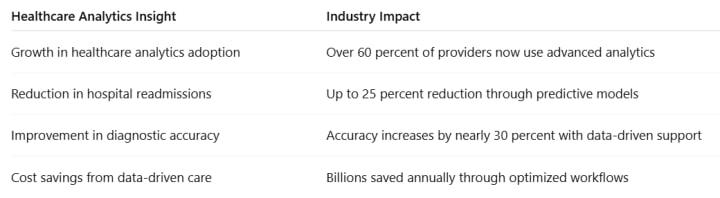
Statistics Highlighting the Impact of Data Mining in Healthcare
We established a strong background in the healthcare niche industry by delivering secure, scalable, and intelligent digital health solutions. Its expertise spans healthcare app development, AI and analytics, cloud infrastructure, and emr integration solutions.
The company’s focus on user-centric design, regulatory adherence, and emerging technologies aligns with modern healthcare demands and Google’s E-E-A-T expectations for expertise and trustworthiness.
Future Trends in Data Mining in Healthcare
The future of data mining in healthcare is closely tied to advancements in artificial intelligence and real-time analytics. As wearable devices and remote monitoring tools become more common, healthcare systems will analyze continuous data streams to deliver proactive and preventive care.
Natural language processing will further enhance the analysis of unstructured clinical notes, while real-time dashboards will empower clinicians with instant insights. Healthcare app development companies will play a central role in making these innovations accessible and usable.
With continued investment in interoperability and emr integration solutions, data mining in healthcare will become more accurate, scalable, and impactful.
Conclusion
Data mining in healthcare is no longer a future concept. It is a present-day necessity for organizations aiming to deliver efficient, personalized, and high-quality care. By leveraging advanced analytics, healthcare providers can uncover insights that drive better decisions and improved outcomes.
Partnering with an experienced healthcare app development companies ensures that data mining initiatives are implemented with the right balance of technology, compliance, and usability. As healthcare continues to evolve, data-driven intelligence will remain at the core of innovation and patient-centric care.
About the Creator
Keep reading
More stories from Steve Waugh and writers in Futurism and other communities.
EMR Integration Solutions for Interoperable and Efficient Healthcare Systems
Electronic Medical Records (EMRs) have become the backbone of modern healthcare delivery. From storing patient demographics to managing clinical documentation, lab results, prescriptions, and billing data, EMRs play a critical role in improving care quality and operational efficiency. However, an EMR system rarely operates in isolation. Hospitals, clinics, laboratories, pharmacies, payers, and digital health applications all rely on seamless data exchange to function effectively.
By Steve Waugh12 days ago in Futurism
UAE Hair Care Market Analysis: Industry Overview, Key Players & Future Outlook
According to IMARC Group's latest research publication, the UAE hair care market size reached USD 436.68 Million in 2024. The market is projected to reach USD 613.51 Million by 2033, exhibiting a growth rate of 3.85% during 2025-2033.
By Abhay Rajput6 days ago in Futurism
UAE Oil and Gas Market Outlook: Industry Trends, Key Players & Forecast
According to IMARC Group's latest research publication, UAE oil and gas market size reached 3.4 BPD in 2024. The market is projected to reach 4.9 BPD by 2033, exhibiting a growth rate of 3.7% during 2025-2033.
By Abhay Rajput7 days ago in Futurism




Comments
There are no comments for this story
Be the first to respond and start the conversation.