
Fog Computing Market Outlook: Edge Intelligence Expansion and Growth Opportunities
The fog computing market is witnessing rapid growth, driven by increasing demand for low-latency data processing, real-time analytics, and efficient connectivity in IoT and edge computing environments.

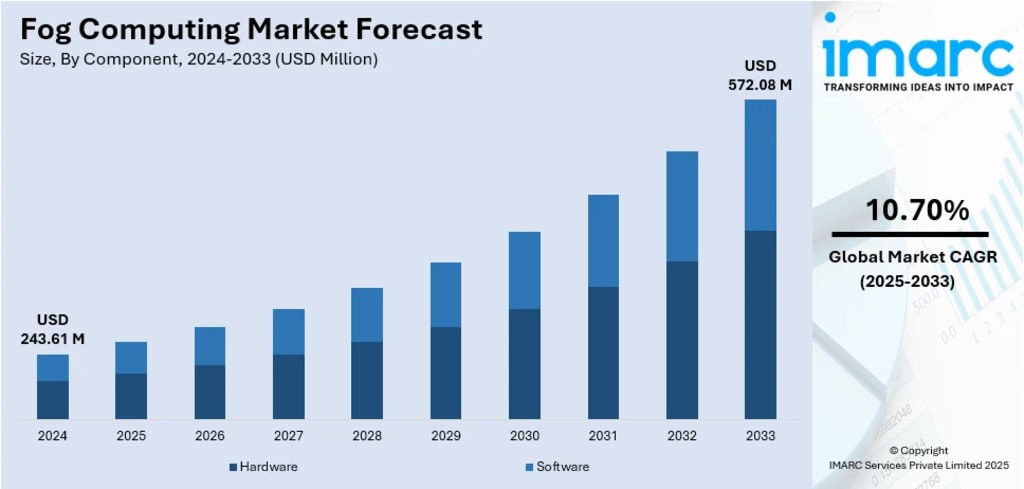
According to IMARC Group's latest research publication, The global fog computing market size is anticipated to reach USD 243.61 Million in 2025. Looking forward, IMARC Group estimates the market to reach USD 572.08 Million by 2033, exhibiting a CAGR of 10.70% during 2025-2033.
How AI is Reshaping the Future of Fog Computing Market
- Edge Intelligence and Local AI Processing: AI algorithms embedded in fog nodes enable real-time inference without cloud connectivity, powering instant decision-making in autonomous vehicles and industrial control systems while dramatically cutting latency.
- Predictive Resource Management: Machine learning optimizes fog infrastructure by predicting workload patterns and equipment failures before they occur, automatically adjusting computational resources across distributed nodes to ensure consistent performance during demand spikes.
- Enhanced Security Through AI-Driven Threat Detection: AI-powered security systems monitor fog networks continuously for anomalies and unauthorized access, identifying cyber threats at the network edge and responding instantly to prevent data breaches in distributed environments.

Fog Computing Industry Overview:
The fog computing landscape is being transformed by 5G network expansion and exploding IoT device adoption. North America leads deployment with VIA Technologies partnering with Rutronik in July 2024 to enhance edge AI solutions using Mediatek Genio processors for industrial sectors. IBM unveiled its industrial fog computing platform with on-site AI training capabilities in March 2024, while Cisco enhanced its Edge Fog Fabric in April 2025 with AI-driven analytics for real-time processing. These developments support smart manufacturing, healthcare monitoring, autonomous vehicles, and smart city infrastructure requiring instant data processing at network edges.
Fog Computing Market Trends & Drivers
IoT device proliferation is driving explosive fog computing demand as organizations struggle with data volume and latency challenges. According to IoT Analytics, connected devices reached 16.6 billion by end of 2023, representing 15% annual growth. These endpoints generate massive data requiring immediate processing rather than cloud transmission. Zscaler's ThreatLabz 2024 report documented 37% year-over-year increase in IoT devices interacting with enterprise systems. Manufacturing facilities deploy fog nodes for predictive maintenance and quality control, healthcare systems use them for remote patient monitoring, and transportation networks rely on them for autonomous vehicle communication, all requiring split-second response times impossible with traditional cloud architectures.
Strategic partnerships between technology leaders are accelerating fog computing innovation and market penetration. NVIDIA partnered with Telit Cinterion in January 2025 to integrate GPU-powered AI inferencing at IoT device edges for manufacturing, healthcare, and smart cities. MediaTek incorporated NVIDIA's TAO Toolkit into its NeuroPilot SDK in June 2024, streamlining edge AI model deployment for surveillance and industrial applications. IBM and Bosch combined fog computing with blockchain in November 2022 to secure decentralized IoT ecosystems. Fujitsu signed a strategic MoU with AMD in November 2024 to develop AI and high-performance computing platforms. These collaborations are creating comprehensive solutions combining hardware capabilities, software frameworks, and industry expertise.
Government smart city initiatives and 5G infrastructure investments are creating enormous opportunities for fog computing adoption. Siemens reported in December 2024 that its Smart Infrastructure division's digital business revenue doubled to €1.7 billion, reflecting rapid validation of decentralized urban systems. The European Union launched IoT European Platform Initiative funding seven projects under Horizon 2020 to build new IoT ecosystems. In China, 5G networks cover over 90% of cities and towns according to the Ministry of Industry and Information Technology. These initiatives drive fog node deployment for smart traffic management, energy grid optimization, public safety networks, and environmental monitoring, all requiring distributed computing architectures that process data locally while reducing bandwidth costs and improving response times across metropolitan infrastructure.
Leading Companies Operating in the Global Fog Computing Industry:
- ADLINK Technology Inc.
- Cisco Systems Inc.
- Cradlepoint Inc. (Telefonaktiebolaget LM Ericsson)
- Dell Technologies Inc.
- FogHorn Systems
- Fujitsu Limited
- General Electric
- Hitachi Vantara Corporation (Hitachi Ltd.)
- Huawei Technologies Co. Limited
- International Business Machines Corporation
- Oracle Corporation
- Toshiba Corporation
Fog Computing Market Report Segmentation:
By Component:
- Hardware
- Gateways
- Routers and Switches
- IP Video Cameras
- Sensors
- Micro Data Center
- Software
- Fog Computing Platform
- Customized Application Software
Software represents the largest component, accounting for 65.2% market share, as businesses demand flexible, scalable platforms managing distributed edge resources and customized applications tailored to specific operational requirements.
By Deployment Models:
- Private Fog Node
- Community Fog Node
- Public Fog Node
- Hybrid Fog Node
Based on deployment models, the market has been segmented into private, community, public, and hybrid fog nodes.
By Application:
- Building and Home Automation
- Smart Energy
- Smart Manufacturing
- Transportation and Logistics
- Connected Health
- Security and Emergencies
Smart manufacturing leads applications with 33.5% market share, driven by demand for real-time monitoring, predictive maintenance, and automated production optimization requiring low-latency data processing at factory floors.
Regional Insights:
- North America (United States, Canada)
- Asia Pacific (China, Japan, India, South Korea, Australia, Indonesia, Others)
- Europe (Germany, France, United Kingdom, Italy, Spain, Russia, Others)
- Latin America (Brazil, Mexico, Others)
- Middle East and Africa
North America exhibits clear dominance in the fog computing market, accounting for 44.6% market share due to advanced technological infrastructure and presence of key industry players.
Recent News and Developments in Fog Computing Market
- January 2025: NVIDIA and Telit Cinterion announced a strategic partnership to integrate AI inferencing at the edge of IoT devices, combining NVIDIA's powerful GPUs and frameworks with Telit's secure connectivity solutions. The collaboration enables intelligent, fog-enabled IoT endpoints capable of real-time data analysis across manufacturing, healthcare, and smart city infrastructure applications.
- November 2024: Fujitsu and AMD signed a memorandum of understanding to develop computing platforms for artificial intelligence and high-performance computing applications. The partnership focuses on creating open-source, energy-efficient platforms with advanced processors, delivering superior power performance and highly flexible AI/HPC software capabilities for distributed computing environments.
- July 2024: VIA Technologies partnered with Rutronik to enhance IoT and edge AI solutions for industrial and commercial sectors. The collaboration leverages high-performance Mediatek Genio processors to streamline product development and support extensive lifecycle requirements, advancing digital transformation and operational efficiency across industry verticals.
- June 2024: MediaTek announced at COMPUTEX 2024 that its NeuroPilot SDK now incorporates NVIDIA's TAO Toolkit, facilitating seamless deployment of AI inference models directly on edge devices. This integration provides smooth model training and deployment workflows, accelerating development of fog-powered applications in smart surveillance, industrial automation, and connected infrastructure.
- April 2025: Cisco Systems introduced an enhanced version of its Edge Fog Fabric platform, incorporating AI-driven analytics specifically designed for edge computing environments. The updated platform solves critical latency and bandwidth challenges through real-time processing and automated decision-making capabilities at the network edge, supporting utilities, industrial automation, and autonomous systems.
Note: If you require specific details, data, or insights that are not currently included in the scope of this report, we are happy to accommodate your request. As part of our customization service, we will gather and provide the additional information you need, tailored to your specific requirements. Please let us know your exact needs, and we will ensure the report is updated accordingly to meet your expectations.
About the Creator
Michael Richard
Michael Richard is a Market Research Expert specializing in market intelligence, competitive analysis, and data-driven insights. He helps organizations understand trends and emerging opportunities through in-depth research.
Keep reading
More stories from Michael Richard and writers in Futurism and other communities.
Circulating Tumor Cells (CTC) Market Outlook: Liquid Biopsy Advancements and Growth Opportunities
According to IMARC Group's latest research publication, The global circulating tumor cells (CTC) market size reached USD 12.9 Billion in 2024. Looking forward, IMARC Group expects the market to reach USD 27.8 Billion by 2033, exhibiting a growth rate (CAGR) of 8.46% during 2025-2033.
By Michael Richardabout 20 hours ago in Futurism
Bottled Water Market Trends: Eco-Friendly Bottles, Smart Labeling & Industry Outlook to 2034
Growing health awareness, concerns about water contamination, and the shift away from sugary beverages are fueling the bottled water market, complemented by convenience factors, premiumization trends, and eco-friendly packaging innovations. According to IMARC Group's latest data, the global bottled water market size was valued at USD 288.8 Billion in 2025. Looking forward, IMARC Group estimates the market to reach USD 498.4 Billion by 2034, exhibiting a CAGR of 6.06% from 2026-2034.
By Andrew Sullivan2 days ago in Futurism
Virtual Reality Market Analysis: Industrial Training, Automation & Forecast to 2033
Rising demand for immersive experiences across gaming, healthcare, and enterprise training, combined with improvements in headset hardware and the spread of 5G connectivity, is pushing virtual reality adoption to new levels. According to IMARC Group's latest data, the global virtual reality market size was valued at USD 15.9 Billion in 2024. Looking forward, IMARC Group estimates the market to reach USD 89.5 Billion by 2033, exhibiting a CAGR of 21.1% from 2025-2033. North America currently dominates the market.
By Suhaira Yusuf2 days ago in Futurism
Goodbye, Mr. Duvall
It is turning out to be an interesting year. I was in the middle of teaching a class when a pop-up appeared on the screen announcing the death of Mr. Robert Seldon Duvall (yes, that was his full name). I was in the middle of a discussion on the obsession we have with winning when it comes to sports (the Winter Olympics was a theme), and I felt as though things were coming full circle. We had already lost Gene Hackman last year, and along with that titan, it feels though one particular golden age has closed off to be replaced by...?
By Kendall Defoe 2 days ago in Geeks



Comments
There are no comments for this story
Be the first to respond and start the conversation.