
Fertilizer Market Forecast: Eco-Friendly Formulations, Regulatory Support & Industry Outlook to 2034
Assessing how organic farming expansion, consumer preference shifts, and eco-friendly inputs are altering fertilizer formulation trends and long-term investment priorities.

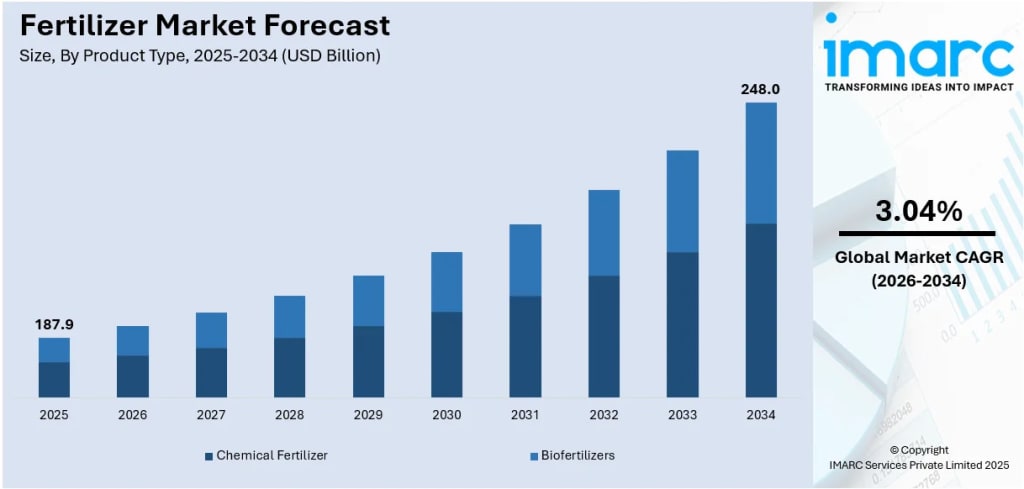
Rising demand for food security, shrinking arable land, and the adoption of high-yield crop varieties are fueling the global fertilizer market. These trends are further supported by government subsidies, advancements in precision farming, and the rapid expansion of the organic and bio-based fertilizer sectors. According to IMARC Group’s latest data, the global fertilizer market size reached USD 187.9 Billion in 2025. Looking forward, IMARC Group estimates the market to reach USD 248.0 Billion by 2034, exhibiting a CAGR of 3.04% during 2026-2034.
The fertilizer industry has evolved into a vital pillar of global food systems, with the market now comfortably exceeding the USD 180 billion mark as of 2024. Growth is anchored in the necessity to maximize caloric output per hectare to feed a global population projected to hit 9.7 billion by 2050. Beyond traditional nitrogen, phosphorus, and potassium (NPK) staples, there is a surge in demand for specialty formulations, including micronutrients and water-soluble variants designed for modern irrigation. Emerging economies, particularly in Asia and Latin America, are driving volume through intensive cash crop cultivation, while developed markets are shifting toward "green" fertilizers and carbon-neutral production to align with environmental mandates.
Fertilizer Market Growth Drivers:
- Global Food Security and Population Pressure
With the world’s population growing by roughly 140 million people annually, the pressure on the agricultural sector to produce more with less land is immense. Farmers are increasingly relying on nutrient-dense fertilizers to sustain soil productivity and achieve the high yields necessary for global trade. Current estimates suggest that global fertilizer consumption has recovered to nearly 194 million tons of nutrients. This demand is particularly high for staple grains like wheat, rice, and maize, which are essential for feeding the 783 million people currently facing food insecurity worldwide.
- Extensive Government Subsidies and Support Schemes
National governments are heavily investing in fertilizer accessibility to stabilize domestic food prices. In India, the 2024-25 budget allocated over USD 22 billion (₹1.91 lakh crore) to fertilizer subsidies, ensuring that essential nutrients like Urea and DAP remain affordable for smallholder farmers. Similarly, the U.S. Department of Agriculture recently funneled USD 120 million into domestic production projects to reduce import dependency. These financial backstops prevent market volatility from trickling down to the farm level, maintaining steady consumption rates even during periods of global supply chain disruption.
Get Instant Access to a Free "Fertilizer Market" Sample Report
- Technological Shift Toward Precision Agriculture
The modernization of farming through IoT sensors, GPS mapping, and drone technology is revolutionizing how nutrients are applied. Instead of blanket spreading, precision farming allows for site-specific application, which can reduce waste by up to 20% while maintaining high productivity. Real-world applications, such as the "Namo Drone Didi" program in India, empower local communities to use drones for spraying nano-fertilizers, ensuring better absorption and efficiency. This technological integration is a primary catalyst for market expansion, as it addresses both economic efficiency and environmental sustainability.
Fertilizer Market Trends:
- Surge in Organic and Bio-based Alternatives
Environmental regulations and a consumer shift toward "clean-label" food are driving a massive transition toward organic fertilizers. The PM-PRANAM scheme in India, for example, incentivizes states to reduce chemical fertilizer use in favor of bio-alternatives, offering grants for the production of fermented organic manure. This trend is mirrored globally as brands launch innovative bio-solutions, such as Nutrien’s recent nitrogen management tool, which utilizes biological processes to improve plant health. The organic segment is growing rapidly, as it repairs soil degradation caused by decades of intensive chemical usage.
- Decarbonization and the Rise of Green Ammonia
The industry is pivoting toward sustainability through the production of "green" and "blue" ammonia. Major players like Yara International and CF Industries are investing in pilot projects that use renewable hydrogen to create low-carbon fertilizers. In the U.S., tax incentives have significantly improved the economics of blue ammonia, which uses carbon capture technology. This shift is not just a regulatory response but a strategic move to future-proof the supply chain against rising natural gas prices and carbon taxes, positioning green fertilizer as a premium, eco-friendly product.
- Innovation in Specialty and Nano-Fertilizers
Traditional dry fertilizers are being supplemented by high-efficiency nano-formulations and slow-release coatings. Nano-DAP and Nano-Urea, which are released steadily into the soil, minimize nutrient leaching and maximize plant uptake. In June 2024, Coromandel International introduced a magnesium-fortified fertilizer to enhance photosynthesis in horticulture crops. This trend toward "specialty" products allows for tailored nutrient management, particularly in high-value fruit and vegetable sectors where precision is critical. These innovations are becoming essential tools for farmers looking to combat soil nutrient imbalances and climate-related stress.
Recent News and Developments in Fertilizer Market
- October 2025: The Prime Minister of India launched the PM Dhan Dhaanya Krishi Yojana with an outlay of over USD 4.2 billion (₹35,440 crore), aiming to unify 36 different government schemes to promote natural farming and self-reliance in the agricultural sector.
- August 2025: USAID announced a strategic investment of USD 170 million in the agricultural infrastructure of Mozambique to help the region navigate climate-induced weather changes and improve fertilizer distribution networks.
- June 2024: ICL signed a five-year, USD 170 million agreement with AMP Holdings Group to supply specialist water-soluble fertilizers in China, specifically targeting high-value horticultural crops like strawberries and apples via drip irrigation.
- January 2025: Nutrien Ag Solutions officially launched N-FINITY, a cutting-edge nitrogen management bio-fertilizer designed to enhance nutrient use efficiency and reduce the environmental footprint of large-scale grain production.
Note: If you require specific details, data, or insights that are not currently included in the scope of this report, we are happy to accommodate your request. As part of our customization service, we will gather and provide the additional information you need, tailored to your specific requirements. Please let us know your exact needs, and we will ensure the report is updated accordingly to meet your expectations.
About the Creator
Andrew Sullivan
Hello, I’m Andrew Sullivan. I have over 9+ years of experience as a market research specialist.
Keep reading
More stories from Andrew Sullivan and writers in Futurism and other communities.
MEMS Microphones Market Analysis: Noise Cancellation Innovation & Industry Forecast 2033
Rising demand for high-quality audio in consumer electronics, along with the proliferation of voice-activated systems and smart home ecosystems, is driving the MEMS microphones market, supported by advancements in semiconductor technology and expanding automotive applications. According to IMARC Group’s latest data, the global MEMS microphones market size was valued at USD 2.2 Billion in 2024. Looking forward, IMARC Group estimates the market to reach USD 5.2 Billion by 2033, exhibiting a CAGR of 9.37% from 2025-2033.
By Andrew Sullivanabout 15 hours ago in Futurism
Automotive Parts Magnesium Die Casting Market Outlook: Lightweight Vehicle Innovation and Growth Opportunities
According to IMARC Group's latest research publication, The global automotive parts magnesium die casting market size reached USD 3.3 Billion in 2024. Looking forward, IMARC Group expects the market to reach USD 5.5 Billion by 2033, exhibiting a growth rate (CAGR) of 5.51% during 2025-2033
By Michael Richardabout 14 hours ago in Futurism
Medium Density Fiberboard Market in Saudi Arabia: Urbanization & Real Estate Drivers
Saudi Arabia's medium-density fiberboard market is quietly riding one of the region's most ambitious economic transformations. With Vision 2030 pumping life into everything from residential towers to world-class hospitality complexes, MDF has become an essential material across furniture manufacturing, cabinetry, wall paneling, and decorative finishes. According to IMARC Group's latest data, the Saudi Arabia medium density fiberboard market size reached USD 267.6 Million in 2025. Looking forward, IMARC Group expects the market to reach USD 427.4 Million by 2034, exhibiting a growth rate (CAGR) of 5.34% during 2026-2034.
By Faisal Al-Harbi5 days ago in Futurism




Comments
There are no comments for this story
Be the first to respond and start the conversation.