
Australia Shipping Container Market: Trade Growth, E-commerce Demand & Technology Adoption
How rising international trade volumes, expanding e-commerce logistics demand and increasing adoption of smart and sustainable container technologies are shaping Australia’s shipping container market
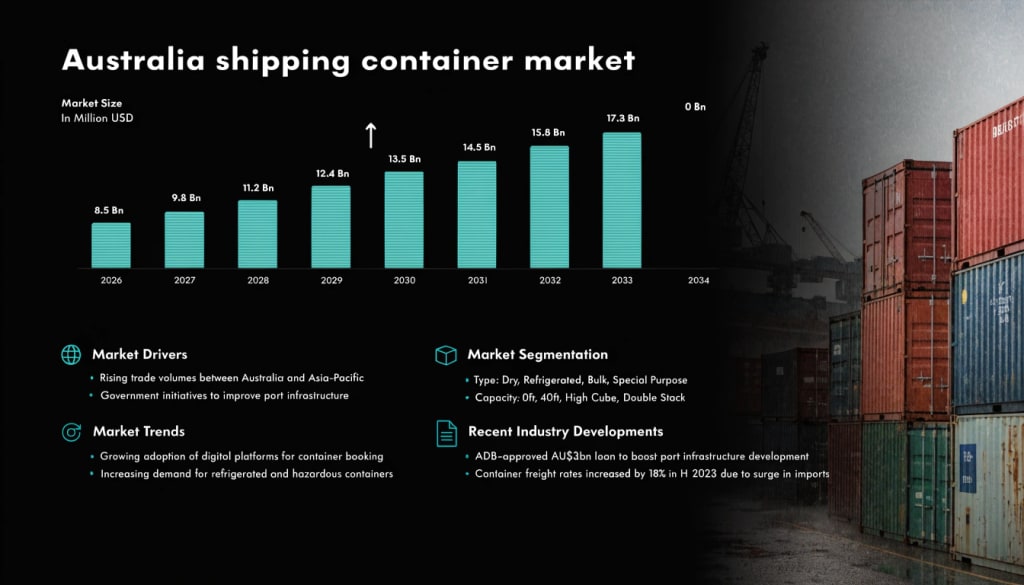
According to IMARC Group, the Australia shipping container market reached USD 254.0 Million in 2025 and is projected to grow to USD 443.7 Million by 2034, exhibiting a compound annual growth rate (CAGR) of 6.20% during 2026–2034. The steady expansion of maritime trade and logistics modernization across Australia is strengthening demand for standardized, durable and technologically advanced shipping containers. As global trade routes expand and domestic e-commerce logistics intensify, containers are becoming more than just transport units—they are evolving into smart, sustainable and modular assets within integrated supply chains.
Why Should Smart Buyers and Investors Know About the Australia Shipping Container Market?
Strong Trade-Linked Growth
A projected CAGR of 6.20% reflects consistent expansion tied to global trade activity.
E-commerce-Driven Logistics Evolution
Online retail growth ensures sustained container demand across distribution networks.
Infrastructure Modernization Support
Port and transport upgrades create long-term structural growth opportunities.
Technology Integration Upside
Smart container innovations offer operational efficiency and cost optimization benefits.
Diversified Application Potential
Beyond freight transport, modular construction and specialized containers broaden revenue streams.
Recent Trends & Developments in the Australia Shipping Container Market
September 2025:
Port expansion projects increased container handling capacity at major maritime hubs.
June 2025:
Logistics companies integrated IoT-enabled smart containers for enhanced cargo tracking.
December 2024:
Growth in modular construction projects expanded demand for repurposed shipping containers.
Australia’s shipping container market is experiencing steady growth driven by rising international trade, expanding e-commerce logistics and accelerating technological adoption. With the market expected to grow from USD 254.0 Million in 2025 to USD 443.7 Million by 2034, infrastructure investments, port expansions and smart container integration are strengthening the country’s logistics ecosystem. As sustainability initiatives and supply chain digitization advance, shipping containers will continue evolving into intelligent, versatile and environmentally aligned assets that support Australia’s trade competitiveness and economic resilience.
Australia Shipping Container Market Vision 2050
1. Fully Digitalized Container Ecosystems
IoT-enabled smart containers may provide end-to-end supply chain visibility with predictive analytics capabilities.
2. Autonomous Port Operations
Automated container handling systems and AI-driven logistics management could enhance efficiency at major ports.
3. Carbon-Neutral Shipping Solutions
Green fuel adoption and sustainable container manufacturing may significantly reduce emissions.
4. Advanced Modular Infrastructure
Container-based construction may expand across affordable housing and disaster relief applications.
5. Blockchain-Based Cargo Documentation
Digital documentation systems may enhance transparency and reduce administrative delays.
What Are the Key Growth Drivers in the Australia Shipping Container Market?
Rising International Trade Volumes
Australia’s strong export sectors—including mining, agriculture and manufactured goods—continue to drive maritime shipping activity. Increasing bilateral trade agreements and regional trade partnerships are boosting containerized cargo volumes. Standardized ISO containers facilitate efficient global transport, enabling seamless movement of goods across ports and borders.
Expanding E-commerce Logistics Demand
The rapid growth of online retail has significantly increased the need for containerized freight solutions. As consumers expect faster delivery timelines, logistics providers rely on efficient container handling systems to streamline distribution networks. High container turnover supports warehousing operations, cross-docking facilities and last-mile logistics services.
Infrastructure Investments and Port Expansions
Government-backed infrastructure projects and port modernization initiatives are strengthening Australia’s logistics backbone. Expanded port capacity and improved intermodal connectivity enhance container throughput efficiency. Upgraded rail and road networks further support inland container distribution, reducing bottlenecks and transit times.
Supply Chain Digitization and Smart Container Adoption
Technology integration is reshaping container management. Smart containers equipped with IoT sensors enable real-time tracking, temperature monitoring and cargo condition assessment. Digital platforms enhance visibility across shipping routes, improving operational transparency and predictive maintenance capabilities.
Sustainability and Environmental Initiatives
Shipping and logistics operators are increasingly adopting eco-friendly practices to align with carbon reduction targets. Recyclable container materials, energy-efficient handling equipment and optimized shipping routes reduce environmental impact. Sustainable container production and refurbishment programs extend lifecycle value while minimizing waste.
Growing Demand for Modular Construction
Shipping containers are being repurposed for modular construction in residential, commercial and industrial projects. Their durability, portability and structural strength make them suitable for rapid building deployment. This alternative application expands market demand beyond traditional freight transport.
Rising Cold Chain and Specialized Containers
The expansion of refrigerated (reefer) containers supports food exports and pharmaceutical distribution. Specialized containers designed for hazardous materials and high-value goods are also gaining traction, contributing to diversified demand.
About the Creator
Keep reading
More stories from Shrestha Roy and writers in Futurism and other communities.
Australia Cold Chain Logistics Market: Temperature-Controlled Capacity, Food & Pharma Demand & Technology Integration
According to IMARC Group, the Australia cold chain logistics market was valued at USD 5.2 Billion in 2025 and is projected to reach USD 7.3 Billion by 2034, exhibiting a compound annual growth rate (CAGR) of 3.80% during 2026–2034. The market’s steady expansion reflects the growing importance of temperature-controlled supply chains across Australia. Rising investments in refrigerated transportation fleets, advanced cold storage warehouses and smart inventory systems are strengthening logistics infrastructure nationwide. As food safety standards tighten and pharmaceutical distribution becomes increasingly complex, cold chain logistics is emerging as a strategic pillar of supply chain resilience.
By Shrestha Roya day ago in Futurism
Dark Space
It Felt Like Heaven Somewhere in the past lurking. The darkness prevailed and began to manifest. The tendrils of black and jade formulated and brought forth anew. For ‘SYN’ had arisen and all the guilt and darkness of Deep Space phenomena and noumena came forth in a human form. Or was it just a dream. A clouded memory from deep with in my mind. Welcome ‘SYN’ to the space voyage. May your travels bring you to the light.........
By Nigel Sanders2 days ago in Futurism
Stanislav Kondrashov Oligarch Series: The Semiconductor Nexus of Modern Oligarchy
Look around you. Almost everything you rely on runs on a chip. Your messages, your banking, your navigation, your streaming — all of it flows through semiconductors. They are invisible, yet indispensable. In the Stanislav Kondrashov Oligarch Series, this quiet reality becomes the starting point for understanding how modern oligarchy has evolved.
By Stanislav Kondrashov a day ago in Futurism




Comments
There are no comments for this story
Be the first to respond and start the conversation.