
Australia Acoustic Insulation Market: Noise Control Demand, Construction Growth & Sustainable Materials
How rising demand for noise control solutions, expanding construction activities and increasing adoption of sustainable insulation materials are shaping Australia’s acoustic insulation market

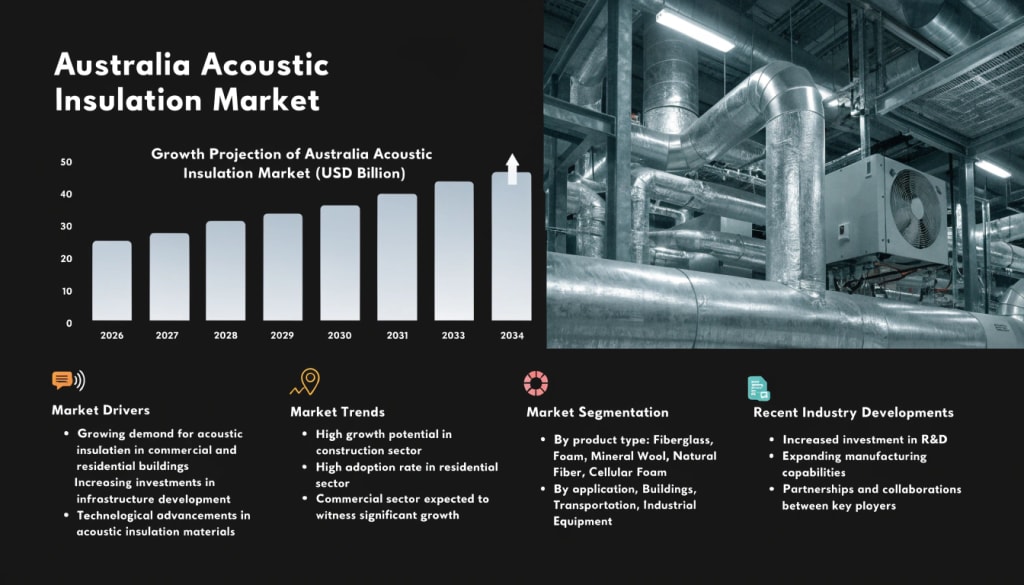
According to IMARC Group, the Australia acoustic insulation market reached USD 464.7 Million in 2025 and is projected to grow to USD 769.0 Million by 2034, exhibiting a compound annual growth rate (CAGR) of 5.58% during 2026–2034. The market’s expansion reflects growing awareness of noise pollution and stricter building performance standards across Australia. Rapid urbanization, high-density residential developments, and expanding commercial infrastructure are driving demand for effective soundproofing solutions. In parallel, sustainability priorities and green building initiatives are accelerating the shift toward eco-friendly acoustic insulation materials, strengthening Australia acoustic insulation market share across construction segments.
Why Should Smart Buyers and Investors Know About the Australia Acoustic Insulation Market?
Consistent Mid-Range Growth
A projected CAGR of 5.58% indicates steady and sustainable expansion.
Regulatory-Driven Demand Stability
Compliance requirements create reliable baseline demand.
Green Building Alignment
Sustainability incentives support eco-friendly product adoption.
Infrastructure Expansion Opportunities
Large-scale construction projects enhance long-term prospects.
Dual Functionality Advantage
Acoustic and thermal benefits improve value proposition.
Recent Trends & Developments in the Australia Acoustic Insulation Market
October 2025:
Introduction of recycled fiber-based acoustic panels for residential projects.
July 2025:
Expansion of green building initiatives encouraging eco-friendly insulation materials.
March 2025:
Increased adoption of high-performance mineral wool insulation in commercial construction.
Australia’s acoustic insulation market is progressing steadily as urbanization, regulatory compliance, and sustainability priorities reshape construction standards. Expanding from USD 464.7 Million in 2025 to a projected USD 769.0 Million by 2034, the industry reflects heightened attention to noise control, energy efficiency, and environmentally responsible materials. Increasing demand from residential, commercial, and infrastructure projects, combined with government-backed green building initiatives, is reinforcing market momentum. As acoustic comfort becomes a core component of modern construction, Australia’s acoustic insulation sector is positioned for sustained and innovation-driven growth within the broader building materials landscape.
Australia Acoustic Insulation Market Vision 2050
1. Smart Acoustic Materials
Innovative materials with adaptive sound absorption properties may enhance performance efficiency.
2. Fully Sustainable Production Models
Carbon-neutral manufacturing and circular material use could become industry norms.
3. Integrated Acoustic and Energy Solutions
Next-generation insulation systems may optimize both sound control and thermal efficiency.
4. Digital Acoustic Monitoring Systems
Advanced building management systems could monitor and adjust acoustic environments in real time.
5. Increased Retrofitting Initiatives
Widespread building upgrades may significantly expand market opportunities.
What Are the Key Growth Drivers in the Australia Acoustic Insulation Market?
Rising Noise Pollution Concerns
Urban centers are experiencing increasing traffic congestion, infrastructure activity, and high-density housing development. As noise pollution becomes a growing concern for both residential and commercial occupants, demand for effective sound insulation solutions is rising. Property developers and building owners are prioritizing acoustic comfort to improve occupant well-being and property value.
Expanding Construction and Infrastructure Activities
Growth in residential construction, commercial office spaces, educational institutions, healthcare facilities, and transportation infrastructure is significantly contributing to market demand. Multi-unit apartment complexes and mixed-use developments require enhanced sound insulation to comply with building standards and improve living conditions.
Stringent Building Regulations
Building codes and construction regulations increasingly emphasize acoustic performance standards. Compliance requirements compel developers to integrate high-quality insulation materials during construction or renovation projects. Regulatory frameworks focused on energy efficiency and indoor environmental quality further support adoption.
Growing Demand for Energy-Efficient Buildings
Acoustic insulation often overlaps with thermal insulation, contributing to improved energy performance. Developers are incorporating materials that provide both soundproofing and energy-saving benefits. This dual functionality aligns with national goals aimed at reducing energy consumption and greenhouse gas emissions.
Adoption of Sustainable and Eco-Friendly Materials
Sustainability trends are driving interest in insulation materials made from recycled content, natural fibers, and low-emission components. Products such as cellulose insulation, mineral wool, and recycled polyester fibers are gaining traction. Green building certifications encourage environmentally responsible material selection.
Urbanization and High-Density Living
As cities expand vertically and horizontally, residents increasingly value quiet living environments. High-rise apartments, hotels, and office buildings require advanced acoustic solutions to minimize noise transfer between units and floors.
Renovation and Retrofitting Demand
Older buildings often lack modern acoustic standards. Renovation projects incorporating upgraded insulation systems are becoming common, especially in urban areas undergoing redevelopment.
About the Creator
Kevin Cooper
Hi, I'm Kavin Cooper — a tech enthusiast who loves exploring the latest innovations, gadgets, and trends. Passionate about technology and always curious to learn and share insights with the world!
Keep reading
More stories from Kevin Cooper and writers in Futurism and other communities.
Australia Oral Care Market: Preventive Hygiene, Consumer Awareness & Product Innovation
According to IMARC Group, the Australia oral care market reached USD 1.1 Billion in 2025 and is projected to grow to USD 2.3 Billion by 2034, exhibiting a compound annual growth rate (CAGR) of 7.74% during 2026–2034. The market’s rapid expansion reflects rising awareness of oral hygiene and its connection to overall wellness across Australia. Consumers are increasingly investing in preventive dental care, advanced hygiene tools, and cosmetic oral products. Technological innovations such as electric and smart toothbrushes, along with demand for natural and eco-friendly solutions, are reshaping product portfolios and strengthening Australia oral care market share.
By Kevin Cooper5 days ago in Futurism
IT Solutions Powering Modern Manufacturing Operations
Manufacturing has always been shaped by technology, from mechanized looms to assembly lines. Today, the transformation is less about physical machinery alone and more about the digital systems that connect, monitor, and optimize every step of production. Information Technology (IT) solutions now sit at the center of modern manufacturing operations, quietly enabling factories to work faster, smarter, and with greater resilience.
By Davin Convay5 days ago in Futurism


Comments
There are no comments for this story
Be the first to respond and start the conversation.