
What the Dark Does First
She had been good for so long. She was only now beginning to wonder what it had cost her.

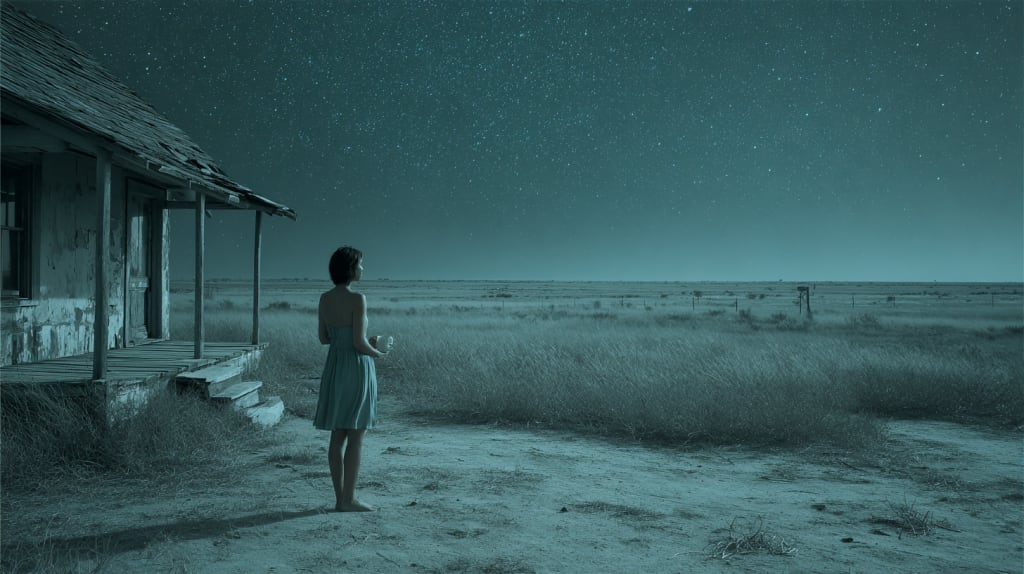
The porch light had been out for three weeks.
Delia had written it on the notepad by the coffeepot — bulb, porch — and then she'd written it again when the first note got buried under Ray's truck-payment reminder and the vet appointment for a dog they'd had to put down in October and a list of things she'd needed from town that she'd eventually just done without. The bulb stayed dark. She stopped writing it down.
Tonight she stood on the porch anyway, in the dark, with her coffee going cold in her hand.
The desert didn't need her light. It had its own arrangements — the blue-white scatter of stars, the moon rising later each night as though it too was reconsidering things. The flats stretched out in front of her, pale and enormous, and somewhere past the fence line something was making a sound she couldn't place. Low. Intermittent. Like an engine that hadn't decided to start.
She'd lived here thirty-one years. She knew every sound this land made.
She did not know this one.
It had begun — if she allowed herself that word — sometime in November. Not with any specific moment. That was the problem with trying to name it. Nothing had happened. There had been no morning she could hold up and say: here, this is where it cracked. Only a slow accumulation, quiet as silt. The way her own handwriting looked unfamiliar to her on the grocery list. The way she'd stood in the cereal aisle holding a box she'd bought for twenty years and felt, with sudden and total clarity, that she had never once chosen it. That she had seen Ray reach for it once, a long time ago, and simply continued reaching for it ever since.
She had stood there for what felt like a very long time.
She had put it in the cart.
There was a photograph on the hall table — had been for so long she'd stopped seeing it — of herself at twenty-four. She'd been standing in front of the bus station in El Paso with a backpack and an expression she barely recognized now, something open and undefended about the eyes, like a person who still believed she was on her way somewhere. She had been on her way somewhere. Austin, that time. A friend's couch. A vague idea about taking classes, painting, something with her hands. She couldn't remember now what exactly she'd meant to do.
Ray had called her from Presidio three days in. His voice low and needing. I don't sleep right when you're not here.
She'd come home on the fourth day.
He'd been asleep when she got in. She'd stood in the doorway watching him and felt, even then, even at twenty-four, something that wasn't quite relief.
She hadn't thought about that in years. Now she thought about it all the time.
Across the flats, the lights appeared.
She'd seen them before, of course. Everyone out here had. The famous Marfa Lights. You got used to them the way you got used to any local wonder — with affectionate indifference, with the mild pride of proximity. She'd watched them with tourists at the platform off 90 and felt faintly superior in her familiarity. I know them better than you do. As if that were something. As if knowing a mystery by name was the same as understanding it.
Tonight they moved with what she could only call intention, though she understood that was projection, that she was doing what people did — finding themselves in whatever held still long enough to be looked at.
She took a step off the porch. Felt the caliche crunch under her bare feet.
She stopped.
Behind her, through the screen door, she could hear the particular silence of Ray sleeping. At four-thirty his alarm would go off. He would rise and start the coffee and pour her cup without asking — had done it for twenty-nine years, always the right amount of sugar, never once asking if she'd changed, if she'd grown into something different, if maybe she didn't want sugar anymore. It had felt, for so long, like love. The kind of love that meant I know you.
She pressed her thumb hard against the rim of the mug.
What it meant, she was understanding now, was that he had never needed to wonder.
Her daughter had called last month. Maggie, who lived in Tucson now and called on Sundays and sometimes in the middle of the week for no reason, which Delia lived for without knowing why until recently. Mom, are you okay?
Fine, yes, everything's fine.
A pause. Then: You sound like you're thinking about something.
I'm always thinking about something.
You sound like you're thinking about something new.
Delia had changed the subject. Propane prices. The garden coming in slow. She was good at that, had always been good at that — the pivot, the redirect, the seamless transition into subjects that required nothing of anyone. She'd raised two children and run a household and shown up to every funeral and every graduation and every neighbor's crisis and she had been, by every available measure, reliably, thoroughly good.
She stood in the cold yard and thought about that word. Good.
What a small word. What a long life to spend inside it.
The lights drifted. That patient, looping inconclusiveness — arriving and not-arriving, gathering toward something they never became.
She had read once that some researchers believed the lights responded to witnesses. That they moved differently when observed. She'd dismissed this as romanticism, the kind of magical thinking that tourists needed and locals outgrew.
She did not dismiss it now.
The sound in the dark changed pitch. Just slightly. Something in it shifting from one unfinished thing toward another unfinished thing.
She thought about the painting she had never done. Not the specific paintings — she didn't have specific ones, had never gotten far enough to have specific ones — but the act of it. The version of herself who had stayed on that bus. Who had slept on her friend's couch and found out what her hands could make when she gave them something to say.
That woman was still in her somewhere. She'd been in there this whole time. Waiting with the particular patience of something that has been set down by someone who kept meaning to come back.
She took another step.
The cold moved up through her feet into the long bones of her legs and she let it. The lights continued their unhurried work, that perpetual almost-arriving, and the sound continued in the near distance, and the house breathed behind her — coffee and cedar and the warm sleep-smell of a man who had never once asked what she dreamed about — and she stood between all of it, at the exact edge where the known ground ended and the dark began.
Not deciding.
Not yet.
But facing it. But facing it with her whole body, the coffee cooling in her hand, the stars doing what stars do, something that had been still for a very long time beginning, slowly, to move.
About the Creator
Leslie L. Stevens Writer | Marfa, Texas
Her work blends personal essays, folklore-tinged storytelling, and emotional realism, often rooted in the West Texas landscape. She publishes fiction and nonfiction across Medium, Amazon KDP, and reader-driven platforms.
Keep reading
More stories from Leslie L. Stevens Writer | Marfa, Texas and writers in Fiction and other communities.
What We Say at the End of Things
The party for the Black family had been Connie Portillo's idea, and everyone agreed it was the right thing to do. The Black family had ranched the same four thousand acres east of Marfa for a hundred and twelve years, and now they were not going to ranch it anymore, and the least the town could do was send them off properly. Connie had used the phrase send off without appearing to hear herself use it. She'd booked the back room at Mando's, ordered two sheet cakes from Lowe's, and made a sign on poster board that said CONGRATULATIONS BLACK FAMILY — ON TO THE NEXT ADVENTURE.
By Leslie L. Stevens Writer | Marfa, Texasa day ago in Fiction

Comments (1)
"the moon rising later each night as though it too was reconsidering things." That is such a beautiful line.