
What We Say at the End of Things
In Marfa, Texas, a ranching family sells a hundred and twelve years of land. Everyone agrees it's an adventure.

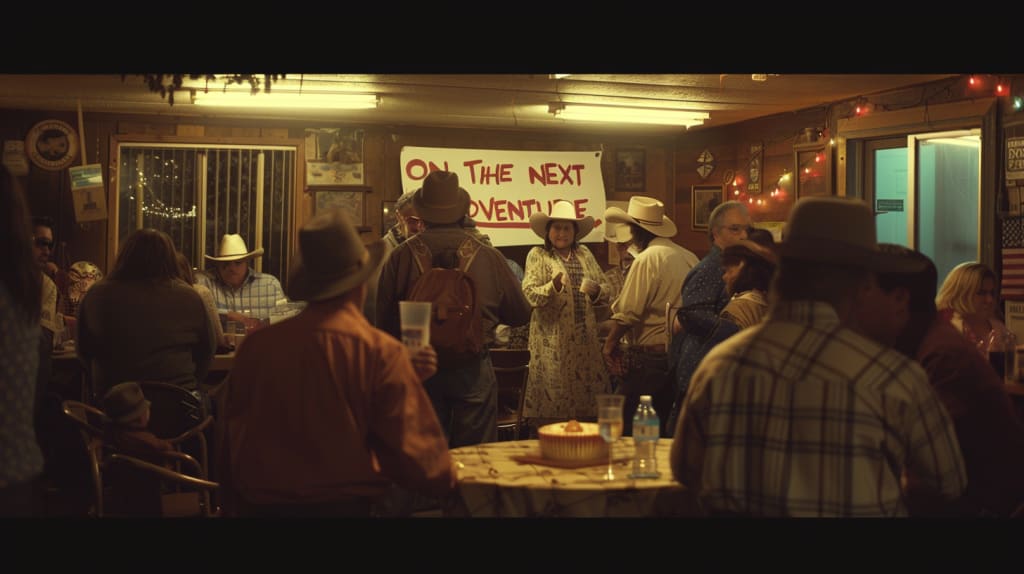
The party for the Black family had been Connie Portillo's idea, and everyone agreed it was the right thing to do.
The Black family had ranched the same four thousand acres east of Marfa for a hundred and twelve years, and now they were not going to ranch it anymore, and the least the town could do was send them off properly. Connie had used the phrase send off without appearing to hear herself use it. She'd booked the back room at Mando's, ordered two sheet cakes from Lowe's, and made a sign on poster board that said CONGRATULATIONS BLACK FAMILY — ON TO THE NEXT ADVENTURE.
The sign was taped above the doorway when people started arriving at six.
Elena Black stood near the cake table in the dress she wore to church and to funerals and to anything that required her to be looked at by a room. She was sixty-three years old. She had a face that had absorbed a great deal of West Texas weather and given nothing back, which was a kind of beauty that people from outside the region sometimes missed entirely. Her husband Tomas stood beside her with his hands in his pockets — hands that in any other room, on any other evening, would have been doing something: muscling a hay bale, running wire, coaxing a stuck valve back to life on the water line that fed the north pasture stock tank. Hands with the scrapes and cuts of a life conducted mostly outdoors, now folded away where no one had to look at them.
Their son Marcos stood a little apart from both of them the way grown children stood when they had run out of things to say to their parents.
People came up in a steady stream.
So excited for you. What a chapter. Must feel like a weight off. You'll have so much more time now. The buyer seemed real nice, didn't he? His people called it a lock-and-leave, which — I mean, that's just how they talk, you know how Austin people are. My cousin sold their place in '09 and never looked back. Have you thought about where you'll go?
Elena answered each one. She smiled at the right moments. She accepted a cup of plastic-cup wine and held it without drinking it.
"You doing okay?" Jessica Ochoa asked, because she was the only person in the room who would ask it that way — not performing the question, just asking it.
"Oh, you know," Elena said.
Jessica nodded. She did know. She knew the way everyone in the room knew, which was completely, which was in the specific and physical way that West Texas people understood things that had been decided without their input. The land would go to a man from Austin whose people had called the main house full of character and a real handyman special and described the whole property as quaint in the listing, which was a word that meant small and outdated and ready to become something else. There had been a piece in the paper using terms like adaptive reuse and honoring the landscape, which was a thing people said when they meant to do something to a landscape that the landscape would not choose for itself. The something was called a retreat destination. Elena had read the piece once and not again.
The party went on.
Connie made a toast. She said the Black family had been the backbone of this community for over a century and you didn't need her to tell you what they meant to this town, and she raised her cup and everyone raised their cups and said hear hear, and Tomas nodded at the floor with the particular expression of a man being buried in real time, standing upright, in his good shirt.
Marcos ate two pieces of cake. He was on his second beer.
The sign above the door said NEXT ADVENTURE in letters Connie had filled in with red marker, and the red had bled a little at the edges the way red marker always did, and in the overhead light it looked like the letters were leaking.
Nobody mentioned this.
Around eight o'clock old Gustavo Reyes, who was eighty-one and had worked the Black ranch for forty years before his knees gave out, made his way across the room to where Elena was standing. He moved with his hat in both hands, turning it slowly, the way men of his generation handled their hats when they were trying to say something they hadn't found the words for yet.
He stood in front of her and didn't speak for a moment.
"Gustavo," Elena said.
He nodded. He kept turning the hat.
Behind them someone was laughing at something. The laughter was loud and real and it landed in the room like something dropped from a height.
"The pasture on the north end," Gustavo said finally. "Where your father put in the stock tank."
"Yes," Elena said.
"This summer was dry." He said it the way he said everything, which was once, without decoration. "The water dropped back. Mud around the edges where the snakes like to sun. You know how it gets."
"I know how it gets."
"But the doves still come in the evening," he said. "To what water's left. Every evening, still."
Elena looked at him. Something moved across her face that she did not allow to complete itself — a brief disturbance, like the surface of the stock tank when the wind picked up, and then still again.
"I know," she said. "I know they do."
Gustavo nodded. He put his hat back on even though they were indoors, because he was eighty-one and past the point of caring about it. He touched the brim once, a small precise gesture that meant everything it meant, and moved back to his chair against the wall where he had been sitting since six o'clock watching the room with the quiet assessment of a man who had seen greed come through this valley before and recognized its current costume.
Connie materialized at Elena's elbow. "Isn't it just so wonderful that everyone came out," she said.
"It really is," Elena said.
Sometime after eight Elena slipped out the side door. Just for a minute, she told herself. Just to stand in it.
The Marfa dark had no bottom to it. It pressed flat and total against everything — the parking lot, the empty street, the mountains invisible in the distance but there, always there, the way certain facts were there whether you looked at them or not. The sky had finished its burning an hour ago, all those deep blues and hard reds that came at golden hour and made the empty spaces roar briefly to life before the quiet took everything back. Now it was just the dark and the cold and the smell of it — that particular high desert smell of dust and dry grass and something mineral underneath, the smell that had been in her lungs since before she could name it.
She stood with her arms crossed and breathed it in.
A hundred and twelve years. Her great-grandfather had come up from Ojinaga with forty head of cattle and a specific understanding of how to build something piecemeal — a few acres at a time, a fence line at a time, a water source at a time, until the pieces added up to something that could hold a family. Remuda built and rebuilt across four generations. The metronome of it: the cattle in their pens in the evening, the lowing carrying across the flat land, the smell of the barn's cool dark interior in summer, the doves at the stock tank as the light went amber and the land held its breath before the night.
That was the thing that could not be listed in a real estate document. That was the thing the paper's words could not touch. The metronome. The regularity of a life conducted in devotion to a particular piece of ground, which was its own kind of salvation and its own kind of serenity and which was now going to become something with a website and a booking calendar and a curated experience of the landscape for people who would be here four days and gone.
Elena stood in the dark until she was sure her face had settled.
Then she went back inside.
Across the room, Marcos was on his third beer. Tomas had not moved his hands from his pockets all evening. The sign bled quietly above the door.
Inside, everyone kept talking. Kept saying what a chapter, what an adventure, so excited for you, must feel like a weight off. Kept saying everything except the one word that would have required them to also say it about themselves — about their own piece of this place, about what was already gone and what was still going and whether any of them would recognize, five years from now, the town they had grown up inside of.
The word sat in the middle of the room like a stone in a dry creek bed.
Everyone stepped around it.
The party went on.
About the Creator
Leslie L. Stevens Writer | Marfa, Texas
Her work blends personal essays, folklore-tinged storytelling, and emotional realism, often rooted in the West Texas landscape. She publishes fiction and nonfiction across Medium, Amazon KDP, and reader-driven platforms.
Keep reading
More stories from Leslie L. Stevens Writer | Marfa, Texas and writers in Fiction and other communities.
9:52
by Leslie L. Stevens 9:52 PM. Jessica bounced into the kitchen like she owned it. Ponytail swinging, sneakers squeaking, still high off sixty bucks in tips and a full week of crushing it. Her tables were clean. Her section was empty. Her stomach was growling.
By Leslie L. Stevens Writer | Marfa, Texas28 days ago in Fiction
Winterthorne
Winterthorne stood alone at the edge of the park. The beautiful snow that had surrounded him was all trampled now, from the feet of all of the children who had built him. He missed the sparkly clean snow blanket, but he was happy that so many children had come out to make him.
By Laura DePace6 days ago in Fiction


Comments
There are no comments for this story
Be the first to respond and start the conversation.