
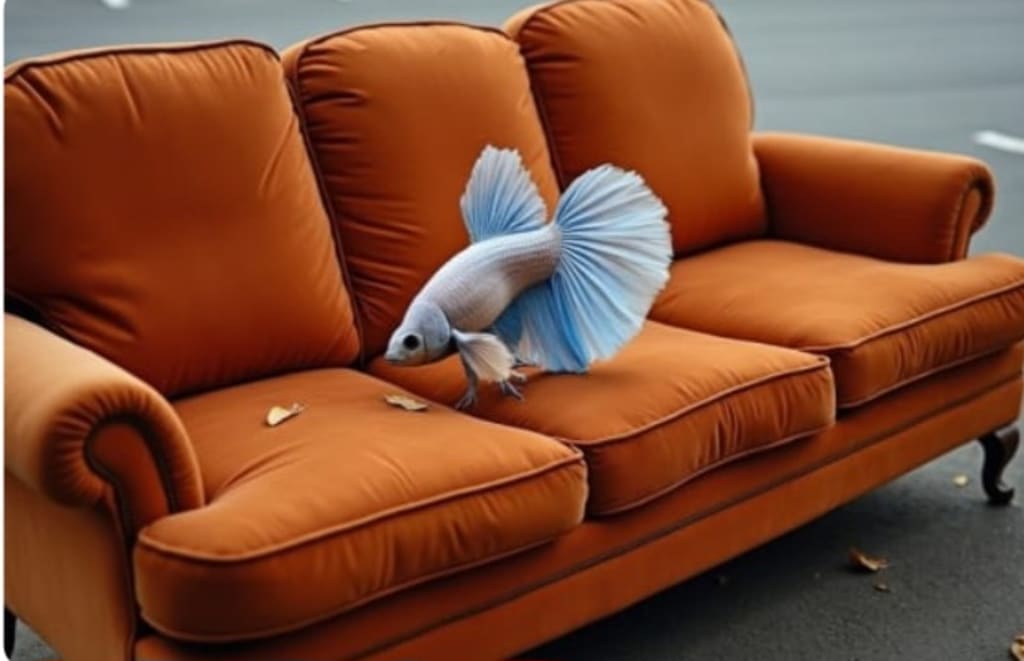
Some stories dazzle with drama and plot twists. Others sneak into your heart slowly, through ordinary moments that feel extraordinary in their simplicity. We Sat Upon the Couch, published on Vocal.Media, is one such story. It explores fear, empathy, vulnerability, and the unexpected bonds that form between two people.
At first glance, the title may seem mundane. But the worn orange couch at the center of the narrative becomes a powerful symbol — a space where emotions, trust, and connection unfold. This is not a story about romance in the usual sense. Instead, it’s about the quiet ways humans connect, care, and grow together.
Meeting Raphael: Nervousness and First Impressions
The story begins with a simple scenario: the narrator, a young person in their early twenties, meets Raphael through a dating app. They arrive at Raphael’s studio apartment, nervous and unsure what to expect. The apartment is modest, but the orange velvet couch — slightly sagging, clearly well-used — becomes their shared space.
Raphael is open and welcoming, offering water and making casual conversation. But before they can talk too much, he makes a confession: he is HIV positive. This revelation triggers a mixture of anxiety, fear, and uncertainty in the narrator. Questions flood their mind: What does this mean? Can I catch it? How should I react?
Instead of shying away, the narrator stays. They talk about films, music, and Raphael’s fish tank, gradually breaking down the initial tension. It’s not an instant connection, nor is it dramatic — it’s slow, awkward, and human in its honesty.
The Couch as a Symbol of Connection
The orange couch is central to the story. It’s not glamorous; it’s old, sagging, and imperfect. Yet it becomes a safe space where vulnerability is allowed. Every conversation, laugh, or shared silence happens on that couch. Through it, the story illustrates a subtle truth: human intimacy doesn’t require spectacle, only presence.
Watching movies together, helping with a fish tank, and sharing quiet moments are small acts. Yet they carry immense emotional weight. The couch bears witness to these moments, making it a metaphor for the imperfect yet meaningful spaces where bonds form.
Friendship Over Romance
One of the story’s most refreshing aspects is how it subverts expectations. Although it begins with online dating, the relationship does not evolve into a conventional romantic narrative. Instead, the narrator and Raphael develop a deep friendship rooted in trust, care, and emotional intimacy.
They spend time together, laugh, help each other, and share life’s simple pleasures. These acts of companionship show that intimacy is not always sexual — it can be emotional and profound. In a world where closeness is often equated with romance, this story reminds us that friendship can be just as transformative.
Caring in Difficult Times
The story takes a poignant turn when Raphael falls ill. Weeks pass without contact, and the narrator worries. Eventually, Raphael reaches out from a hospital. This moment becomes a turning point: the narrator is no longer just a friend; they become a source of care, comfort, and emotional support.
The narrative emphasizes how love and compassion manifest in ordinary acts — holding a hand, sharing a quiet moment, or simply being present when it matters most. These are not dramatic gestures but the ones that leave a lasting impact.
Loss, Memory, and Legacy
Raphael eventually moves to a hospice. The narrator visits him there, and their time together becomes a testament to the enduring bond they share. The couch, which had been a silent witness to their growing connection, is eventually discarded. Yet its memory remains symbolic: a reminder that ordinary spaces can hold extraordinary meaning.
Through this journey, the narrator experiences grief, but also a deep appreciation for the lessons Raphael imparted: fear can be confronted, empathy can grow, and connections can endure beyond physical presence.
Why This Story Resonates
We Sat Upon the Couch is quiet, deliberate, and profoundly human. It doesn’t rely on sensational events or dramatic plot twists. Instead, it shows that friendship, vulnerability, and emotional presence can be powerful forces.
The story challenges societal fears, particularly surrounding HIV, and encourages readers to confront their own assumptions. It’s a reminder that meaningful connections often arise in ordinary moments, and that love — in its broadest sense — is about care, trust, and shared experience.
Conclusion
In a culture obsessed with spectacle and instant gratification, We Sat Upon the Couch is a gentle but powerful reminder that human connection thrives in quiet spaces, through patience, empathy, and shared vulnerability.
Two people. A worn orange couch. And the slow, steady growth of trust and companionship. That is the heart of the story — and its enduring message: that ordinary moments, shared with sincerity, can transform lives.
About the Creator
Keep reading
More stories from Ayesha Lashari and writers in Fiction and other communities.
How to Fuck Around
Language is alive, and slang is often where it grows the fastest. Among the many expressions that have emerged and evolved over the last decade, few have captured the imagination—or the eyebrows—of English speakers quite like the phrase “fuck around.” At first glance, it seems crude, irreverent, and downright offensive. But dig a little deeper, and you’ll find that it’s much more than a simple expletive; it’s a linguistic mirror reflecting modern culture, humor, and social dynamics.
By Ayesha Lashariabout 3 hours ago in Fiction
~ Fired ~
— Ai Intrusion ~ Are you Next ~ Is Ai Evolution after your job? — Few workplaces haven't been affected. Ai is in supermarkets, at doctors' offices, and even monitoring farms. I just can't think of anything this machine is not getting into, can you? For instance: Education ~ Law and Tech jobs will one day have a major influence or be taken over by these inanimate machines, with accuracy and vigor. From mechanics' diagnoses to a wide variety of everyday jobs, including fast food workers, with this input having the ability to cut their unnecessary work hours. I'm certain all of us have been touched by this with our short stories and colorful headings, have you? Even comments are very questionable 'Non-Robot' insertions.
By Jay Kantor5 days ago in Journal




Comments
There are no comments for this story
Be the first to respond and start the conversation.