
THE SEA RAIDERS
A Terror Rising from the Deep When the Ocean Sends Its Monsters Ashore The Day the Sea Fought Back Invisible Enemies Beneath the Waves A Coastal Nightmare Beyond Reason Strange Shapes on the Tides of Fear From the Depths Came the Raiders A Battle Between Humanity and the Unknown

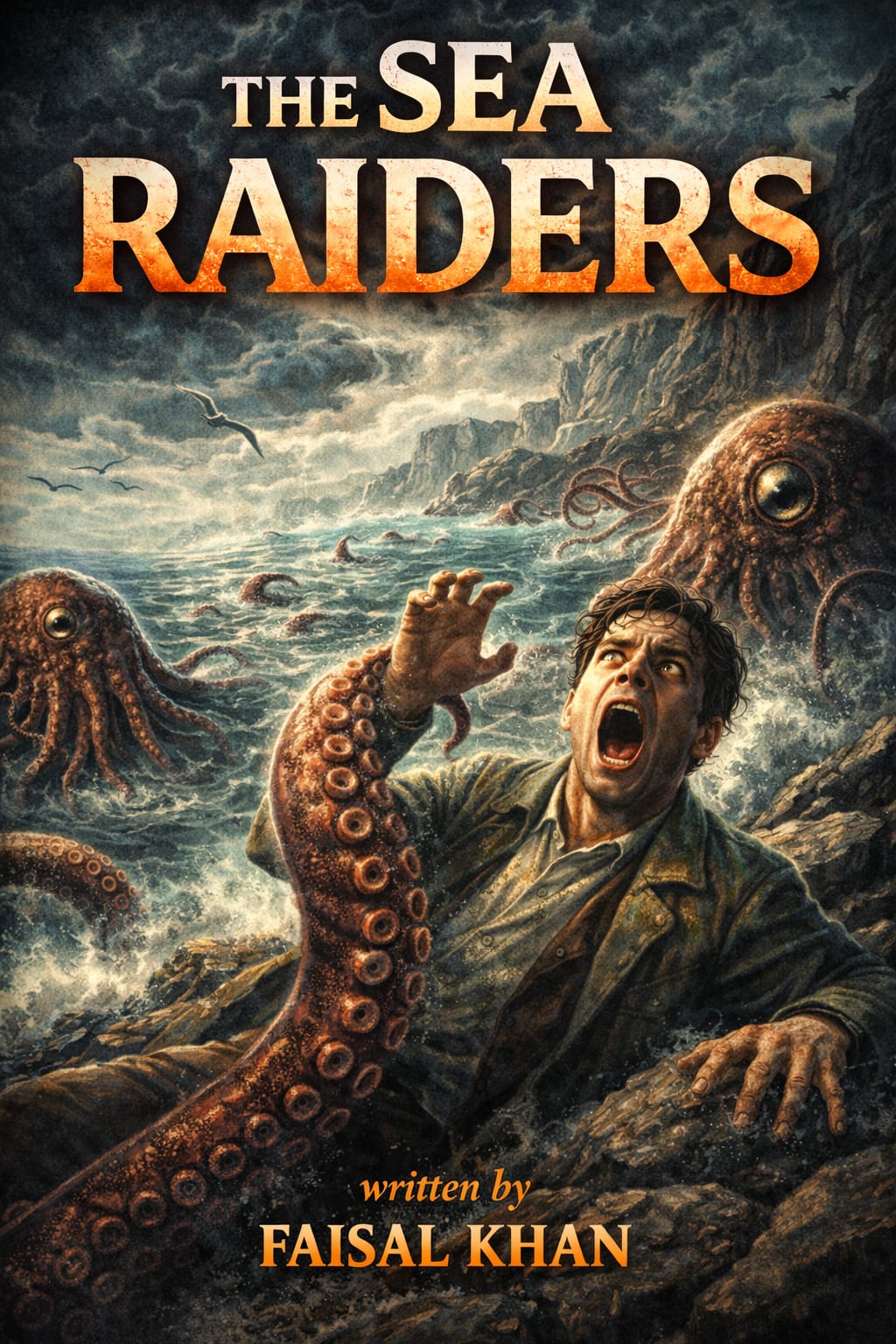
Until the strange events at Sidmouth, the deep-sea creature known as Haploteuthis ferox was barely understood by science. Only fragments—tentacles found near the Azores and a decaying body discovered off Land’s End—hinted at its existence. Like most deep-sea cephalopods, it lived beyond the reach of nets and observation, known only through rare accidents. Zoologists could not explain how or why such creatures ever reached shallow waters.
It was believed that hunger migration or some unusual disturbance in the depths may have driven them toward the coast. Whatever the cause, early May brought a wave of unexplained drownings and boating accidents along the coasts of Cornwall and Devon. These tragedies were later linked to Haploteuthis ferox.
The first person to see one of these creatures and survive was a retired tea dealer named Mr. Fison, who was staying at Sidmouth. One afternoon, while walking along the cliff path toward Ladram Bay, he noticed what he first thought was a cluster of birds fighting over food far below on the exposed rocks. Curious, he descended the steep ladder cut into the cliff to investigate.
As he crossed the slippery, seaweed-covered rocks, Mr. Fison removed his shoes and rolled up his trousers to move more safely—a small decision that likely saved his life. Drawing closer, he realized the birds were circling something far larger than he had imagined. When he climbed over a ridge of rocks, the horrifying truth was revealed.
Before him lay the partially eaten body of a human being. Surrounding it were several grotesque creatures resembling enormous octopuses. Their bodies were round and glossy like wet leather, their tentacles long and powerful, coiled across the rocks. Each creature possessed large, intelligent eyes and a disturbing suggestion of a face. There were seven or eight of them on the shore, with more emerging from the sea as the tide returned.
At first, Mr. Fison felt more horror than fear. Believing the creatures had simply found a drowned body, he shouted to scare them away and threw a stone. Instead of retreating, the creatures slowly began moving toward him, their tentacles uncoiling as they advanced with a low, purring sound.
Suddenly realizing the danger, Mr. Fison fled. He barely escaped as tentacles spilled over the rocks behind him. Slipping and stumbling, he raced toward the cliffs. The creatures pursued him until he reached the ladder, where two workmen happened to be repairing it. Together, the men threw stones and managed to drive the creatures back long enough to escape and summon help.
Later that day, Mr. Fison returned in a boat with the workmen and a boatman to recover the body. By then, the tide had risen and the remains were gone. Peering into the water, they saw one of the creatures swimming beneath them, followed by several more tangled among the seaweed. When the men shouted and struck the water with their oars, the sea floor seemed suddenly alive with watching eyes.
The creatures rose rapidly. Tentacles streamed upward, wrapping around the boat. One seized the side and tried to climb aboard. Mr. Fison stabbed at it with a boat hook, forcing it back, but more tentacles gripped the oars and rudder. The boat became trapped, rocking violently as the men struggled.
Then disaster struck. The boatman, Hill, was grabbed by the arm and dragged toward the water. Despite desperate efforts to save him, he was pulled overboard by the mass of writhing tentacles and disappeared beneath the surface. At the same time, Mr. Fison noticed another boat nearby carrying women and a child. Realizing the danger, he abandoned his oar and screamed for them to stay away.
The fight continued as the boat drifted dangerously close to the rocks. Seeing a chance to escape, Mr. Fison leapt from the boat onto the rocks and fled toward shore with the two surviving workmen. When he finally dared to look back, the sea appeared calm again. The creatures, the struggle, and the missing boatman were gone, as if swallowed by the ocean itself.
Later, it was discovered that a second boat had capsized, and all aboard were lost.
This marked the most serious known appearance of Haploteuthis ferox along the English coast. Authorities patrolled the shoreline that night, and several armed boats searched the waters. Near midnight, witnesses reported seeing the creatures glowing faintly beneath the sea, moving together in a slow, wedge-shaped formation, phosphorescent like ghosts drifting through darkness.
Soon after, the creatures vanished. Over the following weeks, isolated sightings occurred—one washed ashore in France, another carcass was found near Torquay—but the shoal was never seen again. Whether they were killed, driven away, or simply returned to the deep remains unknown.
Science still cannot say how many there were or whether they may ever return. But it is hoped that these terrible beings, risen so briefly from the sunless depths, have gone back forever to the dark middle seas from which they emerged.
About the Creator
Faisal Khan
Hi! I'm [Faisal Khan], a young writer obsessed with exploring the wild and often painful landscape of the human heart. I believe that even the smallest moments hold the greatest drama.
Keep reading
More stories from Faisal Khan and writers in Fiction and other communities.
THE MOTH
Hapley was one of the most celebrated entomologists of his time, famous for his discoveries and infamous for his bitter feud with Professor Pawkins. Their rivalry had lasted for decades and had grown from an academic disagreement into a personal war. It began when Pawkins dismissed a species Hapley had named, and from that moment onward, the two men attacked each other relentlessly in papers, meetings, and public lectures. Their quarrel became legendary within scientific circles, stirring passions as fierce as any religious dispute.
By Faisal Khan27 days ago in Fiction
A Child With A Broken Heart
Lisa used to be a free-spirited child until dark cloud and curses strike her life at an early age. Lisa was the apple of her father's eyes and also his pride and joy at an early age. Her dad was very controlling to her mother, and her mother would not have any of that. Lisa's mother moved to Florida to get away from a controlling man. Different people would babysit Lisa because her mother had to work to support them. There was no stable babysitter in 2-year-old Lisa of life.
By Mariann Carroll2 days ago in Fiction




Comments
There are no comments for this story
Be the first to respond and start the conversation.