
The Persistence of Elpis
The jar had been Epimetheus's idea, naturally.
Everything disastrous in that household had been Epimetheus's idea, and Myrto had worked for the family long enough to know that when the master of the house said something like it's perfectly safe, just don't open it, the correct response was to begin mentally cataloguing which of your personal belongings could be easily replaced.
Myrto had arrived at the estate on the slopes of Pelion fifteen years prior, sent by her uncle who had connections with the household staff of several minor gods and thought the work would be steady. It had been steady, she would grant that. Steadily peculiar. Steadily exhausting. Steadily the sort of employment that made you grateful, on the walk home at the end of a long season, that you were merely mortal and therefore had some reasonable expectation of things eventually ending.
She had been scrubbing the courtyard stones when she heard the sound.
It was difficult to describe what the opening of that jar sounded like, except to say that it was like every sound you had ever dreaded hearing, the creak of a beam in a fire, the particular silence after a loved one stopped breathing, the intake of your own breath before very bad news arrived, compressed into a single moment and then released outward in every direction simultaneously. The birds in the olive grove went silent. The goat tied near the well sat down abruptly on the packed earth, which goats do not ordinarily do.
Myrto put down her brush.
She went inside.
The receiving room was in a condition that took her several moments to fully process.
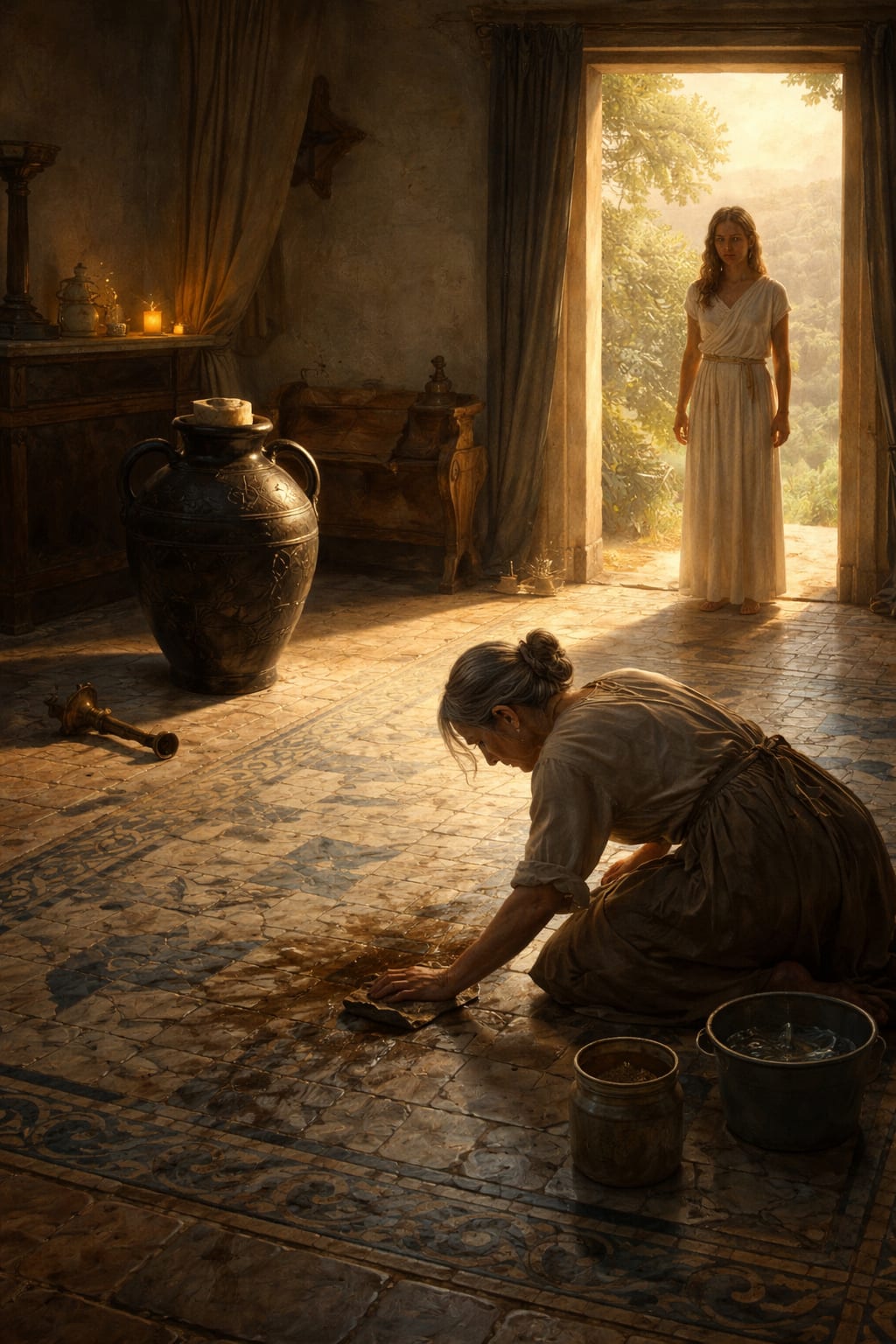
Pandora was standing against the far wall with her back pressed against the plaster, both arms extended outward as though she intended to embrace whatever was coming toward her or possibly repel it, she seemed uncertain which. The jar, an enormous thing, black-figured, with a stopper she had clearly pried off using the bronze candlestick that was now lying on the mosaic, sat on the low table in the center of the room, tipped slightly onto its side.
What had come out of it was not invisible. That was the first thing Myrto had to revise in her understanding of the situation. She had assumed, in the half-second between hearing the sound and walking through the door, that if anything had escaped the jar it would be intangible, atmospheric, the sort of thing you couldn't see or clean up after. This was incorrect.
Plague was crouched in the corner near the window.
It looked, in the honest assessment of a practical woman with no investment in making things more poetic than they were, like a very large wet dog that had additionally been set on fire at some point in the recent past and had not entirely recovered. It was gray-green in the areas that were not the dull red of old injury. It panted. It left marks on the mosaic wherever it shifted its position, and the marks were spreading, the grout between the tiles darkening as she watched.
Sorrow was worse.
Sorrow was not crouched in a corner being containably terrible. Sorrow moved. It drifted through the room the way smoke moves when a door opens, filling the spaces between furniture, settling into the folds of the curtains, pooling in the ceramic bowls of the sideboard. It had no fixed shape but it had a texture, and the texture was of something dense and gray pressing against you from the inside, and Myrto found, standing in the doorway, that she had been thinking about her mother, who had died seven years ago, and about the specific angle of afternoon light in the room where she had sat with her at the end, and she had to stop looking at Sorrow directly and instead look at the space just to the left of where it seemed most concentrated.
"Pandora," she said.
Pandora was crying. She was also, in the way of people who have done something catastrophic and are still in the physical presence of the catastrophe, making small gestures of ineffectual correction, picking up the bronze candlestick, putting it down again, moving slightly to the right, moving back.
"The stopper," Myrto said. "Where is the stopper."
"I was only going to look—"
"Yes. The stopper."
Pandora pointed. It had rolled under the couch, which was a low cedar couch with carved lion's paw supports and approximately two inches of clearance, and now Myrto was going to have to get on her stomach on the mosaic to retrieve it, a thing she was already resentful about.
She got on her stomach on the mosaic.
The stopper was a piece of carved alabaster, stoppered with beeswax and wound about with cord that had been, she was almost certain, tied by a god, because the knot was unlike any configuration of rope she had ever encountered in her life and she had been tying things for forty-three years. She retrieved it. She stood back up. Her knees communicated their dissatisfaction at length.
Plague had moved closer to the couch while her attention was elsewhere.
"Stay," she said to it.
It paused. It seemed, despite everything, to find this instruction confusing rather than offensive. It sat. The sitting produced additional marks on the mosaic.
"Good," she said, with the measured tone she used with the household's actual dogs, who were large and not particularly intelligent and responded well to confidence.
Getting Sorrow out of the room took most of the morning.
The difficulty was that you could not sweep it, exactly. You could not gather it into a pile. It responded to movement and to the presence of grief-adjacent thought, which meant that every time Myrto allowed her mind to drift toward anything melancholy, the cost of olive oil this season, her nephew's persistent cough, the way the light in the room really did look like that afternoon, seven years ago, she had to stop, the Sorrow thickened and spread.
She developed a technique.
It involved holding very determinedly in the mind something completely neutral, something that had neither happiness nor sadness attached to it, and she found after some experimentation that what worked best was the list of household inventory she kept on a wax tablet in the kitchen. Forty-two amphoras of oil. Sixty of grain. Three of the good Chian wine, which Epimetheus had been instructed would last through the next two seasons but would certainly not. One cracked amphora she had been meaning to mention. The woolen blankets in the cedar chest, the ones from Corinth, seventeen of them, plus four smaller ones of indifferent quality from the market at Larissa.
She moved through the room with a clay lamp in one hand, she had found that Sorrow contracted away from direct light, not eliminating it but concentrating it further, and a wide-mouthed ceramic basin in the other. She would pause near a concentration, hold very still, think about the amphoras, and then with a quick scooping motion transfer what she could of the gray density into the basin.
It was the most exhausting thing she had done since the winter three years ago when the roof had partially collapsed during a storm and she had spent six hours moving roof tiles in the dark and the rain.
By the time the room was mostly clear, she could still see Sorrow in the far corners and in the fold of the curtain nearest the window, a residue she would need to address separately, she had filled four basins and was considering the problem of disposal.
She could not pour it into the garden.
She tried that with the first basin, experimentally, and the almond shrub it landed near immediately began to look like something out of a funeral, all its small green growth suddenly heavy with intimations of loss, the birds that had been perching in it departing at speed. She upended the second basin into the well and spent an hour afterward feeling that the water she drew was somehow inadequate to the problem of being alive.
In the end she found that the Sorrow could be buried, in significant quantity, in the deep compost heap behind the animal enclosure, where it mingled with the organic process of decomposition and became, after a fashion, productive. She was not certain this was orthodox. She suspected there was no orthodox. No one had apparently anticipated that someone would need to clean this up.
Plague was a more straightforward problem in the sense that it was visible and had a location, and a less straightforward problem in every other respect.
It had, while she was occupied with Sorrow, eaten the couch.
This was the cedar couch with the lion's paw supports, which was not new and had some scratches on the arm but was otherwise still a perfectly serviceable piece of furniture, and was now reduced to a scattering of debris and some marks on the mosaic that she was going to have difficulty explaining to Epimetheus. Plague sat among the wreckage with the specific self-satisfied posture of something that has done something terrible and is entirely comfortable with this fact.
"Right," Myrto said.
She went to the kitchen. She found the large bronze pot used for laundry. She filled it with water from the good cistern, the one that hadn't had Sorrow poured into it. She added vinegar, which she used for cleaning the stubborn mineral deposits on the storage amphoras, and also, on instinct, on the theory that nothing would make this situation worse, a substantial quantity of sulfur, which she kept for fumigating the storage rooms against pests.
She boiled this mixture on the kitchen fire until the fumes were significant.
She carried it, using the thick cloth wrapped around the handles, through the house to the receiving room.
Plague retreated from the smell. This was, she felt, useful information. She pursued it methodically around the room, sloshing the sulfur mixture onto the marks it had made on the mosaic, and found that while the marks did not disappear entirely they lightened considerably and stopped spreading. Plague itself she drove into the corner farthest from the door and then, by the simple method of continuing to advance with the pot, maneuvered it through the garden door and out onto the slope behind the house.
It stood in the scrub looking at her.
"Go on," she said.
It went. She watched it until it disappeared over the ridge. She was aware that this was not a solution, exactly, that she had released Plague into the wider world rather than containing or destroying it, but she had been given a specific and limited set of tools, sulfur, vinegar, a bronze pot, the authority of a person who has been cleaning up other people's disasters for fifteen years, and she had used them as effectively as she could. There was a philosophical position available here about the limits of what any one person could accomplish in the face of forces larger than themselves, and she was in too much of a hurry to articulate it.
She went back inside.
At the bottom of the jar, which she had to look at eventually because she was the person who was going to be putting the room back in order, there was something remaining.
She looked at it for a long time.
It was small and luminous and it had the quality of something that had survived a significant event in good condition, not unaffected, the way it glowed had the character of something that has been inside a dark enclosed space for a very long time, but intact. Complete. She reached into the jar and held it, and it was warm in a way that she associated with the hour after dawn and with the smell of bread rising and with the look on her nephew's face when he had recovered from the winter illness that had frightened them all so badly.
She replaced the stopper in the jar.
She carried the small luminous thing to the windowsill and set it there, because it seemed to want light, or at least seemed to respond to light by becoming more itself, more clearly whatever it was, and she thought it should be allowed to do that.
Then she went back to the receiving room with her bucket and her cleaning rags and the jar of sand she used for the mosaic.
The marks Plague had left on the tiles were stubborn but not impossible to remove. She worked at them for the remainder of the afternoon, on her stomach more often than she preferred, and the tiles came clean in the areas where the damage was superficial, and in the areas where it was not she worked around the permanence of it and found that the pattern of the mosaic, which was fish and dolphins in the Cretan style, was still visible and still coherent even with several tiles that would need replacing. The room still functioned as a room.
Pandora came to stand in the doorway near dusk.
"I'm sorry," she said.
Myrto sat back. She looked at the room, at the state of it, at what had been damaged and what had been recovered and the gap where the cedar couch had been.
"The couch," she said, "is going to be a problem."
"Epimetheus will be—"
"Yes." She already knew what Epimetheus would be. She had worked for Epimetheus for fifteen years. "There's a merchant at the market at Larissa who has serviceable couches. We could say the original needed repairs. That it was sent out."
Pandora looked at her. "You would do that."
"I would prefer not to spend the next month explaining what actually happened to the couch." She got to her knees, then to her feet. "The mosaic is mostly recoverable. There are three tiles I'll need to replace. The curtain near the window is salvageable if I soak it tonight." She paused. "There's something on the windowsill. I'd leave it there if I were you."
"What is it?"
Myrto considered the question. She thought about what it had felt like in her hand, and about the quality of warmth it had, and about the fact that the world had just spent a morning receiving Plague and Sorrow out of a jar and she was still here in it, with her bucket and her sand and her functional knees, cleaning up the mosaic.
"It was in the jar with the rest," she said. "So I imagine it's the same type of thing." She picked up her bucket. "I'm going to start on dinner. Epimetheus comes back tomorrow and I'd like the receiving room to look normal before he arrives."
She went to the kitchen.
On the windowsill, in the last of the evening light, the small luminous thing continued to glow with the patient persistence of something that has been waiting in the dark for a very long time and is entirely accustomed to waiting, and is content, now, with the simple fact of the open window.
About the Creator
Tim Carmichael
Tim is an Appalachian poet and cookbook author. He writes about rural life, family, and the places he grew up around. His poetry and essays have appeared in Beautiful and Brutal Things, his latest book.
Keep reading
More stories from Tim Carmichael and writers in Fiction and other communities.
The Midsummer Ritual. Winner in Rituals of Affection Challenge.
Granny Wise kept the tin box on the highest shelf. I wasn’t allowed to touch it. I wasn’t allowed to stand too close when she opened it on Midsummer’s Eve. Seed spilled through her fingers like brown rain.
By Tim Carmichael17 days ago in Fiction
THE QUIET RULE
(A family keeps one simple rule: never go into the basement after 9 p.m. But when something begins knocking from below - patient, deliberate, and alive - the real horror isn’t what’s waiting in the dark… it’s that everyone else has already accepted it.)
By Lori A. A.a day ago in Fiction



Comments
There are no comments for this story
Be the first to respond and start the conversation.