
The Midsummer Ritual
A Love That Answers Beyond Life and Time
Granny Wise kept the tin box on the highest shelf.
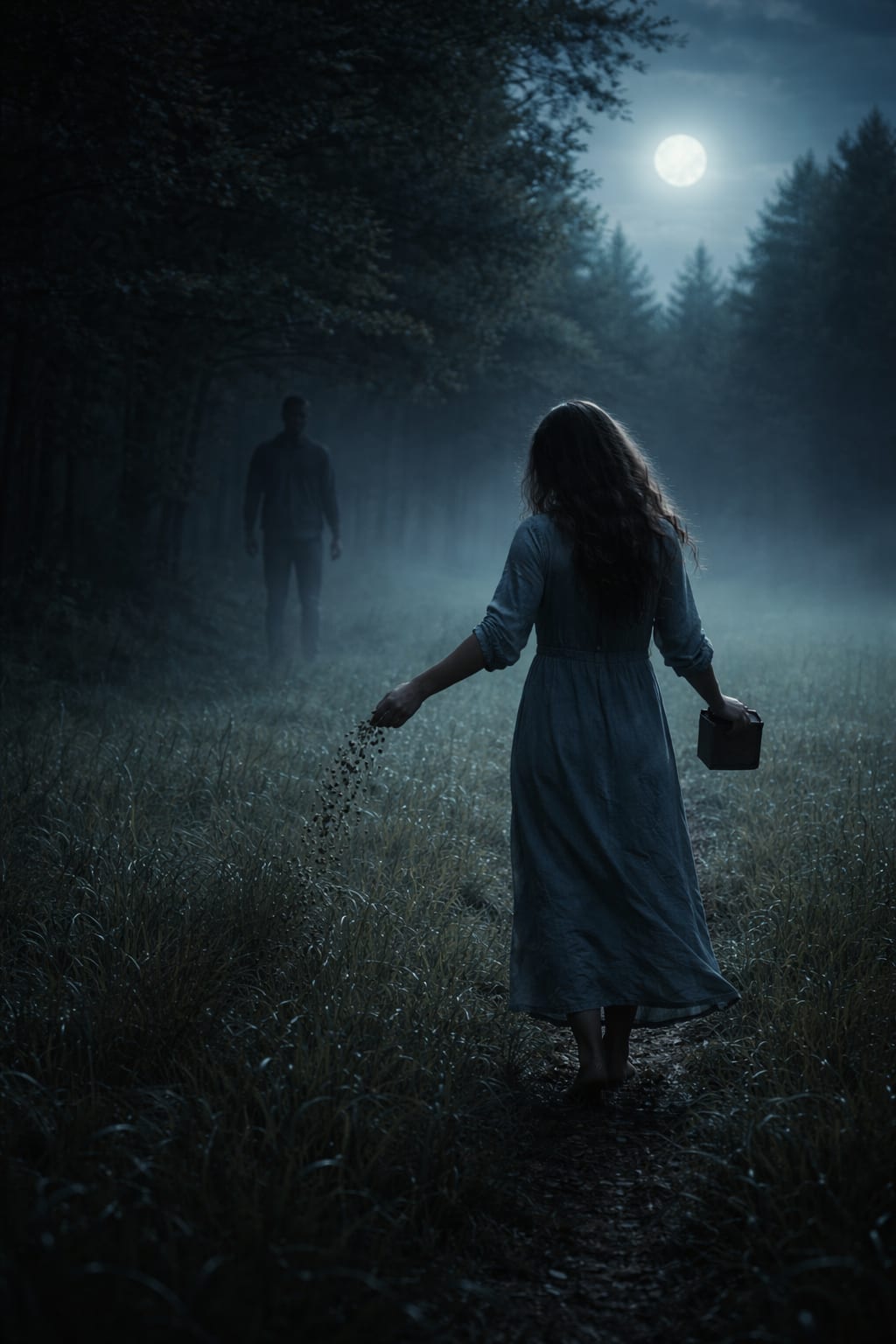
I wasn’t allowed to touch it. I wasn’t allowed to stand too close when she opened it on Midsummer’s Eve. Seed spilled through her fingers like brown rain.
Hemp seed I sow, hemp seed I cast,
He who will be my love at last,
Come rake these scattered seeds for me,
And walk my heart where none can see.
She walked backward through timothy grass, her house dress catching burrs, her bare feet sure on rough ground. She never stumbled and she never looked away from the tree line.
I watched from the porch, knees pulled to my chest. I was ten. I’d asked my mother why Granny did this, and my mother said your grandmother is touched.
Touched meant crazy. Crazy meant we didn’t talk about it.
I watched anyway.
Cade Toller was seventeen when he first looked at me like I was something worth seeing.
I was fifteen. My hair was too long, my jeans too short, my mouth ran faster than my brain. He laughed at something I said and his eyes crinkled at the corners and something caught in my chest, a hook, a line, something pulled taut between us.
“You’re Keener’s girl,” he said.
“I’m Rowan.”
He tilted his head. Sawdust covering his shirt, his arms, the dark sweep of his hair.
“Rowan,” he said, tasting it.
My voice left me. He smiled, like he had all the time in the world.
“Alright, Rowan. I’ll see you around.”
He kissed me for the first time behind the Methodist church.
Revival spilled through open windows, voices rising, tambourines shaking. He pushed me against the siding, and his mouth was warm, and he tasted like wintergreen mints.
“Why you cryin’?” He pulled back.
“I don’t know.”
“You want me to stop?”
“No.”
He kissed me again. Slower.
I went home with a swollen mouth and a chest so full I thought it might split me open. Granny Wise sat on the porch, her rocker creaking, her eyes on the boundary.
“You been with that Toller boy.”
“Yes’m.”
She rocked. Creak. Creak. Creak.
“You love him?”
My face burned. “Yes’m.”
She nodded. Her hands lay in her lap, like she was ready to pray.
“Then you’ll need my seeds.”
I stole the tin that night.
Granny slept, mouth slack, breathing shallow. I dragged a chair to the cabinet and stretched until my fingers caught the edge. It came down easy. Too easy.
I took it to my room. Sat on my bed with the box in my lap, my heart beating against my ribs.
Hemp seed. Brown, ordinary, indistinguishable from the seed my daddy bought in fifty-pound sacks for planting.
Underneath the seed, flat against the bottom, a photograph.
A man. Young, dark haired, smiling at someone just out of frame. His collar too wide, his hair too long, his face too young to be the man I knew only from a faded grave marker.
My grandfather. Arlen Wise. Dead thirty-three years before I was born.
I turned it over. Ink was faded.
He comes every year. I don’t know how. I don’t know why. But he comes.
J. Wise, 1947
Midsummer’s Eve. I walked to the boundary.
My palms sweating and holding the seeds. I’d heard the words every year since I was old enough to understand speech, but my voice locked around them.
Hemp seed I sow, hemp seed I cast,
He who will be my love at last,
Come rake these scattered seeds for me,
And walk my heart where none can see.
I scattered backward. Seed arced through moonlight, fell dark against darker grass. I walked until my heels met porch steps and I couldn’t walk further.
Nothing moved. Tree line still. Pasture empty.
I waited.
Cade Toller didn’t come.
He married Loretta Mayfield the summer I turned eighteen.
I stood at the back of the church, against the same siding where he’d first kissed me. Inside, a voice rose. Dearly beloved. If anyone can show just cause. I put my palms flat against the wood and breathed.
Nobody showed cause.
Loretta came out on Cade’s arm, her dress white, her mouth red, her eyes wet with happy tears. She looked like a bride from a magazine. She looked like everything I wasn’t.
Cade’s gaze swept the crowd. Found me. Held.
His smile faltered for just a second.
Then Loretta tugged his arm and he looked away, and I drove home with my windows up and my radio off and my hands so tight on the wheel my knuckles went white.
Granny Wise died on a Tuesday in November.
I was twenty two. I’d moved three states away. I told people I was pursuing a degree; I told myself I was pursuing a life. I studied folklore because it was the only way I could justify thinking about boundaries and seed and photographs hidden in tin boxes.
My mother called. Your grandmother passed. Peacefully in her sleep.
I flew home. Stood at the grave site. Watched them lower her into the ground that had held her people for a hundred years.
I didn’t cry.
That night, I went through her things. Good dishes, and worn linens. Photo albums with yellowed pages and fading smiles.
Cabinet above the stove was empty.
I searched every room, every closet, every drawer. Crawled under her bed. Stood on chairs and ran my hands along tops of shelves.
The tin box was gone.
I met Elliott at a conference. He was a cartographer. He liked borders and boundaries and clean, sharp lines.
He asked where I was from. I said the mountains of Western North Carolina. He asked what I studied. I said folklore and Appalachian culture.
“Like ghosts?” he asked.
“Like love magic.”
His eyebrows rose. “People really do that?”
I thought of Granny Wise walking backward through timothy grass. I thought of the photograph, the ink, the words I’d never been able to make true.
“They try,” I said.
We got married and we moved back to the property because Elliott wanted to see it, because I couldn’t stay away, because the house sat empty and waiting like a patient dog.
He fixed the roof. Rewired the kitchen. Traced boundary lines onto fresh paper with his pencil with a steady hand.
He didn’t know about the tin box. He didn’t know about Midsummer. He didn’t know about Cade Toller, dead six years now, killed by a logging truck on the mountain road.
I didn’t tell him.
I didn’t tell anyone.
I found it the summer I turned thirty.
Cleaning out the root cellar, Elliott’s idea, good for preserves, my flashlight caught something on the highest shelf. Gleam of worn metal and a shape I knew.
I dragged a crate beneath it. Stretched until my fingers caught the edge.
It came down easy. Too easy.
I opened it.
Hemp seed. Brown, ordinary. Underneath, pressed flat against the bottom, a new photograph.
It was of Granny Wise. Young, maybe twenty. Standing at the boundary with her hair loose and her mouth smiling. Beside her, barely visible, a man’s shape. A smudge of warmth where no warmth should be.
On the back, in her own hand.
He came. He always comes. He always will.
J. Wise, 1948
Midsummer’s Eve. I walked to the boundary.
Elliott was sleeping and I had told him I needed air, space, something. He’d kissed my forehead and rolled over. He trusted me.
With the grass still wet and the tin box warm against my hip.
I opened it. Poured seed into my hands and spoke.
Hemp seed I sow, hemp seed I cast,
He who will be my love at last,
Come rake these scattered seeds for me,
And walk my heart where none can see.
I walked backward. My heels found the same path Granny’s had worn, bare and sure, for sixty years.
Something moved at the tree line.
My heart stopped. My hand froze mid scatter. Figure resolved slowly, shoulders, jaw, shape of a man I’d loved since I was old enough to know what love meant.
Cade Toller stepped into moonlight.
Same broad shoulders. Same shale gray eyes. Same mouth that had said I reckon we will.
“Rowan,” he said.
His voice came from far away. Like he was calling down a well. Like he was calling from the bottom of something deep and dark.
“You’re dead.”
“Nine years now.”
“You didn’t come. That first time. I waited all night.”
His smile was the same.
“You weren’t ready.”
“Ready for what?”
He looked at his own hands. I could see grass through his chest, trees through his shoulders, moonlight through his face.
“To see what you were really calling.”
I went back every Midsummer.
Elliott knew, he had figured it out. He knew I went to the boundary. He knew I stayed hours. He knew I came back changed.
He never asked me about it and I never told him.
Cade got fainter every year. His edges blurred. His voice arrived later. His shape smeared like rain on a photograph.
“What’s happening to you?”
“You know.”
“Tell me anyway.”
He looked at me his eyes were a shale gray color.
“Each time you call, I answer. Each time I answer, I give more of myself. That’s the bargain. That’s the ritual.”
“Then I’ll stop.”
“You won’t.”
He was right. I didn’t.
Elliott asked the year I turned forty.
We sat at the kitchen table with his maps spread before him, fountain pen uncapped.
“Who is he?”
I looked at him. His face calm. His hands still.
“What?”
“Who comes when you walk to that boundary?” In his gentle voice. His eyes not. “Who do you love that much?”
I could have lied. I should have lied. I was so tired of carrying it alone.
“His name is Cade. He died when I was twenty one. I’ve loved him since I was fifteen. Every Midsummer, I scatter seed at that boundary, and he comes to rake it after me.”
Elliott stared at me. His pen dripped ink onto his careful lines.
“He’s dead.”
“Yes.”
“And you love him.”
“Yes.”
Silence, all you could hear was the clock ticking in the bacground. My heart pounded.
“Do you love me?” he asked.
“God, Elliott. Yes. You’re my husband. You’re my home. You fixed this roof. You make breakfast. You hold me when I wake screaming from dreams about my grandmother walking backward through the grass.”
“But you still love him.”
“I’ll always love him.”
He nodded. Once. Twice. His jaw clinched.
“When I die,” he said. “Will you scatter seed for me?”
I couldn't speak.
“Will you walk that boundary every Midsummer and call my name?” His voice cracked. “Will you love me that much?”
“Yes,” I said. “Every year. As long as I live.”
He picked up his pen. Capped it. Folded the map carefully, ink stain and all.
“Okay,” he said.
I am sixty three. Elliott’s hair is white. He walks with a cane. He still makes breakfast. He still kisses my forehead before I walk out the door on Midsummer’s Eve.
Cade is barely visible now. I see him in peripheral vision, in between blinks, in the moment before sleep. His voice comes from so far away.
“You’re almost gone,” I say.
“Yes.”
“Next year?”
He doesn’t answer.
I stand on the boundary. Moonlight pools at my feet. Tin box warm against my hip.
“Will you wait for me?”
His smile is barely a suggestion. His shape barely a shape.
“I’ll be raking,” he says. “You’ll be sowing. We’ll meet in the middle.”
He fades and I stand alone.
I turn toward the house. Elliott stands at the kitchen window, his silhouette looking like a photograph, his hand raised.
I raise mine.
I walk home through grass wet with evening. Seed rattles softly in the tin box.
Next year.
Always next year.
Granny Wise was wrong about one thing.
She said the ritual was about calling. About summoning. About dragging love back across the boundary through sheer force of want.
That’s not what it is.
The ritual is about answering.
Every Midsummer, for sixty-three years, Cade Toller has walked out of those trees. Every Midsummer, for sixty-three years, he has raked the seed I scattered. Every Midsummer, for sixty-three years, he has answered a call that should have died when he did.
That’s summoning, and that’s devotion. That’s love so stubborn it refuses to stay dead.
When Elliott goes, and he will go, we both will, time runs through our grip like hemp seed, I will walk this boundary every Midsummer until I can’t walk anymore.
I will scatter seed. I will speak his name. I will wait for him to answer.
Because that’s what love does.
It answers.
It always answers.
About the Creator
Tim Carmichael
Tim is an Appalachian poet and cookbook author. He writes about rural life, family, and the places he grew up around. His poetry and essays have appeared in Beautiful and Brutal Things, his latest book.
Keep reading
More stories from Tim Carmichael and writers in Fiction and other communities.
What the Moon-Eyed People Left Behind
The story goes that before the Cherokee came to the Appalachian Mountains; there lived a race of pale people who could only see at night. They had large, round eyes sensitive to daylight, and they built stone walls and earthworks across the valleys. When the Cherokee arrived, they drove the Moon-Eyed People west, and that was that. The pale night-dwellers vanished, and the Cherokee claimed the land.
By Tim Carmichael11 days ago in Fiction
Salt for the Returning
The first time Elin came to the shore, she brought too much with her. But it was a lantern, full moon. Bread wrapped in cloth. A knife she did not know how to wield. A little jar of honey, which spilled on her coat pocket, and stuck sandy to everything she came into contact with.
By Edward Smith2 days ago in Fiction
Mismatch Challenge Winners
Blending genres isn’t about stacking elements side by side. It’s about what happens when two sets of expectations refuse to cooperate. The strongest entries in the Mismatch Challenge understood that tension and leaned into it. Rather than smoothing the edges, these stories let their chosen genres complicate one another, creating friction that carried through voice, structure, and consequence.
By Vocal Curation Team3 days ago in Resources


Comments (1)
You've rendered me speechless.