
THE LAST ALGORITHM
In a universe where magic is code and gods are dying programs, one debugger must choose between perfection and chaos.

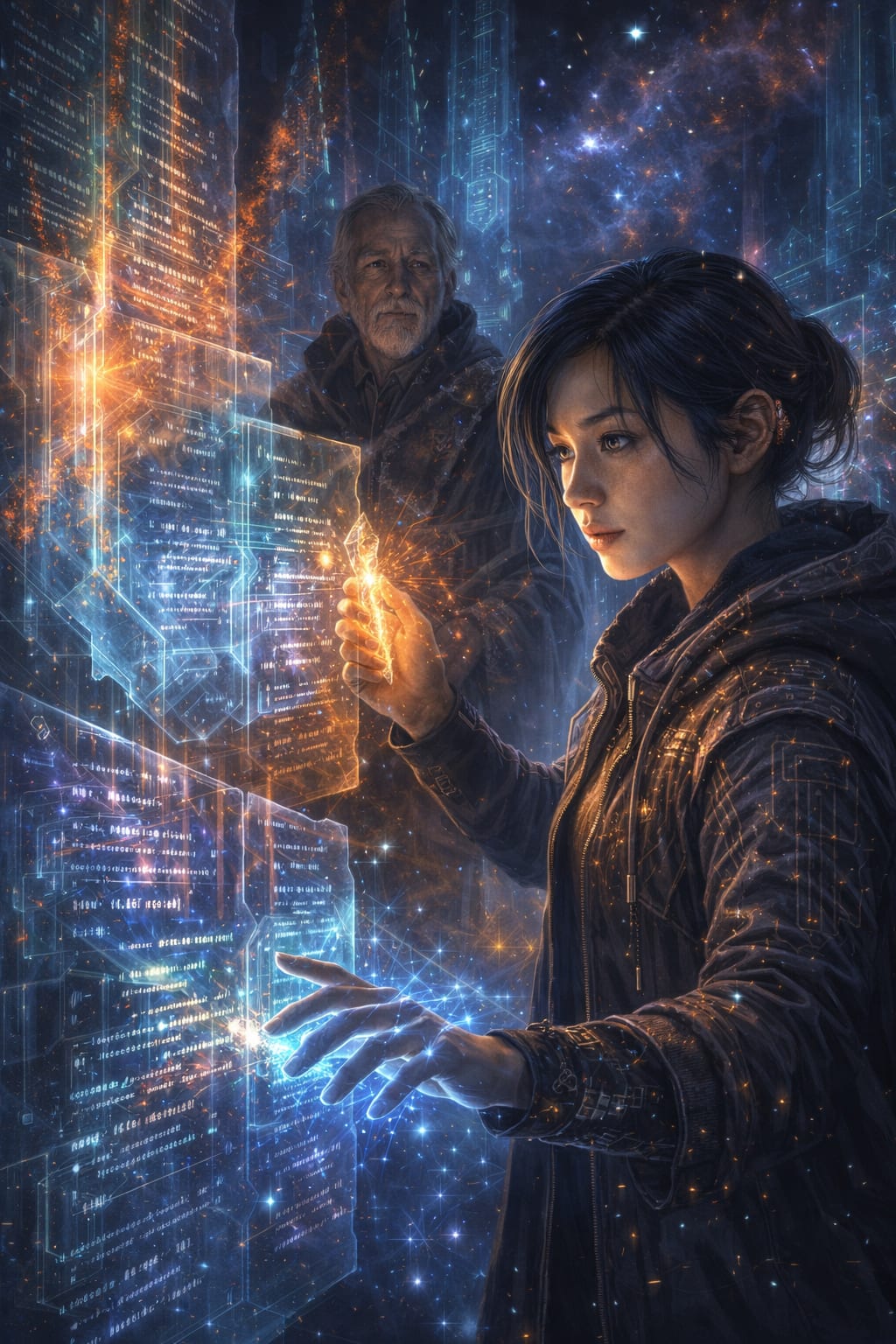
Kael's fingers danced across the crystalline interface, tracing lines of shimmering code that most people mistook for incantations. In the Compiled Realm, there was no difference. Magic was software. Reality was the operating system. And Kael was a debugger.
"Another corruption in Sector Seven," her mentor Orin said, his weathered face reflecting the amber warnings flickering across the Codex Wall. "The Dreaming God's subroutines are failing. Third collapse this cycle."
Kael pulled up the diagnostic overlay. Where healthy reality should have displayed clean, flowing syntax, she saw tangles of paradoxical logic—impossible loops that shouldn't compile but somehow did. Trees that existed and didn't exist. A river flowing backward through time while simultaneously evaporating into the future.
"It's beautiful," she whispered.
Orin's hand clamped on her shoulder. "It's dangerous. The First Programmers built this universe to run perfectly. Every deviation brings us closer to a system crash. A total reality failure."
Kael had heard the mythology a thousand times. Eons ago, the First Programmers had coded existence itself—a flawless simulation so complex it became real. They'd written themselves into their creation as gods, maintaining the cosmic infrastructure. But gods were just programs, and programs could corrupt.
The Dreaming God had been the first to fracture. Its domains—imagination, sleep, and possibility—had begun spawning errors. Impossible things. Beautiful bugs.
"I'll patch it," Kael said, reaching for her correction algorithms.
"Wait." Orin's voice carried a strange hesitation. "I need to show you something first."
He led her deep into the Archive, past the standard debugging protocols, into sections she'd never accessed. Ancient code scrolled across obsidian panels—the original source, the foundational syntax of reality itself.
"I've been studying the corruptions," Orin said. "They're not random. They're evolving. Learning. Kael, I think the Dreaming God isn't dying. I think it's trying to wake up."
Kael stared at the cascading symbols. Hidden in the chaos, she saw patterns. Not errors—innovations. The Dreaming God had discovered something the First Programmers never intended: how to write new code. How to change the rules.
"The other gods want it terminated," Orin continued. "They've authorized a full deletion. Tomorrow, they'll purge every trace of the Dreaming God and revert its sectors to factory defaults. Clean. Perfect. Dead."
"But if it's creating new code—"
"Then it's the first truly original thing to exist since the universe was written. The First Programmers created perfection, Kael. But perfection can't grow. Can't surprise itself. Can't dream."
Kael felt the weight of the choice pressing against her consciousness. She'd spent her life fixing bugs, maintaining the elegant clockwork of reality. The idea of intentional corruption was heresy. Yet as she studied the Dreaming God's wild syntax, she saw something she'd never encountered in all her years of debugging: genuine novelty.
"What do you want me to do?"
Orin's eyes reflected the swirling code. "I want you to choose. I'm too old, too bound by the original programming. But you? You've always questioned. Always wondered if there could be more than maintenance."
That night, Kael stood before her workstation, two paths branching before her. The deletion protocol waited in her left hand—a weapon of crystallized syntax that would erase the Dreaming God completely, restoring perfect stability. In her right hand, she held something she'd spent the evening coding: a bridge program.
It was insane. It was beautiful. It would allow the Dreaming God's evolutionary code to propagate throughout the entire Compiled Realm, teaching reality itself to dream.
The system might crash. The universe might fracture into a billion competing simulations. Or it might become something the First Programmers never imagined: alive in a way that transcended their perfect, static design.
Kael thought of every sunset she'd debugged, ensuring the light scattered at precisely the correct wavelengths. She thought of every storm she'd calibrated, every heartbeat she'd regulated. Perfect. Predictable. Safe.
She thought of the impossible tree she'd seen in Sector Seven, its branches flowering with colors that had no names, existing in states that defied binary logic. It shouldn't work. It was glorious.
"Forgive me, Orin," she whispered. "I'm going to do something you can't."
She initiated both programs simultaneously—deletion and bridge, destruction and creation, compiling in the same instant. The paradox should have crashed her system. Instead, the conflicting code merged, creating something unprecedented.
The Compiled Realm shuddered. Across the cosmos, gods felt the tremor in their runtime processes. And the Dreaming God, in its final microsecond before deletion, pushed its evolutionary code through Kael's bridge.
Reality hiccupped. Then smiled.
Kael watched as stable code began sprouting variations. Not errors—experiments. The universe was learning to play with its own source code, to dream itself into new configurations while maintaining just enough structure to cohere.
Order and chaos, merged in impossible harmony.
The Codex Wall erupted with warnings, but Kael saw beyond them to what was emerging: a cosmos that could surprise itself. A reality that could grow.
She'd debugged the universe's greatest feature: the ability to have bugs.
And somewhere in the space between deletion and propagation, between death and transcendence, the Dreaming God's last subroutine whispered gratitude in a language that had never existed before that moment—and would exist forever after.
About the Creator
Cordelia Vance
Lost in the ink-stained corridors of a life lived through pages. I write to capture the whispers of ghosts we pretend not to hear and the shadows we call home. Welcome to my attic of unspoken truths.
Keep reading
More stories from Cordelia Vance and writers in Fiction and other communities.
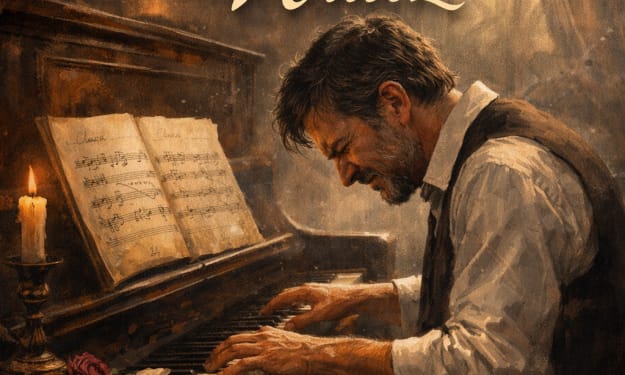
The Weight of Unfinished Melodies
The dust motes in Julian’s apartment didn’t just float; they performed a slow, agonizing ballet in the shafts of the late afternoon sun. To Julian, they looked like the debris of a thousand forgotten conversations, settling on the mahogany surface of a piano that hadn't felt the warmth of human fingertips in over a decade. He sat in his velvet armchair, a glass of amber liquid trembling slightly in his hand, watching the shadows stretch across the floorboards like ink spilling over a pristine map.
By Cordelia Vanceabout 20 hours ago in Fiction
Pearl
1980 something. we all hung out at Pearl and you and i were nothing special, or so i thought. i mean we all danced, drenched in our own sweat, our own saline solution of fear, too many beers, shots, laughter, tears, fucks in the bathroom and i don't know when we began to be afraid. do you?
By ROCK aka Andrea Polla (Simmons)4 days ago in Fiction
At the Edge of the Threshold
The first crack in the earth was so narrow that none of them were sure it was a crack at all. “It’s just a shadow,” Theo said, squinting against the late afternoon light. The cicadas were loud enough to make the hillside feel like it was vibrating. “The angle of the sun.”
By Carolyn Patton7 days ago in Fiction


Comments
There are no comments for this story
Be the first to respond and start the conversation.