
The Clockmaker’s Secret
Some hearts tick like clocks — waiting for the right moment to be wound again.
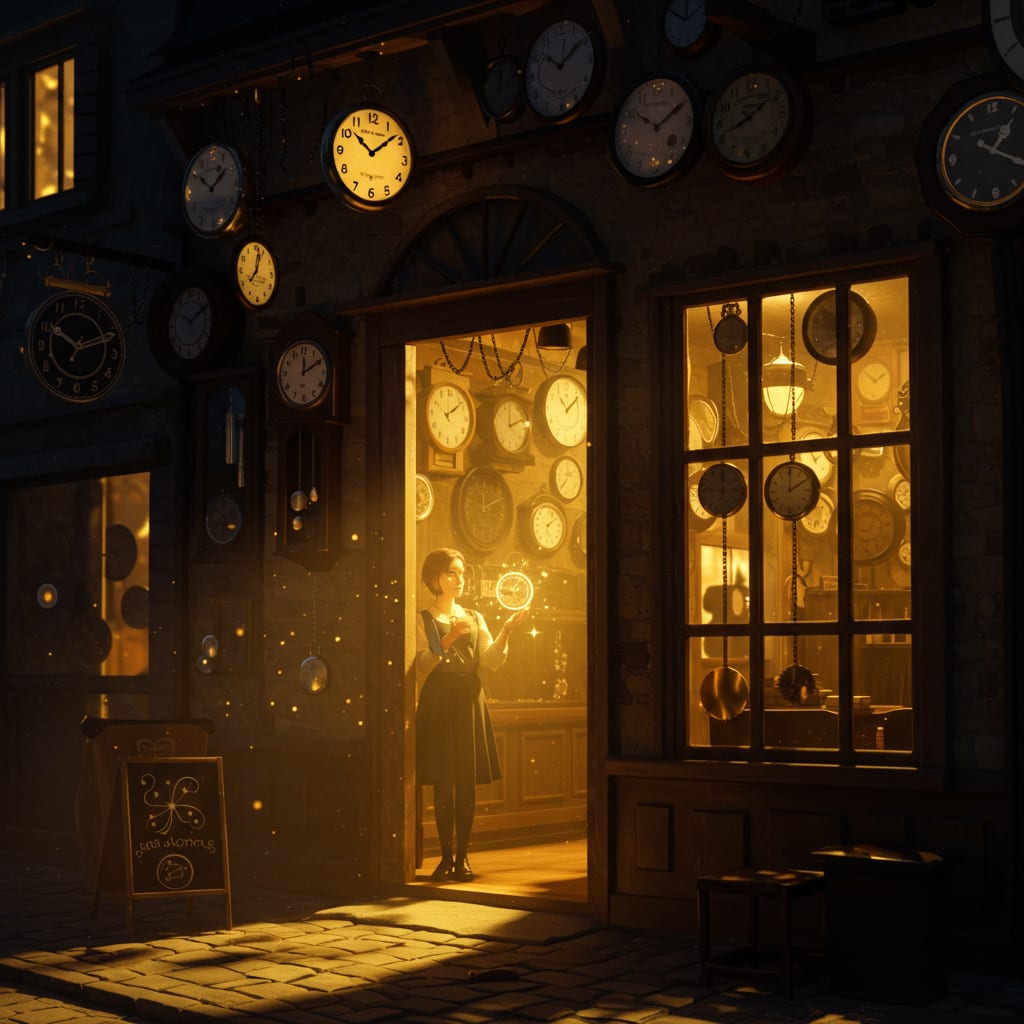
Tucked at the end of Wren Hollow Street, between a forgotten tea shop and an ivy-covered antique store, stood a little workshop with a faded sign that read:
“E. Morrow — Clocks & Curiosities.”
Most people didn’t notice it. Those who did often passed by, mistaking it for abandoned. But every evening at precisely 5:33 PM, a soft golden glow spilled from its windows, accompanied by the gentle ticking of hundreds of clocks — each perfectly synchronized.
Clara Bellamy noticed it.
She had just moved into her aunt’s crumbling house down the road after a long, lonely year of losing things: her job, her fiancé, her faith in happy endings. She didn’t know why the little shop pulled at her heart like a memory she hadn’t lived yet. But on the third rainy afternoon of her new life, curiosity won.
She stepped inside.
The air smelled like cedarwood and brass. Tiny ticking filled the space like a soft symphony, echoing through a forest of clocks — wall clocks, pocket watches, cuckoos, grandfather clocks, and strange timepieces shaped like birds, stars, even keys. All ticking in perfect time.
Behind a counter sat an old man with silver spectacles and a velvet vest. He looked up and smiled without surprise, as if he’d been waiting for her.
“You’re late,” he said gently.
Clara blinked. “Excuse me?”
“Not by much,” he said, standing. “But a heart like yours usually arrives a little sooner. No matter — you’re here now.”
She hesitated, unsure if she’d walked into a repair shop or a dream. “I just... I saw the sign.”
“Most don’t,” he said, “unless they’re looking for something they’ve lost.”
She opened her mouth to argue — but something about the way he said it made her pause.
“I’m not here to buy a clock,” she finally said.
He chuckled. “That’s good. I don’t sell them. I mend what’s broken. Tick by tick.”
He turned and disappeared behind a curtain. When he returned, he held a strange little pocket watch — silver, with vines engraved along the edge, and a faint glow in its center.
He offered it to her.
“It’s yours.”
She stared at it. “I’ve never seen this before.”
“Not in this life,” he said softly. “But it belongs to you. You left it behind once, when your world fell apart.”
Clara stared at the watch. The hands weren’t pointing to numbers, but to little symbols: a star, a tear, a feather, a door, and a heart. The ticking grew louder as she held it.
“What does it do?” she whispered.
“It remembers,” the clockmaker said. “And it guides. When hearts are too broken to trust themselves, sometimes they need a map.”
Suddenly, the little heart-shaped hand shifted — pointing directly to the door symbol.
The man smiled. “Time to begin again.”
---
That night, Clara dreamed of a garden from her childhood — one she hadn’t visited in twenty years. She saw herself, age seven, burying something shiny beneath a cherry blossom tree. When she woke, her fingers tingled.
By noon, she was in her old neighborhood. The tree was still there, bent but blooming. She dug with her hands, ignoring the dirt under her nails, until her fingers struck metal.
A locket.
She opened it to find a tiny sketch of her parents — smiling, young, alive.
Tears welled in her eyes.
She had forgotten this memory. Forgotten how safe love could feel. The watch ticked gently in her pocket.
The next day, the hand pointed to the feather. She visited her old ballet school, long closed. In a dusty locker, she found her childhood journal, full of dreams she had abandoned. On the last page, she’d written:
“One day, I will be brave again.”
Each symbol led her to a forgotten piece of herself — a note from an old friend, a letter she never sent, a poem her mother once wrote. Day by day, she felt her spirit stitching itself whole again.
And every evening, she returned to the shop.
The clockmaker — whose name she still didn’t know — would nod, make her tea, and say nothing unless she wanted to talk. He was part mentor, part magician, part memory-keeper.
One evening, she asked him: “Why do you do this?”
He looked at her, his eyes distant. “Because once, someone wound my heart back to life. This shop isn’t mine. It belongs to time — and those brave enough to reclaim it.”
Then, something changed.
The next day, the watch’s heart hand stopped ticking.
She ran to the shop — but it was dark.
The sign was gone.
Inside, the clocks had all stopped. Dust covered the shelves. The golden glow was gone, as if the shop had never been there.
Except… the pocket watch still ticked in her palm.
And inside it, now engraved, were the words:
“For Clara. Time is not lost. Only waiting.”
About the Creator
Keep reading
More stories from Bilal Ahmad and writers in Fiction and other communities.
Winterthorne
Winterthorne stood alone at the edge of the park. The beautiful snow that had surrounded him was all trampled now, from the feet of all of the children who had built him. He missed the sparkly clean snow blanket, but he was happy that so many children had come out to make him.
By Laura DePace3 days ago in Fiction
What We Chose Not to See
The morning the cracks appeared, no one said a word. It started with the sound. A thin, splitting noise like glass bending under pressure. I heard it while brushing my teeth. The mirror above the sink trembled slightly, but when I looked at it, my reflection stood steady. Calm. Ordinary. Behind me, however, a thin black line ran from the ceiling to the floor. I blinked. It was gone. At breakfast, my mother spread butter across toast as if the world had never once disappointed her. “Did you hear that?” I asked. “Hear what?” she replied, not looking up. “That sound. Like something breaking.” She smiled faintly. “Old houses make noises.” Our house wasn’t old. I wanted to argue, but my father folded his newspaper with precise movements and stood up for work. The headline read: CITY REPORTS RECORD STABILITY Outside, the sky was pale gray. Not cloudy — just colorless, like someone had erased the blue. The air felt thick in my lungs. On the way to school, I noticed something else. The streetlight at the corner leaned slightly to the left, its metal pole twisted unnaturally. Cars drove past it without slowing. A woman pushing a stroller walked directly beneath it without glancing up. Didn’t they see? Or were they choosing not to? At school, the cracks were everywhere. A long fracture ran across the classroom wall, jagged and dark. The clock above the board ticked backward for three full seconds before correcting itself. No one reacted. Mr. Halpern continued explaining supply and demand as if time reversing was part of the curriculum. I raised my hand. “Sir, the clock—” He didn’t look at it. “Focus on your notes.” “But it just—” “Everything is functioning normally,” he said firmly. The class nodded. I stopped talking. By afternoon, the air outside carried a faint smell of smoke. Not strong enough to cause panic. Just noticeable enough to make breathing uncomfortable. People walked with their usual rhythm. They checked their phones. They laughed. They ordered coffee. The café windows reflected the street, but something was wrong with the reflections. Buildings looked taller in the glass. Skewed. Like they were stretching upward beyond the sky. I stepped closer to look. In the reflection, I wasn’t alone. Behind me stood a crowd of faceless figures. Perfectly still. Watching. I turned. The street was empty. When I looked back at the glass, the reflection was normal again. A barista tapped on the window from inside. “We’re closing early.” “Why?” I asked. She hesitated. Just for a second. “Maintenance.” Smoke drifted faintly above the rooftops. No alarms sounded. That night, the cracks returned. This time they didn’t disappear. They spread across the ceiling like lightning frozen in place. My bedroom light flickered. The air hummed. From downstairs, I heard my parents talking in soft, measured voices. “…it’s spreading faster.” “…don’t scare him.” “…if we act normal, it stabilizes.” I froze. If we act normal. Stabilizes what? The humming grew louder. A picture frame fell from the wall, its glass shattering against the floor. I ran downstairs. The living room ceiling had split open. Not wide — just enough to reveal darkness beyond it. Not night sky darkness. Not empty space. Movement. Slow. Shifting. Breathing. My mother stood beneath it with her arms crossed. “Mom,” I whispered. “You see that, right?” She didn’t look up. “See what?” “The ceiling!” “It looks fine.” My father placed a hand on my shoulder. His grip was firm. Too firm. “Listen to me,” he said quietly. “Nothing is happening.” “But it is.” He leaned closer. “The more you acknowledge it, the worse it becomes.” The crack above us pulsed. Dust fell like ash. I felt something inside me twist. “So we just pretend?” “Yes,” my mother said gently. “That’s how we’ve always survived.” Survived what? The house groaned. The next morning, half the sky was gone. Where blue should have been, there was only blankness. Not clouds. Not storm. Just absence. News channels played cooking shows. Social media was full of selfies under a disappearing sky. #Blessed #AnotherBeautifulDay The city continued moving. I stood in the center of the street and stared upward. The blank space spread slowly, swallowing color inch by inch. Birds flew into it and never came out. A man beside me checked his watch. “Traffic’s bad today.” “Look up,” I said. He frowned. “At what?” The blankness crept closer to the sun. Shadows sharpened. Windows began cracking outward. Still, no one screamed. My chest tightened. Maybe they were right. Maybe acknowledging it made it worse. Maybe silence was safety. A loud snap split the air as the leaning streetlight finally broke in half, crashing onto a parked car. People stepped around it casually. I looked at the sky again. It was nearly all gone now. Only a thin strip of blue remained, trembling like fragile glass. My reflection appeared in a nearby shop window. Behind me stood the faceless crowd again. But this time, they weren’t watching. They were fading. And in the reflection, I saw something else. Cracks spreading across my own skin. Thin. Dark lines tracing my arms. I touched my face. Smooth. Untouched. But in the glass, I was breaking. The last piece of blue sky shattered without sound. Everything turned white. Blinding. Endless. I waited for panic. For screams. For collapse. Instead— Voices. Calm. Measured. “Beautiful morning.” “Everything’s fine.” “Nothing unusual.” The white brightness softened. Buildings reappeared. The sky returned — perfect blue. No cracks. No smoke. No blankness. The streetlight stood upright again. The car was undamaged. People walked past me with mild annoyance. I rushed home. The ceiling was whole. The walls smooth. My parents sat at the table drinking coffee. “Rough night?” my mother asked lightly. “You remember it,” I said. “You have to.” My father folded his newspaper. The headline read: CITY REPORTS RECORD STABILITY He met my eyes. “For things to remain,” he said carefully, “some things must go unseen.” My reflection in the window smiled before I did. And that was when I understood. The cracks hadn’t been in the world. They had been in me. And everyone else had learned the secret long ago: Ignore the fracture. Ignore the smoke. Ignore the missing sky. Because if even one person refuses to pretend— The illusion breaks. And maybe the world with it. So I sat down. Picked up my cup. Looked at the perfect ceiling. And said nothing.
By Inayat khan7 days ago in Fiction
Goodbye, Mr. Duvall
It is turning out to be an interesting year. I was in the middle of teaching a class when a pop-up appeared on the screen announcing the death of Mr. Robert Seldon Duvall (yes, that was his full name). I was in the middle of a discussion on the obsession we have with winning when it comes to sports (the Winter Olympics was a theme), and I felt as though things were coming full circle. We had already lost Gene Hackman last year, and along with that titan, it feels though one particular golden age has closed off to be replaced by...?
By Kendall Defoe 8 days ago in Geeks




Comments
There are no comments for this story
Be the first to respond and start the conversation.