
PART 1
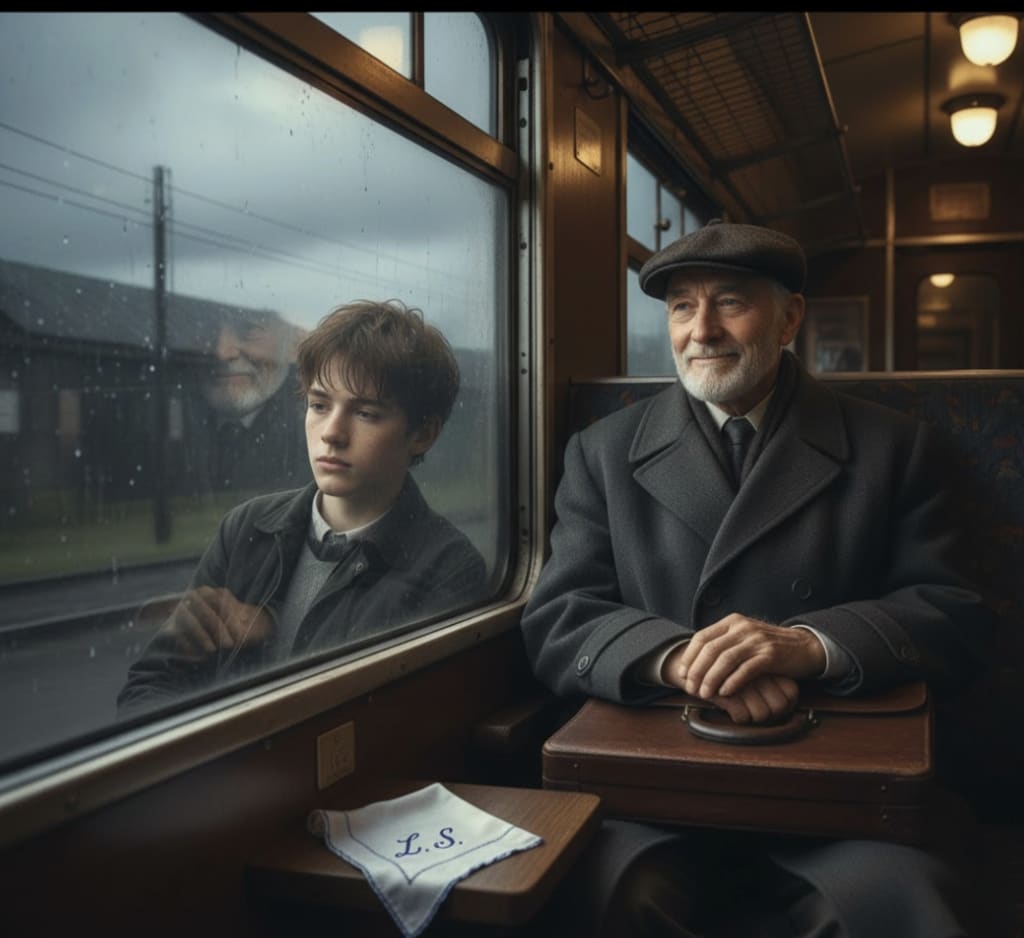
The 4:12 to Darlington was a vessel of tired echoes. It smelled of damp wool, industrial floor cleaner, and the peculiar, metallic scent of impending rain. Leo sat by the window, his forehead pressed against the vibrating glass, watching the industrial outskirts of the city blur into a smudge of grey and rust. He was sixteen, a huddle of sharp elbows and bruised pride, clutching a backpack that felt heavier than it actually was.
The compartment remained empty until the very last second. Just as the doors hissed to a close, an older man stepped in. He wore a charcoal overcoat that had seen better decades and a flat cap pulled low. He didn't look like a stranger; he looked like a piece of furniture that had been moved from one room to another—settled, silent, and inevitable. He sat directly opposite Leo, grunting a soft "Good evening" that Leo barely acknowledged with a non-committal grunt.
For three stations, the only sound was the rhythmic clack-clack of the tracks and the whistle of wind through a faulty window seal. Leo tried to disappear into his hoodie, staring at his own reflection in the darkening glass.
"The math test didn't go as well as you hoped, I take it?" the man said suddenly.
Leo snapped his head up. His pulse spiked, a sudden heat rising to his neck. The man wasn't looking at him; he was staring out at the passing hedgerows, his liver-spotted hands folded neatly over a leather briefcase.
"Excuse me?" Leo asked, his voice cracking slightly.
"The way you're chewing your thumbnail," the man said, gesturing vaguely. "It’s a specific kind of nervous habit. Usually reserved for quadratic equations or people you’re afraid to disappoint. At your age, I’d wager the math. The disappointments come later, and they’re much harder to solve."
Leo tucked his hand into his pocket, his face flushing. "I don't know you."
"Just a fellow traveler," the man said. His voice was gravelly, but it had a strange, melodic cadence that felt like a song Leo had heard in a dream once. "I’ve spent a lot of time on this specific line. You get to recognize the patterns. For instance, I know that at the next bend, you’re going to want to check your phone for a message from Sarah. Don’t. She’s at her aunt’s. The reception is terrible there, and she’ll only reply tomorrow morning. Save yourself the battery."
Leo stared at him, his mouth slightly open. The rational part of his brain told him to get up and move to another carriage, to find a conductor, to do anything other than sit across from this person. But there was something about the man’s posture—the way he leaned into the curve of the train as if he knew exactly when the tilt was coming—that kept him anchored.
"How do you know about Sarah?" Leo whispered.
"People are remarkably predictable," the man replied easily, finally turning to look at Leo. His eyes were a faded, watery version of Leo’s own, tucked behind a dense web of wrinkles. "And you look like a Leo. Or a Leonard. But you hate Leonard because it sounds like a man who owns a hardware store. So, Leo it is."
"This is weird," Leo said, though he didn't move.
"Is it?" The man leaned back, his coat rustling. "We share breath in these tin cans, we swap stories without speaking. It’s only weird if you decide to be a stranger to yourself. I’m just offering a bit of perspective from someone who’s seen the end of this particular track."
They fell into a rhythm then. The man spoke of things that sounded like generic advice but hit Leo with the force of a targeted strike. He spoke about the bridge over the Ouse and how the light hits the water in October. He spoke about the specific, hollow sting of a father’s silence. He spoke about a dog named Buster who would live to be fourteen and die on a Tuesday in the sun.
"You talk like you know everything that's going to happen," Leo said, his skepticism finally bubbling up through his fear.
"Not everything," the man corrected. "Just the things worth remembering. The rest is just noise. You’ll learn to filter it out. You’ll learn that the day you forgot your lines in the school play wasn't the end of the world, even though it feels like it right now."
Leo looked down at his shoes. "I didn't tell you about the play. That was three years ago."
"Time is a funny thing on a train," the man said gently. "It stretches and folds. Take a breath, kid. The middle chapters are much better than the beginning."
The train began to slow, the brakes shrieking as they approached the outskirts of Leo’s village. The man stood up, moving with a stiff-jointed grace that seemed to cause him a flicker of pain in his hip—the same hip Leo had landed on during a football match last month.
The man reached into his breast pocket and pulled out a small tin of mints, offering one to Leo. As he withdrew his hand, a small, folded square of fabric came with it, fluttering onto the seat between them.
Leo picked it up to hand it back. It was a white silk handkerchief, yellowed at the edges with age, smelling faintly of cedar and peppermint. In the corner, stitched in a shaky, amateur hand, were the initials L.S. in a very specific shade of midnight blue.
Leo’s heart stopped. He felt the phantom weight in his own pocket. He reached in and pulled out his own handkerchief—the one his grandmother had embroidered for him when he was a toddler, the one he had carried every day of his life like a talisman. He laid it on the seat next to the man’s.
They were identical. There was the same slight tilt to the 'L,' the same accidental knot in the 'S' where the thread had bunched, the same specific midnight blue silk. But while Leo’s was pristine and white, the man’s was a map of a lifetime—stained with a faded tea spot, frayed at the hem, and softened by a thousand washes. Leo looked up, his breath catching in his throat, but the man was already stepping through the sliding door onto the fog-shrouded platform. By the time Leo reached the window, the station was empty.
About the Creator
Marce
I live a slow, peaceful life in the UK, fueled by books and long walks with my dog. I believe the best stories aren't always the loudest, but the ones that linger long after the final page is turned.



Comments
There are no comments for this story
Be the first to respond and start the conversation.