

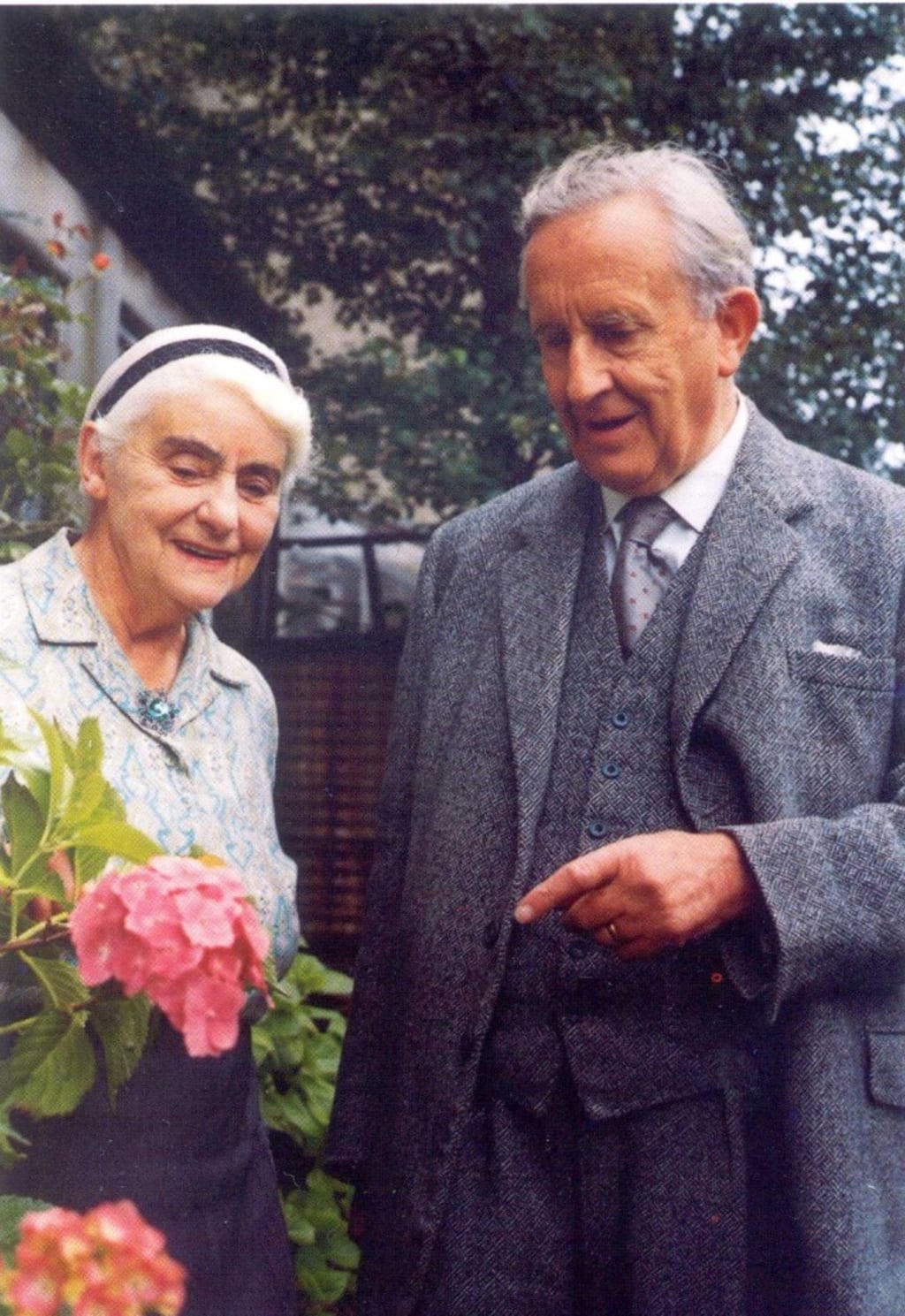
Long ago when two hobbits roamed the world,
carrying the fate of dwarves, elves, and men,
striving for freedom, a new earth unfurled,
the Dark Tree withered, the White bloomed again.
Yet, the Dark could ne’er be felled forever,
but once again fall swiftly as the rain.
The kings of men, now in each endeavor,
have minds of metal, without regard for
growing things nor loving life together.
Internal combustion gave rise to war,
created as faster modes of travel,
but tanks, bombs, dominance lie at man’s core.
Yet, a small rivulet runs from the West,
carrying a reed basket with new hope,
a heart-shaped locket from Taniquetil blest,
found by Edith lovely, the beautiful
maiden, the last of Arwen’s elvish line,
to return to men the great musical
of creation, the Ainur’s wondrous Song.
The locket she wore, unseen by all men,
as the three elven rings of ages long
ago, shall support her, to kindle hearts
in a world that was once again grown chill,
to shield simple life, heal the broken parts.
The locket set her apart from man’s race;
imparting to her the ancient magic,
she caught the eye of John Ronald by grace,
he, the last of Beren’s old, gnomish men,
who touched a Silmaril and was not burned,
keeper of knowledge that flowed from his pen.
For him she gave up the world, her old faith,
to embrace older, mysterious wonders
by his side always and in his love bathe.
Her sacrifice he never did forget,
as Beren of old fought Morgoth so brave,
the hand of bless’d Luthien he did get.
She was his light, strengthening both his hands,
to write of the ages long since vanished
from all of England’s sunlit but chilled sands.
A country with a lost mythology,
speeding to the future, not looking back,
enthralled by the newest technology.
A world enslaved by hubris, his lament,
so by the pow’r of Yavanna’s locket
he did build an eternal monument,
a firm rock on which all may stand,
loving God’s earth, nature and all who dwell
in it, unswayed by technology’s sand.
The Elves came forth by the holy God’s breath,
the firstborn of his children did they come,
ever-live, untouched by natural death
while the earth did last, children of nature.
Dwarves, children of earth, came first but second,
born from impatience but fellow-creatures
made live by humility but would strive
in pride against the firstborn of Eru
till in each immortal glories revive
at dawn of Men, Eru’s youngest children.
To Men he gave strange gifts, mortality,
driven to leave their mark as earth’s pilgrims,
to create their own world even as he.
From poets to architects, astronauts,
remaking the earth, sprouting a new tree,
looking toward the future, their grandchildren,
ever making countless sacrifices
improving themselves, their world they’re building.
Yea, but the shadow of Morgoth covers
the young race and never completely lifts,
but only can twist, never discovers
anything on its own apart from God.
Only when Men create but live as Elves
will the paths of Earth and Valinor trod
together, God and Men and Elves as one
under the heavens, the greatest city
seen as of yet by none, and yet, begun
through Edith, her locket, John Ronald’s pen,
immortal love through undying ages.
They call all men to repentance again,
to cast their Precious away, look to him,
shining Eru with his arms stretched e’er-wide,
or else be consumed by desire and dim,
burning in fire that destroys the Precious.
Let none now fear to leave this world behind,
leave Precious in the East, see the gracious
land of Valinor and sail to the West,
nevermore to feel the burden of guilt
hanging about the neck and at last rest.
Edith, she changed his life, his childhood love,
and he gave all a new mythology,
of life, death, and woes made right from above.
Of hapless children of Hurin he wrote,
striving against Morgoth, their lives ruined,
but in the Song Turin has the last note.
He whom the Black Hand deceived and destroyed,
dealt the dragon Glaurung the final death blow,
and laughs at the end of time when the Void
releases Morgoth, that Black Hand, old foe,
to meet his final end at Turin’s hand,
destroyed by test’mony’s word long ago.
John Ronald saw the desolation of
world wars, Angband rise again among Men,
as bombs dropped, captives mourned, yearning for love.
The gloom had gathered, the darkness growing,
the light of Valinor seemed to dim from
the world, sickness on evil wind blowing.
But softly in the gloom, Edith heard birds,
singing afar as from old Nargothrond,
magic and might that he put into words,
that sang a song of strength and of staying,
of resistance, freedom, trust unbroken,
even as the will of Men was swaying.
Men yearned ever for immortality,
as the Numenoreans in ages
long ago, on their terms, their vanity.
Rather than building for his future line,
each man tenaciously held to his life,
refusing to yield to passing of time
and longing to rise above death itself,
desiring to create and be anchored
to the world, living as both Man and Elf.
“Ye must choose,” says Manwe to Elves and Men,
mortals create but immortals depart,
Elrond, Elros, bless’d Luthien, Arwen.
Immortals that remain will fade away
to a rustic people of vale and glen,
to be forgotten at the break of day.
Men that seek immortality on their
terms will fade and be forgotten the same,
vanishing as a mist upon the air,
making no mark or imprint of their lives
upon souls of generations that come
later as ev’ry new age soon arrives.
But for Men who live to build and create,
artists, poets, architects, and painters,
they shall find true life, remembered by Fate
in the lives of those who bear their image,
working together to build a better
future for all till Heav’n and Earth finish.
From Yavanna’s locket on Edith’s heart,
the Song came rushing on wind from Manwe,
knitting two souls together, ne’er apart.
John and Edith Tolkien, two names that fly,
immortal names and forever enshrined
in the halls of Mandos, never to die.
About the Creator
Michael Kelley
Check out more of my poetry on Facebook and Instagram, @michaelkelleypoetry
Keep reading
More stories from Michael Kelley and writers in Fiction and other communities.
Super Bowl LX Recap: A Team Called Hawks
Sixty. The Super Bowl turned 60! Still amazes me that this was the sixtieth Super Bowl played in NFL history. It seems like yesterday that I watched Super Bowl XXVII, the first SB I ever watched. The QB who won Super Bowl XXVII has since called a few SBs, and will call next year's game, but that's another story. Super Bowl LX took place at Levi's Stadium in Santa Clara, California, the home stadium of the San Francisco 49ers. However, it was one of their division foes who represented the NFC, as the Seattle Seahawks faced off against the New England Patriots.
By Clyde E. Dawkins5 days ago in Unbalanced




Comments
There are no comments for this story
Be the first to respond and start the conversation.