humanity
Humanity begins at home.
The Empty Mansion and the Small Hut: A Lesson in True Wealth
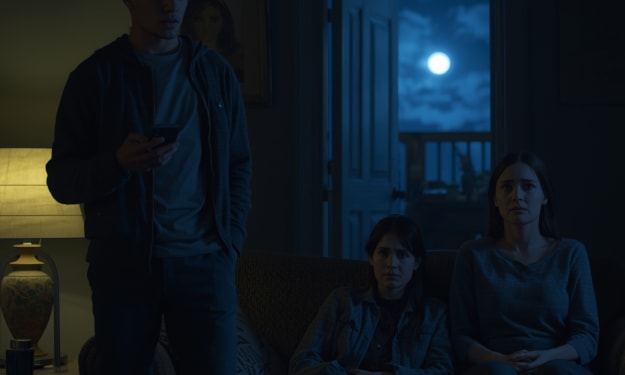
By Hazrat Umer Why having everything money can buy might still leave you with nothing. I once knew a man named Sameer. Sameer was a very successful businessman in 2020. He had everything a person could dream of: a giant mansion with marble floors, three expensive cars, and a bank account that never ended. He was always busy, moving from one meeting to another, his phone ringing every second. People looked at him and said, "He is the luckiest man in the world."
By Hazrat Umerabout 6 hours ago in Families
The Cracks in Our Walls: Why Our Homes Have Lost Their Peace
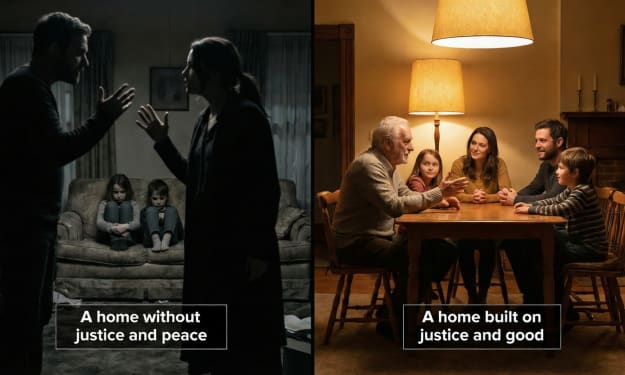
By Hazrat Umer The Secret to a Happy Family: Why Justice and Character Matter More Than Money Today, if you look at almost any house, you will see a sad reality. On the outside, the house looks beautiful. But on the inside, there is no peace. In almost every home, people are fighting. Parents are arguing with children, brothers are fighting with sisters, and married couples are struggling to stay together.
By Hazrat Umerabout 11 hours ago in Families
Wait, is it okay not to go home for the Holidays?
Kids these days are choosing to stay home rather than see their parents or their other family members for the holidays. I found it a bit absurd and tried to explain that it is important to bond with family, because you don’t know when you'll see them again, until someone called me out for not having visited my family in over 20 years.
By stephanie borges2 days ago in Families
The Silent Rooms: Life Without Children
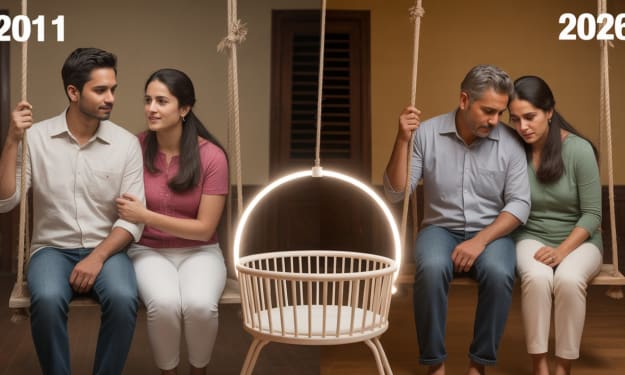
By Hazrat Umer A True Story of Marriage, Hope, and the Empty Cradle I got married in 2011. It was a year filled with the kind of joy that is hard to put into words. Like every young man, I had dreams. I remember sitting with my wife in our new home, talking about the future. We didn't just talk about our careers or our travels; we talked about the children we would one day hold in our arms. We imagined the sound of tiny feet running down the hallway. We even thought about names. In 2011, the world felt like it was at our feet, and the promise of a big, happy family felt like a certainty.
By Hazrat Umer3 days ago in Families
A True Story from Damascus I was 19 years old.. Content Warning. AI-Generated.
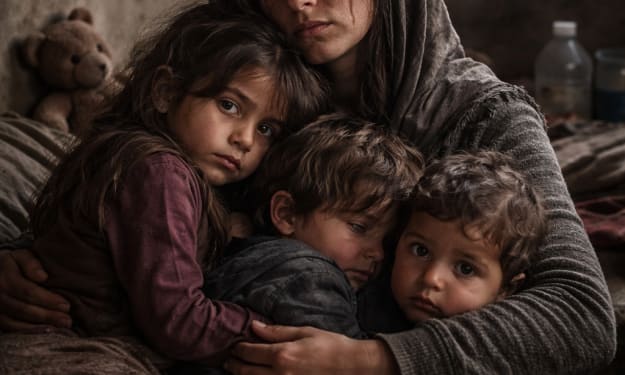
A True Story from Damascus I was 19 years old. October 6, 2013. I was arrested when I was nineteen. Today, I am 32 years old and I have three children. I am their mother, but I do not know who their father is. “Nour” was just a nineteen-year-old girl living on the outskirts of Damascus when spring began to bloom in a different color. She was not interested in politics as much as she was devoted to her university studies and her simple dreams—dreams woven between the scent of jasmine and the sounds of music. But the violent winds of change asked no one about their dreams. On that fateful day, she was doing nothing more than delivering medical and food aid to a besieged area. A purely humanitarian act suddenly turned into a grave accusation. It was a fleeting, blurred moment; she barely understood what was happening before she was violently dragged away and thrown into a cold, dark cell. Nineteen years of age became just a number before the power of silent walls. Nour disappeared. Her name disappeared. Her dreams and the jasmine of Damascus vanished from her life. She became nothing more than a number, a pale shadow in a place that knew no mercy and never saw the light of the sun. Years of loss and darkness—years of imprisonment in Syria—are not merely time passing. They are a history of brutal experiences that reshape a human being from their ashes. Nour resisted forgetting. She resisted despair and tried to cling to a thin thread of her humanity. But the circumstances were stronger. Under constant intimidation, torture, and fear, the sense of time itself began to dissolve. When Nour finally emerged, after years whose true number only God knows, she was a different woman—one carrying invisible scars and a fragmented history that could not be told. She no longer knew anything about life outside those walls. She was now in her thirties and carried with her a heavy, almost impossible secret. The Mystery of Motherhood and a New Life Today, Nour is 32 years old. She is the mother of three children who fill her life with noise and warmth: a six-year-old girl, a four-year-old boy, and a two-year-old toddler. They are her life, the light of her eyes, and everything that still gives her meaning. Yet every day carries a question like a silent dagger that tears at her from within: Who is their father? During the years of detention and loss, Nour lost the ability to determine the identity of her children’s fathers. She does not know which child was the result of which period or which circumstances she endured. Each child is a miracle born from the womb of suffering, and each one carries a fragment of a lost truth. Nour now lives in a country of asylum, desperately trying to build a wall of protection between her children and the past that continues to pursue her. She knows they will not ask today, but she fears tomorrow—the day they will ask the hardest question of all: “Mom, who is my father?” She is a complete mother—loving, sacrificing, and struggling—but she carries the burden of a secret born in a time of war and darkness. Her three children are proof of her survival, yet they are also a silent testimony to the heavy price paid by that girl whose only fault was that spring came to her at the wrong time. And so, life goes on. Nour does not search for answers in the painful past; she searches for the strength to build a future where her children’s laughter overcomes the silence of memories. This is a true story that took place in Syria during the era of the fallen Syrian regime. No artificial intelligence websites were used except for the metaphorical imagery of the story. I hope for your moral support to continue.
By ADAM KARTER4 days ago in Families
What Fathers Uniquely Provide
The Error of Treating Parenting Roles as Functionally Identical Modern parenting theory often begins with the assumption that mothers and fathers are largely interchangeable, differing only in style or temperament. From this view, any deficits in one parent can be compensated for by the other through increased emotional effort, sensitivity, or presence. Parenting becomes a question of intention and quantity rather than function and role. This assumption is appealing because it aligns with cultural preferences for symmetry and fairness, but it collapses under closer examination of developmental outcomes.
By Peter Thwing - Host of the FST Podcast4 days ago in Families
From the Rainy UK to the Sunny Italian Soul: My First 100 Days 🇮🇹
At the age of 20, I left Poland with a head full of dreams and moved to the United Kingdom. I spent a decade there—ten long years of growing up, learning the British way of life, and getting used to the grey skies and the fast-paced, often solitary lifestyle of the Isles. But recently, I decided to follow my heart. Driven by a long-distance relationship and a spark of intuition, I traded my stable life in the UK for a country I knew almost nothing about.
By Piotr Nowak4 days ago in Families