
Why Products Get Ignored on Retail Shelves (And How Brands Can Fix It)
This blog will help to understand through the store merchandising techniques, retail marketing strategies and shelf placement strategies to increase the point of sale visibility of your product.

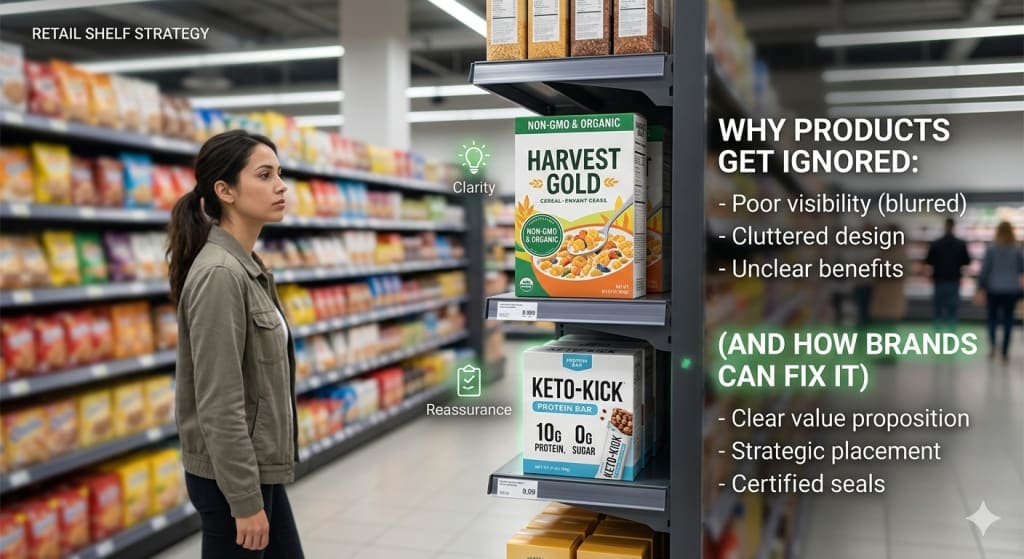
Today, when you walk through any retail store, they have a very cluttered retail display design. You will see shelves packed with products. Most of them are decent. Some are even excellent. But have you wondered why they are never picked up or made into the cash-out zone? Many are well-made, reasonably priced and even thoughtfully designed. And yet, a large number of them never get picked up. This is one of retail's quietest problems. It's because customers don't notice them. It's very natural that shoppers scan shelves in seconds. Products must communicate value instantly.
This blog will help to understand through the store merchandising techniques, retail marketing strategies and shelf placement strategies to increase the point of sale visibility of your product.
Common Reasons Why Products Get Ignored
- Retail Shelves are Packed with Invisible Products
Modern buyers have a very short attention span. Due to the shorts and reels culture, their brains have been conditioned to scan or filter information at a very high speed. Even the most trusted brands are facing problems with customer attention in retail. Their products are also failing to grab the eyeballs of every customer passing by. In this reality, products don't compete on quality alone. They compete for attention. And without a strong in-store product presentation, even the best products blend into the background.
2. Overcrowded Shelves and Visual Noise
Another common reason for products being ignored on retail shelves is that customers get confused by looking at similar-looking products. We, as buyers, have faced this challenge of identifying the real product we want to buy. This happens when competitors use similar colors, shapes and claims for the same product they are selling. This similarity dilemma is often referred to as visual noise. In such a situation, nothing stands out because every product seems the same. When differentiation is weak:
- Brands visually merge.
- Shoppers feel overwhelmed.
- Decision-making slows down or stops
The core issue is straightforward. Customers cannot notice what does not stand out. The cluttered placement of products makes the eye skip over products rather than engaging with them. Too many similar products competing for attention challenge customer sensory receptors.
3. Poor Shelf Placement and Product Positioning
Products at corner placements and low-traffic zones create a problem of not even coming into the eye of the passing by consumers. Lack of retail shelf visibility and strategic product grouping becomes invisible. But also creates confusion in the minds of passing-by buyers. Products placed at retail store cash counters naturally attract attention. On the other hand, shelves in corners always go overlooked unless the customer themself is searching for the product. Items placed in low-traffic areas may as well be invisible, regardless of how good they are. So, poor grouping has a central role in making products get ignored. Good shelf placement strategies guide the eye. Poor ones lose it.
4. Weak Visual Presentation and Branding
Inconsistent colors, fonts and messaging are another reason that products are disappearing from the retail shelves. Even if they are physically there. But customers don't pay heed to them. Further, their packaging also fails to communicate. On a crowded shelf, confusion equals rejection. Many brands design packaging in isolation without considering how it will actually appear in a retail environment. What looks good online does not always translate well to in-store retail product displays. Without a strong point of sale visibility and identity, products lose the chance to communicate trust, value and relevance in those critical few seconds.
5. Customers Are in a Hurry
Most retail decisions happen fast. Shoppers don't carefully read every label. They scan shelves in seconds, subconsciously filtering out anything that feels unclear or unimportant. This makes customer attention in retail one of the most valuable and limited resources. Suppose a product cannot instantly answer questions like what, why or is it right for the customer. The product failing to answer these fundamental questions will easily get ignored. In-store product presentation must communicate value immediately or the moment is lost.
How Smart Visual Merchandising Solves the Problem
Here, the importance of structured product presentation is paramount to understand. Innovative visual merchandising solutions do not shout. It organizes. Shoppers feel less exhausted and lost when picking up a product if presented in simple, straightforward branding. The uncluttered packaging design guides the consumer's eyes naturally, helping to develop an instant perception and comparison with other products. The role of organized, branded display solutions helps to:
- Reduce visual clutter.
- Create structure.
- Improve navigation.
- Highlight key products.
- Support quicker decision-making.
The Role of Customized Retail Displays
Customized retail displays boxes play a quiet but influential role in improving product visibility. Rather than pushing products at customers, tailored display solutions create order and focus. They help separate a brand from surrounding noise without relying on heavy messaging. Thoughtfully designed displays support:
- Better organization.
- Stronger brand recall.
- Higher engagement at shelf level
Customized retail displays provide flexibility to an extent that allows brands to adapt for promotions, launches and seasonal campaigns. These retail display methods altogether contribute to a positive shopping experience rather than being interrupted.
Practical Tips Brands Can Apply Immediately
Small details are the cheapest way to make products distinguishable. Brands don't have to spend hefty budgets to improve retail shelf visibility. Start with:
- Improving product grouping and spacing.
- Creating clear visual hierarchy on shelves.
- Simplifying messaging for faster understanding.
- Aligning presentation with brand identity
In The Final Analysis: Visibility Drives Sales
Products get ignored due to weak placement, cluttering, inconsistent branding and very short attention span. Shoppers scan shelves in seconds. Products must communicate value instantly. Reinforcing that a thoughtful presentation is a long-term solution. With the help of innovative visual merchandising solutions, retail marketing strategies, shelf placement strategies and store merchandising techniques ordinary products are noticed. In the retail world, seeing is buying.
About the Creator
Keep reading
More stories from writers in Education and other communities.
How Meteorites Differ from Meteors: Understanding Space Rocks Before and After They Hit Earth
The Simple Difference: Stage of the Journey The easiest way to understand the difference is this: • Meteoroid – A small rocky or metallic object traveling through space.
By shahkar jalal5 days ago in Education
The Modern Real Estate Landscape: Key Trends Defining Today’s Market
The real estate market today is far from static, shaped by a combination of economic shifts, lifestyle changes, and technological innovation. Buyers, sellers, and investors face a dynamic environment that demands awareness of emerging patterns and adaptability in strategy. From shifting work habits to sustainability concerns, understanding these trends is essential for navigating the current market and making informed decisions.
By Michael O'Sullivan Hamptonabout 16 hours ago in Education



Comments
There are no comments for this story
Be the first to respond and start the conversation.