
The Invisible Beacon
Drawing the path without shining - Leadership and Strategy
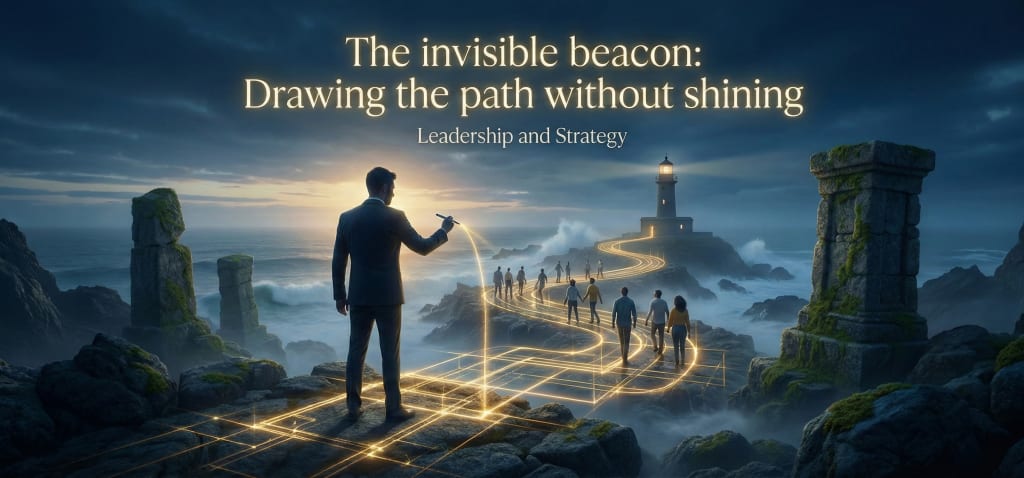
Throughout my career, I’ve worked with diverse teams and management styles. Each project is a different creature: some are meticulously planned; others a frantic dance with uncertainty where the path hasn’t even been cleared yet. But one truth remains - success is never a guarantee.
In this chaotic, hyperconnected world, true leaders are needed more than ever.
But could you recognize one if they stood right in front of you?
And if you did, would you be able to see and follow their strategy?
Chapter 1: The Boss vs The Leader
A Perfect Agent in Control vs a Gravitational Force
Act 1: The Boss
The Boss is the manager who believes they have all the answers. They define what everyone does, how to do it, and exactly how long it should take. In their world, mistakes are someone else’s fault, admitting a plan can fail is a sign of weakness. To them, listening to others is a sign of incompetence, considering alternative approaches are a lack of "conviction”.
They confuse rigidity with strength, and often see questions as threats.
Like a secular deity, The Boss is the Truth. They know all; they know best. Doubt is a sin; questions are heresy. If they allow you to speak, it is only to ensure you repeat their ideas in your own words. You learn to walk on tiptoes. If you hint at a better way, you’d better get back on track fast - and perhaps throw in a compliment to the manager’s "vision" along the way.
But even in this perfect world, "bad apples" appear - or perhaps just someone who isn't yet a 100% fit for the task. This is when the Boss truly shows their "strength": a cocktail of finger-pointing, a heavy dose of arrogance, and a patronizing tone to "solve" the problem.
Act 2: The Leader
If the Boss is the loud, performative "Agent" of the system, the Leader is its “Architect”.
In a world obsessed with noise, we often mistake volume for authority and arrogance for foresight. But leaders don’t demand the spotlight, they are busy designing the stage. A true leader doesn't need to be the brightest thing in the room. In fact, if you look for them in the middle of the "theatre," you might miss them entirely. They are the Invisible Beacon – a source of light that does not blind, it guides.
Their presence is fluid. You will find them in the trenches, exchanging impressions with the most operational team member on the smallest task, just as you’ll find them in a hallway holding a deep structural conversation with an administrator. They are equally at home in a 1-1 design thinking session over a messy whiteboard as they are delivering a presentation to 100+ people or being summoned to a meeting to untangle a complex situation and provide strategic clarity.
While the Boss spends their energy pushing people from behind, the Leader architects a strategy to create a gravitational pull from the front.
They convince the team that "this is the way" not by commanding the how, but by demonstrating the what. Nothing inspires more than a leader who "walks the walk" and "eats their own dog food." The leader doesn't just assign a challenge; they inhabit it. They aren't afraid to show how it’s done - they love the challenge and seize every opportunity to prove themselves wrong and learn from it. It takes courage, and it consumes immense energy, but every willing soul in the organization will eventually spot that spark and follow it.
Leaders don't just tell what to do and how to do it. They nudge the system and clarify the "Why" until their vision becomes your own internal logic. You don't follow the path because you are being watched; you follow it because the leader has designed a path that simply makes sense.
They aren't "seen" in every room, in every meeting or micro-decision, but their influence is felt. They are the force that holds the system together, ensuring that even in the most chaotic storms, the organization can use them as a “compass” to the right path.
Act 3: Beyond Compliance: The Art of Absorption
- Leadership is not a position or a title; it is a recognition.
- Leadership is done by people, with people.
- Leadership is granted, not given by decree.
The leader possesses a natural presence and a clarity in the path they trace that makes gravitation inevitable. People are drawn toward them, eventually unknowingly on the why they follow them, it just makes sense and it feels good to go that way.
Chapter 2: Strategy vs Tactic
The destination and the way to get there
Act 1: The Perfect Blueprint
Academia has produced a myriad of articles and papers that define how strategy should be built. Based on this body of knowledge, strategy is the exercise of designing the “High-Level Future State”. It creates a map of the “What” and the “Where” - a perfect blueprint where the most impactful variables are identified and human and material resources are plotted along a roadmap.
It is a world of logic, clean lines, and predictable outcomes.
Often, this clinical view of strategy brings with it a desire for the "new." There’s a push to incorporate the latest capabilities and reach ever-higher goals. Frequently, this is accompanied by a proud, yet patronizing, view of everything that has been done before. The feeling is that "new blood" is the only answer to the legacy debt.
New goals, new tools, new faces.
From the heights of the ivory tower, the strategy looks as unyielding as a stainless-steel shell. There is the belief that sound logic guarantees swift execution. But a question remains: How will it survive the “l’écume des jours” and the real world?
Act 2: Terrain!!! Terrain!!!
The moment the strategy leaves the pristine case it was born in, it meets the friction of the real world with all its corrosive salty waters and sharp edges.
This is the domain of the tactical approach. Tactics are the daily heartbeat of the organization - the boots on the ground, the late-night troubleshooting, and the complex human emotions that no roadmap can fully predict.
When a strategy is defined from a distance, the first encounter with "l’écume des jours" doesn't just scratch the shell; it cracks it. “New faces" find themselves holding a map of a city that doesn't exist, while “new tools” act as precision instruments calibrated for a climate the organization has never actually lived in.
In this scenario, the “legacy” team watches as these sophisticated answers are applied to the wrong questions, weakening the ranks, diminishing the capital of trust. As in material science, the me(n)tal fatigue is one of the hardest things to spot and to repair.
You cannot "command" the terrain to be flat and the path to be straight. Without proper calibration, the strategy becomes a collection of expensive gear being used to climb the wrong mountain.
Act 3: The Grounded Strategy
A valuable strategy is not a monument; it is a navigation system.
The “Grounded Strategy” approach recognizes that the strategy blueprint is only a starting point. An actionable strategy is a continuous dialogue where the operation informs the vision. The organization should stop trying to protect the stainless-steel shell of the strategy and start treating it like a living organism.
Every tactical struggle is a data point. Every "failure" in the field is a signal to refine the high-level design. Instead of devaluing the existing team, the grounded strategy leverages their Tactical Truth to reinforce the path. By engaging the existing team and solidifying the common mission, new tools and faces can then add value. This creates a positive feedback loop where:
- The Strategic Vision provides the "Why"
- The Tactical Execution tests the "How"
- The Operational Feedback enriches the "What"
The strategy becomes "invisible" not because it is gone, but because it has become common sense. It is no longer a document hanging in a frame, it is the logic found in every corridor and every whiteboard session. By grounding the strategy in the grit of the daily operation, the organization ensures that the path is not just drawn - it is actually walkable.
Every person in the organization is a cog on this mechanism. The way each cog turns, every dented wheel, is a reflection of the culture. Distilling Peter Druker’s ideas, “culture eats strategy for breakfast”, and since:
- There is no strategy without culture,
- There is no culture without people,
- There is no strategy without people.
Chapter 3: Finding the invisible beacon
The unseen Lighthouse
The leader and the strategy walk hand in hand. Just as a lighthouse is useless without a tower, and a tower is purposeless without a light, the leader doesn’t exist without a strategy, and a strategy doesn’t exist without a leader.
Yet, the leader’s beacon doesn’t emanate from the top of a tower. They define and refine it by "walking the walk", implying that they enter the operation not to police it, but to inhabit it. If the leader isn't eating the same "dog food" as the operational teams, they won't smell when it’s gone bad. They won't see that the new tools are ill-fitted for the old problems, or that the new goals are being choked by ancient, unaddressed bottlenecks.
Without tactical immersion, the leader is just a spectator watching a car crash in slow motion. You cannot refine a blueprint if you don't know how the bricks feel in your hands. When the leader stays close to the operation, the strategy isn't something "imposed" on the teams, it is something "validated" alongside them.
By being involved in the "least impactful" tasks, they gain the most valuable currency in leadership: Tactical Truth.
The true Leader translates Tactical Truth into Strategic Logic. Like a mist, they disappear into the trenches, blending seamlessly with the operational teams. The ultimate success of the Leader is to be Strategically Redundant.
Their art is making the destination so clear, and the grounded path so intuitive, that people gravitate toward it naturally. They may even forget when or how the path was defined - they simply know that "this is the way".
This reveals the Achilles’ heel of the leader. In our world of appearances, these leaders are often invisible. Like dark energy in the universe, they are the glue that holds it all together, yet remain unseen by the many.
So, the initial questions are paramount:
Could you spot this leader if they were in front of you?
Would you be able to see the strategy and follow it?
Whatever position you hold, be aware: in the social network and the world of appearances we live in today, these leaders are disappearing. Not because they do not exist, but because they are not being recognized and are often undervalued.
Let’s change this narrative.
As we look toward 2026, let us stop chasing the loudest voices and start recognizing the architects. We need leaders. We need grounded strategies. We need hope. We need direction.
Let’s draw the path together.
We choose this and do the other things, not because they are easy, but because they are hard. Because when the Leader inhabits the challenge and the Strategy honors the truth, the path is no longer a command - it is our destination.
About the Creator
Keep reading
More stories from writers in Education and other communities.
The Light She Gave Us
A Tribute to Dr. Shirley Ann Jackson and the Power of Fiber Internet Ladies and gentlemen, today I want to tell you a story a story about light, legacy, and the brilliance of a Black woman whose mind helped shape the very way our world communicates. Before fiber‑optic lines stretched across America… Before light traveled through glass to carry our voices at breathtaking speed… Before companies like Frontier and Verizon built vast modern networks… There was a little girl in Washington, D.C., collecting honeybee's in jars, studying the patterns of nature, and discovering curiosity as her superpower. That little girl grew into **Dr. Shirley Ann Jackson a name that deserves to be spoken with honor, with reverence, with pride.
By Organic Products 3 days ago in Education
Growing Strong Customer Loyalty Through Exceptional Customer Service
Building loyalty through exceptional customer service is one of the most effective ways to create long-term business success. Customers have many choices today, and they can easily leave if they feel unimportant. Loyalty is not built only through products or prices. It is built through experiences. The way a business treats its customers can make the difference between a one-time buyer and a lifelong supporter.
By Apex Service Partners5 days ago in Education
Time to change your life.
Is it even possible for you to change your life? A lot of people, more than there should be, are unhappy with their lives. But what are they doing about it? Usually nothing. People talk about how shitty their lives are and want change, but are they not taking the actions to change?
By Jen Phillips2 days ago in Humans
Not Just For Clean Up: A History Of The MCU's Department of Damage Control
Initially an organisation that seemed to exist to help the heroes of the Marvel Cinematic Universe, from Phase Four onwards, the Department of Damage Control has shifted into a more antagonistic role. Most recently seen in the Wonder Man series, the current incarnation of Damage Control seems to target superpowered individuals, regardless of whether that person poses an active or intentional threat.
By Kristy Andersona day ago in Geeks


Comments
There are no comments for this story
Be the first to respond and start the conversation.