
Redefining Health in a High-Performance World
The Holistic Blueprint

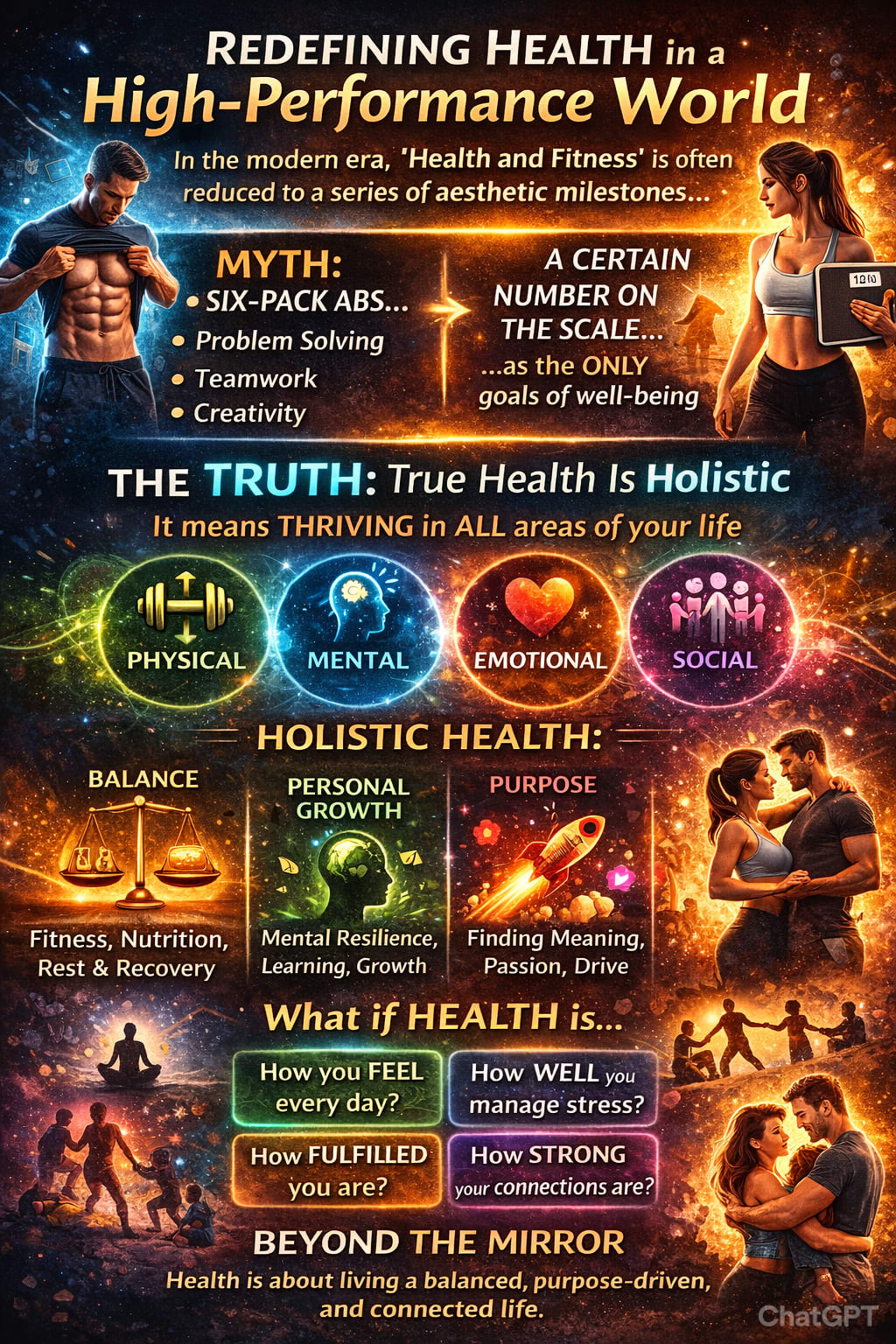
In the modern era, "Health and Fitness" is often reduced to a series of aesthetic milestones—six-pack abs, a specific number on a scale, or the ability to run a marathon. However, true vitality is far more profound. It is the synergy between physical capability, nutritional wisdom, and mental resilience. This article moves beyond the surface-level trends to provide a practical, deep-thought guide to sustainable well-being.
The journey to a healthier self isn't a sprint toward a "finish line"; it is an ongoing process of refining your habits to support the life you want to lead. By debunking common misconceptions and focusing on foundational pillars, you can build a body and mind that don't just look good, but function at their peak.
1. Shattering the Illusion: Weight Loss Myths
The fitness industry is rife with "magic bullets" that often lead to metabolic frustration. The most persistent myth is that extreme calorie restriction or fads (like juice cleanses) are the key to long-term success.
- The Reality: Weight loss is fundamentally governed by the First Law of Thermodynamics—energy balance. However, the quality of those calories dictates your hormonal health and muscle retention.
- Deep Thought: Your body isn't a calculator; it's a chemical laboratory. Focusing solely on "less food" without considering nutrient density often leads to a "yo-yo" effect where the metabolism slows down to protect itself.
2. Strength as a Foundation: Functional Workout Routines
Exercise should be viewed as an investment in your future autonomy. While cardio is vital for heart health, resistance training is the ultimate "anti-aging" tool.
- Actionable Tip: Prioritize compound movements like squats, deadlifts, and overhead presses. These exercises engage multiple muscle groups and stimulate bone density.
- Why it works: Muscle is metabolically active tissue. By increasing your lean muscle mass, you increase your basal metabolic rate (BMR), meaning you burn more energy even at rest.
3. Food as Fuel: Designing Healthy Meal Plans
A "diet" is something you go on and off; a "meal plan" is a strategic approach to nourishment. The goal should be to stabilize blood sugar and provide the raw materials for cellular repair.
- The Blueprint: Aim for a balance of lean proteins, healthy fats (like avocados and nuts), and complex carbohydrates (like quinoa or sweet potatoes). High-fiber vegetables should make up the bulk of your plate to aid digestion.
- Practical Guide: Meal prepping isn't about eating the same thing every day; it's about reducing the "friction" of making healthy choices when you are tired or busy.
4. The Silent Engine: Mental Health Awareness
You cannot have a healthy body without a healthy mind. Chronic stress produces cortisol, a hormone that, in excess, can lead to muscle breakdown and fat accumulation around the midsection.
- Actionable Tip: Integrate "Active Recovery" into your routine. This includes meditation, deep-breathing exercises, and ensuring 7–9 hours of quality sleep.
- Deep Thought: Productivity and fitness are often fueled by "hustle," but long-term health is fueled by "recovery." Silence and rest are not weaknesses; they are the periods where the body actually does the work of rebuilding.
Q&A: Your Practical Health Guide
Q1: How do I know if my workout is actually working?
A1: Don't just look at the scale. Track "Non-Scale Victories" (NSVs) like increased energy levels, better sleep quality, lifting heavier weights than last month, or clothes fitting differently. Consistency is the best metric.
Q2: I don't have time for a 60-minute gym session. Is it even worth it?
A2: Absolutely. Research shows that 15–20 minutes of High-Intensity Interval Training (HIIT) or a brisk walk can offer significant cardiovascular benefits. Some movement is always better than no movement.
Q3: Is "cheat day" a good idea for weight loss?
A3: A "cheat day" can often lead to a binge-restrict cycle that is psychologically damaging. Instead, aim for the 80/20 rule: 80% whole, nutrient-dense foods, and 20% "fun" foods that you enjoy without guilt.
Q4: How can I stay motivated when I stop seeing fast results?
A4: Shift your focus from "motivation" to "discipline." Motivation is a feeling that comes and goes; discipline is a system. Set small, process-oriented goals (e.g., "I will walk 10,000 steps today") rather than just result-oriented goals.
Q5: What is the single most important factor for long-term health?
A5: Sustainability. If you cannot see yourself doing your current workout or diet five years from now, it is likely too extreme. Find the intersection of what is effective and what is enjoyable.
About the Creator
Being Inquisitive
Blogging can provide a creative outlet for expressing your thoughts, feelings, and ideas. It can be a way to share your passion and interests with others and to engage with like-minded individuals.
Keep reading
More stories from Being Inquisitive and writers in Education and other communities.
AI, Tech, and Thriving in Online Business
The landscape of business and work is undergoing a monumental transformation, driven by rapid advancements in Artificial Intelligence and ever-evolving digital technologies. For entrepreneurs, freelancers, and ambitious professionals, understanding and leveraging these trends is not just an advantage—it's a necessity for thriving in the fast-growing online economy of 2026 and beyond. This article explores key areas where technology intersects with opportunity, offering insights into making money, optimizing operations, and securing your place in the future of work.
By Being Inquisitiveabout 7 hours ago in Education
What Makes Venus Visible in Daytime? The Science Behind Seeing the “Morning Star” in Broad Daylight
Venus: The Brightest Planet in the Sky Among all the planets visible from Earth, Venus is by far the brightest. At its peak, Venus reaches an apparent magnitude of about –4.6, making it brighter than any star in the sky and second only to the Moon in nighttime brightness.
By shahkar jalalabout 8 hours ago in Education
The Natural Path to Radiant Skin: How Simple Care Yields Lasting Results
In today’s beauty industry, the pressure to chase the latest miracle product is relentless. From serums packed with dozens of actives to aggressive exfoliants promising instant transformation, it’s easy to forget that healthy skin doesn’t need constant intervention. The natural skincare approach flips the script: it focuses on supporting skin’s innate ability to heal, protect, and maintain balance. By working with your skin rather than against it, natural routines deliver results that are not only visible but also long-lasting.
By Kelln Small3 days ago in Education




Comments
There are no comments for this story
Be the first to respond and start the conversation.