Latest Stories
Most recently published stories in Education.
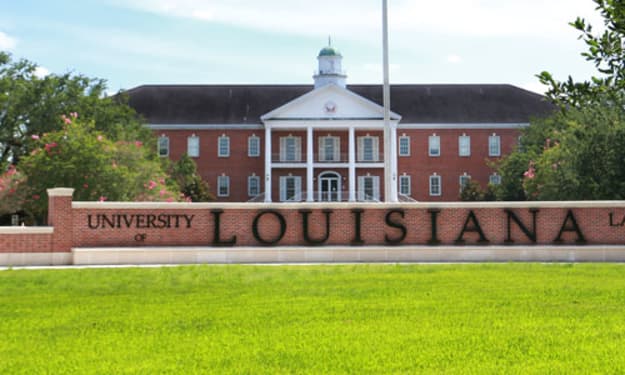
Chronicles of a ULL Student - Mini Series
Like everyone in high school I knew that college was going to be no joke. Just how serious, I had no way of knowing. First, let's start from when was looking into all the colleges I could go to. They had the same fun flair, some more serious than others, but most had the impression that they had the downtime for students to not always feel the pressure of massive amounts of debt and studying weighing so heavily on them. This way it'll just be that little voice in your head that you can ignore for a couple hours.
By MementoMori 0_o7 years ago in Education
My Life After High School
You know, I’m not ready to be an adult. I wish there was a way to time travel back to when I was a kid. By junior and senior year everyone always told me that I should get prepared for college and to be ready for adulthood, but I put it off because I thought I had time. Now it’s here and I’m just making it. Adjusting to life after high school is definitely different for everyone, but I’m going to tell you about mine. Right now I’m in college about 170 miles away from my house and I’m struggling between missing my family, friends and dog and trying to keep up with my college classes, homework and having some relaxation time.
By Rosemary Guzman7 years ago in Education
Does College Accreditation Matter?
When it's time for young students to prepare for the next step in their education by applying to colleges, they typically don't seek out the school's accreditation. This is because it's simply something they don't think to check, though, it is definitely one of the things to consider before starting college. Luckily for these students, this oversight usually doesn't come back to haunt them, as pretty much all public colleges and universities in the United States (your "state schools," etc.) are, as a rule, recognized by the appropriate accrediting bodies, but more on that process in a moment.
By Joseph D. N. Kendrick7 years ago in Education
The War on Textbooks
Since beginning college I have been faced with the harsh reality of money. The reality being I don’t have any and everything in this world has a price I must pay. A price we all must pay. Tuition has risen so much over the years that so many students either drop out or go into debt. Moreover, the price for textbooks have also been risen. Some books go for over $100 each and when you have six classes that is $600 you are forced to pay just for books. Most people who are attending college can’t afford that. There needs to be an alternative so students don’t go even further into debt over textbooks that half the time aren’t even used throughout the semester. An article in the Times by Kaitlin Mulhere discusses the alternative of eliminating printed textbooks at Maryland University College to save money for their 64,000 undergraduate students. Using online methods instead of printed textbooks is not only much more convent for a busy, traveling student but it can be one less thing they must worry about paying for. Mulhere states, “whether individual students are paying a literal 1,041 percent more today than they were in 1977 is not the question, said Mark Perry, a professor of economics at the University of Michigan who has tracked rising textbook prices for years. College textbook prices are increasing way more than parents' ability to pay for them. At the extreme end, one specialized chemistry textbook on his campus costs $400 at the campus bookstore.” This quote from Mulhere lays out for us the exact difference from the prices in the 70’s to the prices for textbooks now.
By Bridget Barnes7 years ago in Education
Benefits of Effective Infusion of Instructional Technology
Effective infusion of technology benefits all students. Technology allows educators to meet the needs of all students no matter what the students' preferred learning modality. Visual, auditory, and second language learners can benefit from programs like EdPuzzle, YouTube, Discovery Education, Quizlet, GAFE, and Flocabulary that use videos to enhance the learning process. Tactile learners can use Google Draw to create pictorial demonstrations of proof of mastering content. ELL students benefit a great deal from any technology that immerses them in the new language they are trying to learn. The more ways they hear, see, and use new language the better chance they will have in learning to comprehend that language. Quizlet, Quizziz, Kahoot, and Socrative bring in the competitive component. Let's face it, we are all competitive in one way or another.
By Randi Merritt7 years ago in Education
Use Your Time Wisely: Advice I Should Have Followed
Time is a very precious thing. It’s funny because it doesn’t actually exist, it’s something that humans concocted for measurement. Over generations it’s taken so much meaning to all of us. One of the biggest life lessons I’ve been told over and over and still never really followed deals with how I use my time. I’m sure everyone has been told that time is precious and we should be spending our time wisely. This is a valuable lesson that I think 95% of us will ignore despite knowing that it’s true. Why don’t we follow this advice and what does spending your time wisely truly mean?
By Brian Anonymous7 years ago in Education
Letter to a Freshman
Dear Jane, High school...the white walls, clogged hallways, and smelly locker rooms. Oh, the glory days, but all of that will cease to exist when it comes to focusing on the actual classes you will be taking. English, in particular, will be a tough one. Gone are the days of easy grammar and spelling worksheets. Say hello to long and constant essay assignments. Yet never fret dear Jane; writing can be fun! Here are a few steps to make your transition from junior high English classes to high school a little easier.
By Alexandria Bliss7 years ago in Education
Help! I’m a Substitute Teacher with No Lesson Plans! Part 2
As discussed in "Help! I'm a Substitute Teacher with No Lesson Plans! Part 1," walking into a classroom and being expected to teach a group of students when you were not provided lesson plans or the proper supplies to carry the plans left to you can be a stressful situation. Below are some tried and true activities I have used that fill time and keep students engaged. The hardest part about being left to teach a class with no lesson plans is finding enough activities to keep the students from acting poorly. Even though some of these activities are not necessarily the most intellectually stimulating, they are educational and will keep most students busy depending on their age.
By Haley Peterson7 years ago in Education
Part II: Should a University Have to Pay the University to Market the University?
Overview In the first part of this article, we examined the changing dynamics between universities and their athletic departments. We looked at how more and more, an institution’s identity is increasingly intertwined with its sports activity. We examined the pressure on colleges across the country to compete in the athletic space—both on the field and financially.
By David Wyld7 years ago in Education
How to Make the Most Out of College
Change isn't easy. Moving over 1,000 miles away from your family and friends and everything you've always known isn't easy. I'm the kind of person that generally doesn't enjoy change (but I mean, who does?) and, in most cases, doesn't handle it very well. Going off to college both scared me and excited me greatly, mostly because I've known I wanted to be at this particular school for the past two years, but it's so far away from my little hometown that it felt like the scariest thing in the world.
By cecil elliot7 years ago in Education
You Can Still Finish Your Degree While Working Full-Time. Top Story - October 2018.
Getting a degree when you work full-time is one of the most challenging things a person can do, but if you have a firm objective, it’s worth chasing. If you know what career path you want but you need a degree to get there, you can still do it even if you’re a non-traditional student.
By Leigh Victoria Phan, MS, MFA7 years ago in Education