
Understanding Solar Eclipses: Types, Occurrence, and Safe Viewing
A General Guide to Total, Partial, Annular, and Hybrid Solar Eclipses and How to View Them Safely
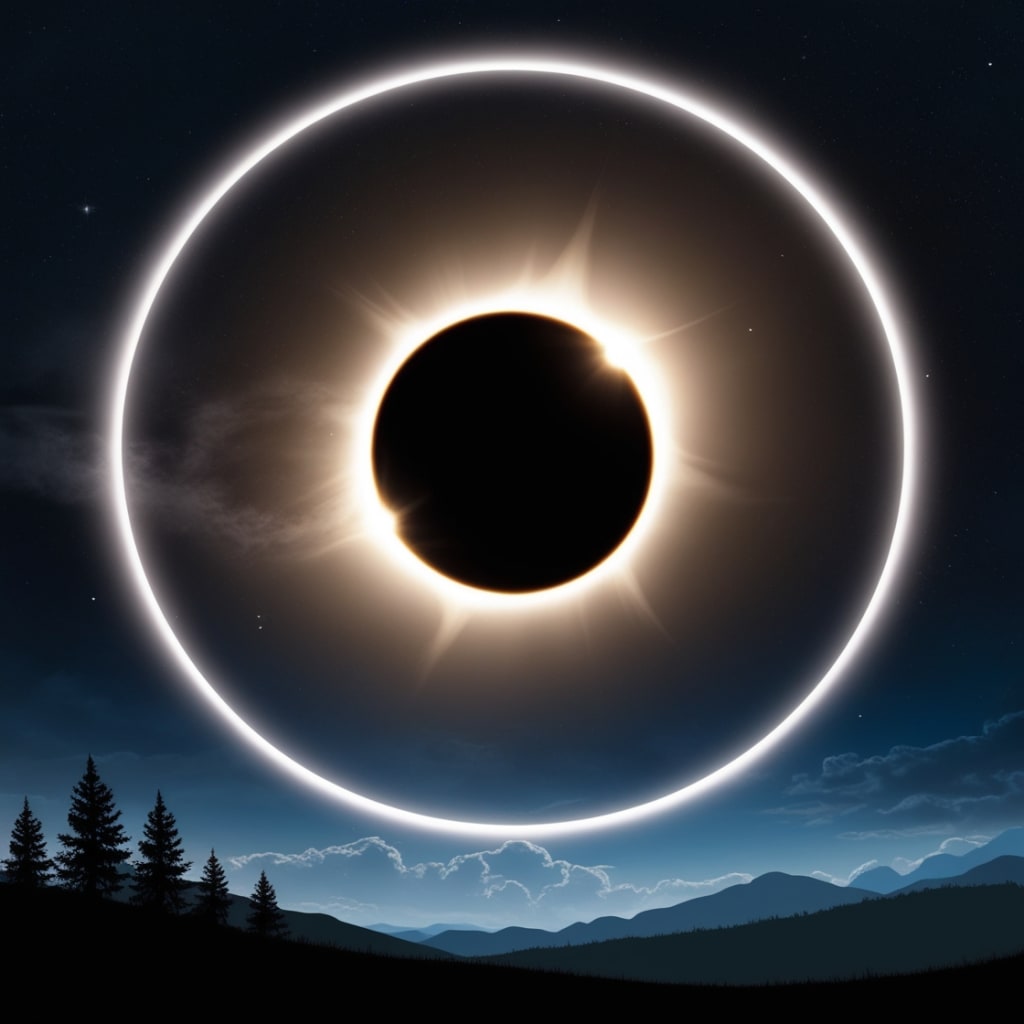
What wonders are hidden here are paths that the moon takes, straight between the Earth and the Sun, in which sunlight can be partially or wholly blocked. And this could happen only during a new moon; it is for this reason that whoever, scientist or skywatcher that he might be, will find this phenomenon of interest. Knowing the kinds of solar eclipses they are and how they happen can make us appreciate this marvelous creation of nature more.
Kinds of Solar Eclipses
There are four kinds of solar eclipses: total, partial, annular, and hybrid. Each type of solar eclipse has been distinctly different in character and character as viewed.
1. **Total Solar Eclipse**: This is one of the types of solar eclipses wherein the Moon wholly covers the Sun, casting an ombre on some parts of the Earth. Day becomes night for a few minutes, so it is a sight never to forget. The sky gets darkened, and stars and planets might appear, and the temperatures may go down by a couple of degrees. That breathtaking phenomenon can only be observed from a narrow path called the path of totality, which generally is narrower than 100 miles wide. Outside of the path, people will only be able to observe a partial eclipse.
2. **Partial Solar Eclipse**: In partial solar eclipse, it happens that only the part of the Sun is covered with its shadow by the moon and the Sun will otherwise be visible. This partial solar eclipse can be seen from a bigger place as compared to a total eclipse. This depends on location; the area covered by the Sun differs. Even though it does not look spectacular at all, like that of a total solar eclipse, it is still a beautiful view of the sun.
3. Ring of Fire Solar Eclipse This occurs when the Moon is far enough from Earth so it can be aligned right in front of the Sun but is too far away to cover the whole Sun. Because the Moon is so far away, the sunlight passing through its edges forms a ring. This is often called more colloquially, the "ring of fire.". The "ring of fire" is very beautiful, yet rather similar to a partial eclipse: it doesn't darken the sky.
4. **Hybrid Solar Eclipse**: This is the rarest kind, putting together a little feature of both total and annular eclipses. It will be like an annular eclipse in one location and like a total eclipse in another, depending on the position of the observer within the path. Hybrid eclipses occur only a few times per century.
**How Solar Eclipses Happen**
A solar eclipse occurs only when the Sun, Earth, and Moon align. Aligned means that there must be a new moon, and its path must intersect between the Sun and Earth. There are two shadow parts of the moon: umbra and penumbra. The umbra is the innermost and darkest region, where sunlight is completely occluded, and hence a total eclipse for whomsoever falls into this shadow. That area outside has only the Sun partly masked. This place is called a penumbra where the eclipse is partial.
It is this tilt in the orbit of the Moon around Earth that makes solar eclipses not occur monthly, though the orbit of the Moon does so. This tilt prevents just often enough that alignment necessary to cause an eclipse during most new moon phases. When such an alignment occurs with the tilt, with the Sun, Moon, and Earth nearly in a straight line, then it is a solar eclipse.
Precautions when Observing Solar Eclipses
Use appropriate eye wear to observe a solar eclipse. The period that a solar eclipse is available to view, your eyes may cause serious harm by their naked view of the Sun. Specific glasses or a solar filter to observe an eclipse must be used. Ordinary sunglasses will not be sufficient as they do not filter out destructive rays that might endanger your eyesight.
All of the individuals who are not going to have a pair of solar viewing glasses will still be in the position to safely view the eclipse through the use of a pinhole projector, or through multiple indirect viewing methods. The former is very simple in that it projects an image of the Sun onto another surface so that you might view it safely without looking at it directly.
**Conclusion**
Eclipses by the sun are a pretty interesting phenomenon and hence a rare incident, allowing public viewing of heavenly alignment. From total to partial, annular, or hybrid eclipse, each kind offers a different experience that enthralls everyone in the world. Proper knowledge and safety precautions rarely hold someone back from witnessing such an event.
About the Creator
Keep reading
More stories from Abhay kumar chauhan and writers in Earth and other communities.
2025 Engineering and Construction Outlook: Building the Future
**2025 Engineering and Construction Industry Outlook** The bridge of two decades, 2025 is going to be such an interesting year for the engineering and construction (E&C) industry. The drivers-including principal among them technology breakthroughs, sustainability mandates, and a booming global economy-will propel this industry to unprecedented growth, but challenges pertaining to workforce skills, supply chain disruptions, and fast-paced urbanization shall be the hurdles to be overcome by the companies. The stakeholders must know what trends will shape the industry and be ahead of the curve. Here's more detail on what 2025 holds in store for E&C.
By Abhay kumar chauhanabout a year ago in Earth
Talks Between Ukraine and Russia to Restart on Wednesday, Kremlin Says – Latest News
Diplomatic negotiations between Ukraine and Russia are expected to restart on Wednesday, according to statements from the Kremlin, marking another potential turning point in one of the most significant geopolitical conflicts in recent history. While previous rounds of talks have produced limited long-term results, the decision to return to the negotiating table has drawn global attention, as world leaders and humanitarian organizations hope renewed dialogue could reduce violence and improve humanitarian conditions.
By Aarif Lasharia day ago in Earth


Comments
There are no comments for this story
Be the first to respond and start the conversation.