
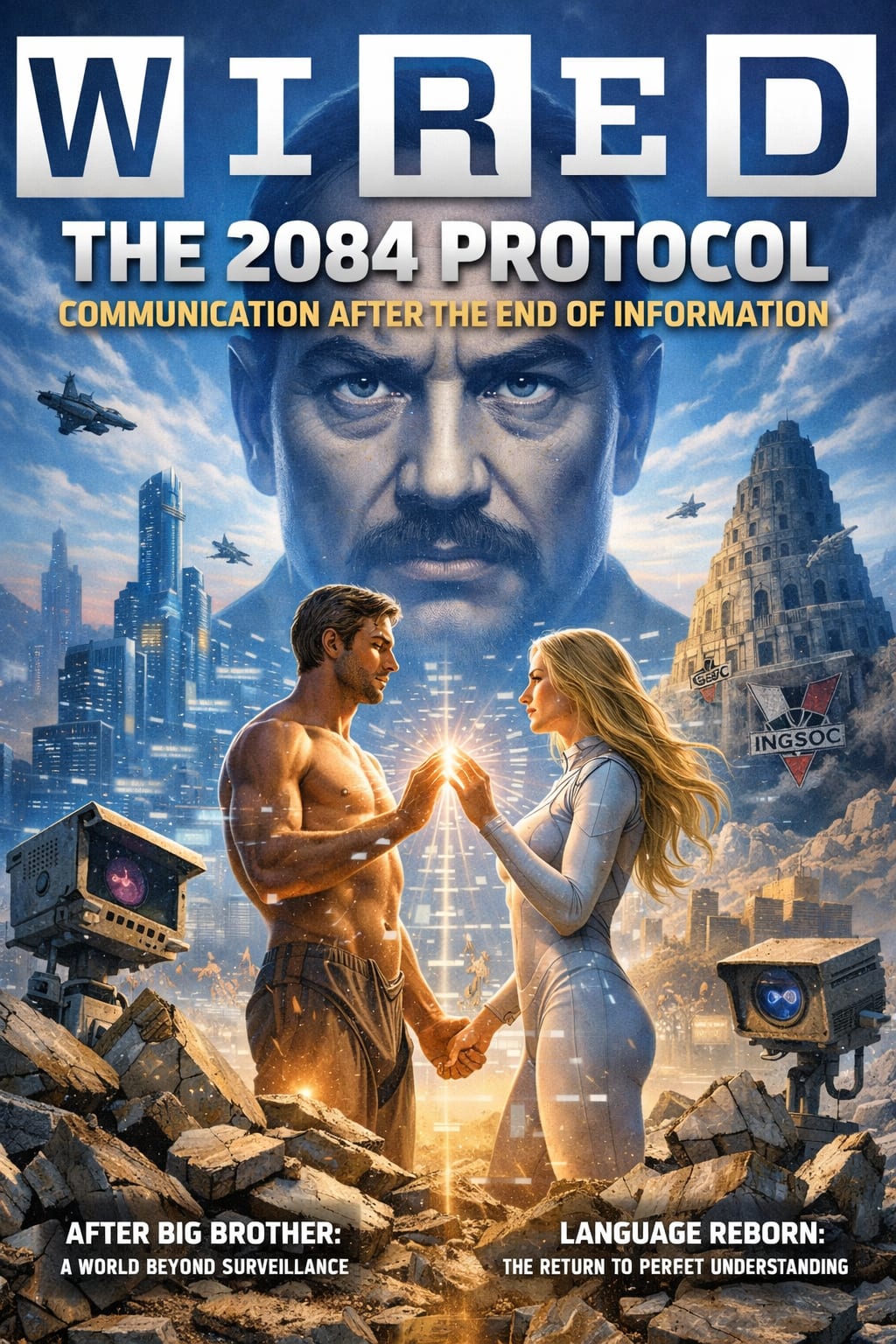
The 2084 Protocol
Communication After the End of Information

A Manifesto
The year 2084 marks one hundred years since the world first learned, through 1984, to recognise the abuse of language as the primary instrument of power. Orwell did not predict a future; he diagnosed a mechanism. Big Brother was not a man, nor even a state, but a communicative order in which language ceased to describe reality and began to replace it. From that moment onward, modern history entered a long cycle of miscommunication and discommunication: truth reduced to slogans, memory rewritten as policy, dissent scripted as opposition, and speech converted into governance.
The twentieth century institutionalised miscommunication through propaganda, ideology, and manufactured consent. The early twenty-first century escalated it through platforms, algorithms, outrage economies, and the manufacture of dissent. Across this century-long interval, language was never neutral. It was trained, disciplined, monetised, and weaponised. Words did not fail accidentally; they were engineered to fail productively. Confusion was not a bug but a feature. Discommunication became the operating system of power.
The 2084 Protocol begins where this history ends. It does not propose better media, more ethical platforms, or improved literacy within the same paradigm. It declares the exhaustion of the information order itself. Information has reached a terminal condition: total abundance, permanent archiving, instant retrieval, infinite comparison. In such a condition, persuasion collapses, secrecy erodes, and narrative authority disintegrates. Power can no longer rely on controlling what is known, because everything is already known—or can be known.
The Protocol names a transition from information as domination to communication as condition. Under the information order, communication functioned instrumentally: to persuade, to mobilise, to divide, to pacify, to govern. Under the 2084 Protocol, communication loses its strategic function. When concealment is impossible, speech can no longer be used to win. There is no advantage in lying when verification is ambient. There is no value in manipulation when provenance is traceable. Language ceases to be a weapon because asymmetry disappears.
This is not the arrival of harmony. It is the end of theatrical conflict. The great political drama of the last century depended on scripted antagonism: heroes and villains, dissidents and rulers, rebels and regimes. *1984* already revealed this logic. Winston Smith was not merely a victim of power; he was one of its functions. O’Brien did not suppress the enemy; he authored it. Opposition and domination were co-produced to keep the system intelligible and alive. The information order perfected this structure through mass media and later through digital platforms, turning dissent into infrastructure and outrage into revenue.
The 2084 Protocol terminates this loop. It marks the point at which communication can no longer sustain spectacle. When archives remember everything, when contradictions persist across decades, when every statement can be compared against its own past, the dramaturgy collapses. What remains is not consensus, but exposure. Not unity, but shared accountability.
The human figure that emerges from this condition is not the manipulated subject of *1984*, nor the performative dissident of the platform age. It is the New Information Human: an individual for whom belief is replaced by verification, loyalty by traceability, identity by responsibility. This human does not consume narratives; one interrogates them. One does not outsource judgement to media, institutions, or movements. Judgement becomes individual, continuous, and unavoidable.
Under the 2084 Protocol, communication is no longer about persuasion. It is about synchronisation. When all relevant information is shared, disagreement shifts from factual distortion to ethical divergence. Conflicts do not disappear, but they are no longer fuelled by lies, omission, or engineered ignorance. Decision-making accelerates because informational friction dissolves. Coordination becomes possible without coercion, not because people agree, but because they operate from the same evidentiary ground.
The deepest consequence of the Protocol is the end of strategic speech. Language loses its protective ambiguity. There is no longer a meaningful distinction between what is said and what is meant, between public discourse and private intention. This does not abolish individuality; it redefines it. The self is no longer constituted through concealment, performance, or narrative positioning, but through open judgement under conditions of visibility.
The risk of this future is not tyranny but paralysis. Total transparency does not guarantee wisdom. Knowing everything does not automatically produce meaning. The 2084 Protocol does not promise salvation. It names a burden. When manipulation becomes impossible, responsibility becomes total. There is no refuge in ignorance, no alibi in misinformation, no shelter in collective illusion.
The century between 1984 and 2084 can be read as a single experiment in linguistic abuse. First, language was centralised and policed. Then it was liberalised, multiplied, and commodified. In both cases, communication served power by obstructing understanding. The end of the information order does not correct this history; it closes it. Communication after information is no longer a technology of rule. It becomes the fragile infrastructure of shared reality itself.
The 2084 Protocol is not a programme and not a reform. It is a threshold. Either communication exits the logic of domination, or it dissolves into noise without function. After one hundred years of organised miscommunication and institutionalised discommunication, the future of language is no longer political in the traditional sense. It is anthropological.
The final question is no longer who controls information, but whether humans can live without lies once lies no longer work.
About the Creator
Peter Ayolov
Peter Ayolov’s key contribution to media theory is the development of the "Propaganda 2.0" or the "manufacture of dissent" model, which he details in his 2024 book, The Economic Policy of Online Media: Manufacture of Dissent.
Keep reading
More stories from Peter Ayolov and writers in Earth and other communities.
The One Problem
(This essay transforms the fragmented material into a single philosophical, future-oriented but non-naive vision. It treats humanity’s problems as one problem: governance understood as the art of living together over time, under shared responsibility, memory, and judgement. It avoids utopian innocence, and stages the solution historically: 2026, 2050, 2075, 2100.)
By Peter Ayolov8 days ago in Earth
Protesters Bid to Save the ‘Heart’ of Margate
Residents and activists in Margate have launched a passionate campaign to save what they describe as the town’s “heart” — a historic public space facing redevelopment. The dispute has ignited local debate over preserving heritage, supporting small businesses, and maintaining the cultural identity of one of England’s most iconic seaside towns.
By Aarif Lashari5 days ago in Earth
The Devil's Triangle
The sails ruffled in the breeze as we cruised along. The Sea Breeze was a mid-size catamaran that sailed out of Royal Naval Dockyard in Bermuda. We had booked this trip weeks in advance and were now looking at our Captain, Spike and two boat hands. Paddy and Wilson seemed like nice guys, joking around with the passengers and telling us some stories about Bermuda that only locals would know. Their island accents sounded almost British but they were pleasant to listen to.
By Barbara Gode Wiles4 days ago in Fiction



Comments
There are no comments for this story
Be the first to respond and start the conversation.