
Discovery of the “Word Fish” That Lived Millions of Years Ago
Ancient Fossil Sheds Light on Prehistoric Marine Life and Evolutionary Mysteries

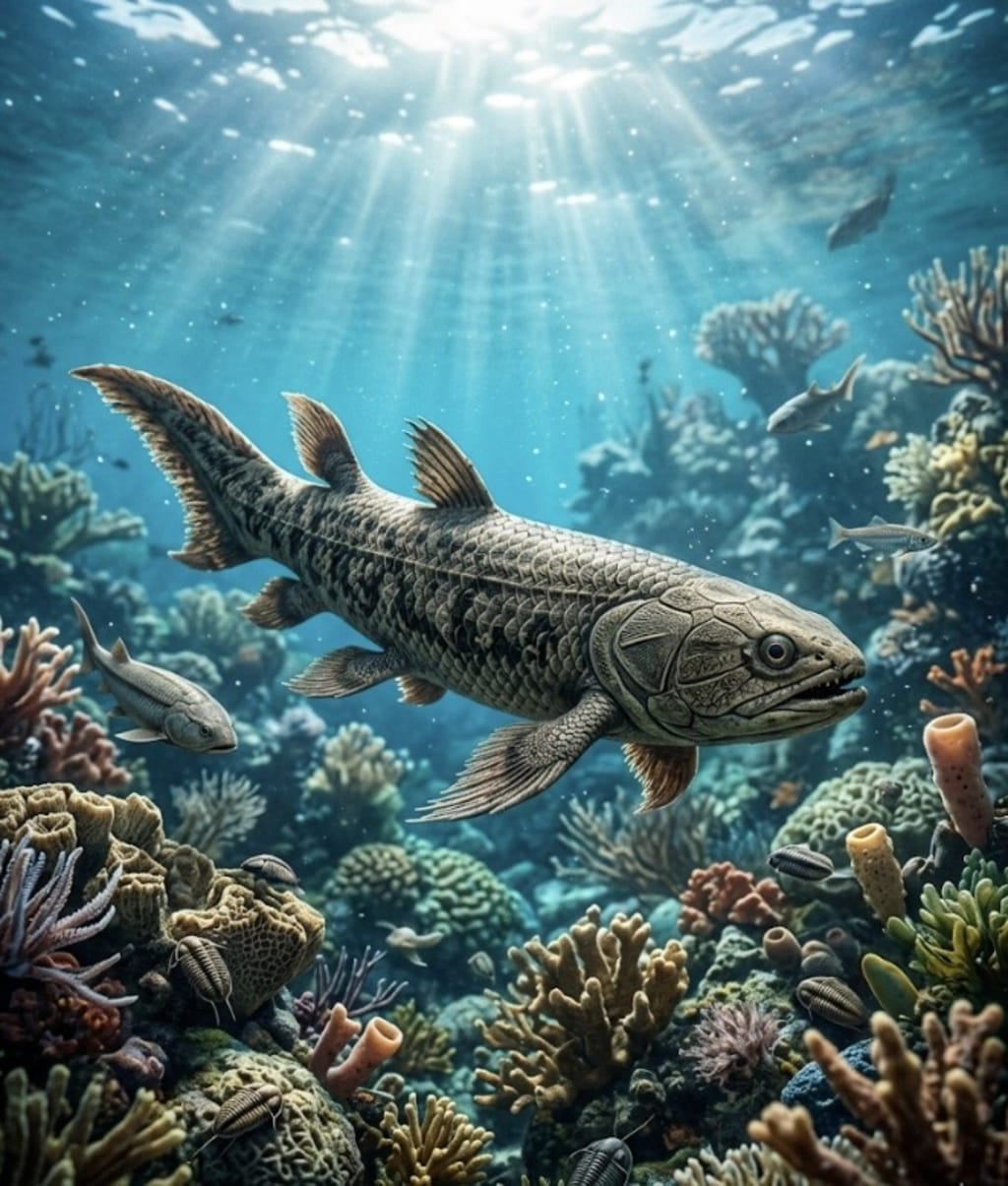
In a groundbreaking paleontological discovery, scientists have unearthed the fossilized remains of an ancient fish species that lived millions of years ago, now being referred to as the “Word Fish.” This remarkable find, preserved in near-perfect condition, is providing researchers with a unique glimpse into marine life from a time long before humans walked the Earth.
The fossil was discovered in sedimentary rock formations that date back to the late Devonian period, roughly 360 million years ago. What makes this species extraordinary is not only its age but also its unusual anatomical features. Preliminary studies suggest that the Word Fish had a body structure unlike most known prehistoric fish, with elongated fins and a streamlined form that indicates it was a highly efficient swimmer. Its jaw structure and teeth arrangement also hint at a specialized diet, likely consisting of small invertebrates and plankton, showing a sophisticated adaptation to its environment.
Dr. Helen Carver, lead paleontologist on the excavation team, expressed her excitement about the discovery: “Finding a fossil like this is extremely rare. The Word Fish provides crucial evidence about the diversity of marine life millions of years ago. Its unique features help us understand how early fish evolved and adapted to changing oceanic conditions.”
The fossil’s name, “Word Fish,” comes from the unusual patterns observed on its fossilized scales. When viewed under a microscope, some researchers noticed intricate, almost language-like grooves and markings along its body. While these markings are purely natural and not indicative of communication, they sparked the imaginative name and highlight the intricate beauty of evolutionary design.
This discovery has significant implications for the study of vertebrate evolution. Fish are the earliest known vertebrates, and their evolutionary developments set the stage for the rise of amphibians, reptiles, and eventually mammals. By analyzing the structure and adaptations of the Word Fish, scientists hope to fill in gaps in the fossil record and gain insight into how environmental pressures drove evolutionary changes in early marine ecosystems.
The site of the discovery itself is located in a remote region known for its exceptionally well-preserved Devonian fossils. Over the past decade, researchers have uncovered numerous ancient species in the area, ranging from early sharks to primitive lobe-finned fish. However, the Word Fish stands out due to its size, completeness, and the clarity of its anatomical features. Its fins, spine, and skull were remarkably intact, allowing detailed analysis that is rarely possible with fossils of this age.
In addition to its scientific value, the Word Fish provides a fascinating narrative for understanding ancient oceans. During the Devonian period, the seas were teeming with life, including corals, trilobites, and the first jawed fish. This era is often referred to as the “Age of Fishes” because of the remarkable diversification of marine species. The Word Fish adds another piece to this rich ecological puzzle, offering evidence of complex interactions within early marine food chains.
Researchers are now using advanced imaging techniques, including 3D scanning and digital reconstruction, to create a virtual model of the Word Fish. This technology allows scientists to study its anatomy in ways that were not possible with traditional fossil analysis. By digitally reconstructing its muscles, fins, and skeletal structure, they hope to simulate its swimming behavior and ecological role in ancient oceans.
The discovery of the Word Fish is also inspiring public interest in paleontology and evolutionary biology. Museums are planning to feature the fossil in exhibits that showcase life in the Devonian seas, emphasizing the complexity and beauty of prehistoric marine ecosystems. For students and enthusiasts, the Word Fish serves as a reminder that even the smallest creatures can provide profound insights into the history of life on Earth.
As research continues, scientists hope that further study of the Word Fish and related fossils will reveal more about how early marine vertebrates adapted to their environment and paved the way for the incredible biodiversity we see today. In a world where much of our past remains buried beneath layers of time, discoveries like the Word Fish are rare windows into the ancient oceans and the evolutionary journeys of life itself.
About the Creator
Irshad Abbasi
Ali ibn Abi Talib (RA) said 📚
“Knowledge is better than wealth, because knowledge protects you, while you have to protect wealth.
Keep reading
More stories from Irshad Abbasi and writers in Earth and other communities.
Human Revenge: A Hidden Cause Behind the Decline of Snow Leopards
High in the rugged mountains of Central and South Asia lives one of the world’s most mysterious and beautiful big cats—the snow leopard. Known for its thick grey-white fur, long tail, and incredible ability to blend into rocky landscapes, this elusive predator has fascinated scientists and wildlife lovers for decades. Yet despite its beauty and ecological importance, the snow leopard faces a growing threat: human revenge.
By Irshad Abbasi 3 days ago in Earth
How Does a Wildfire Sprinkler System Work to Protect Homes from Advancing Fires?
Wildfires have become an increasing concern in many regions where dry vegetation, strong winds, and high temperatures create conditions that allow fires to spread quickly. Homeowners in wildfire-prone areas are now turning to proactive protection systems designed to reduce risk and improve property resilience. Among these solutions, wildfire sprinkler systems are gaining attention for their ability to defend structures before flames reach them.
By Brandon Honeyabout 7 hours ago in Earth



Comments
There are no comments for this story
Be the first to respond and start the conversation.