
Scales of Passion

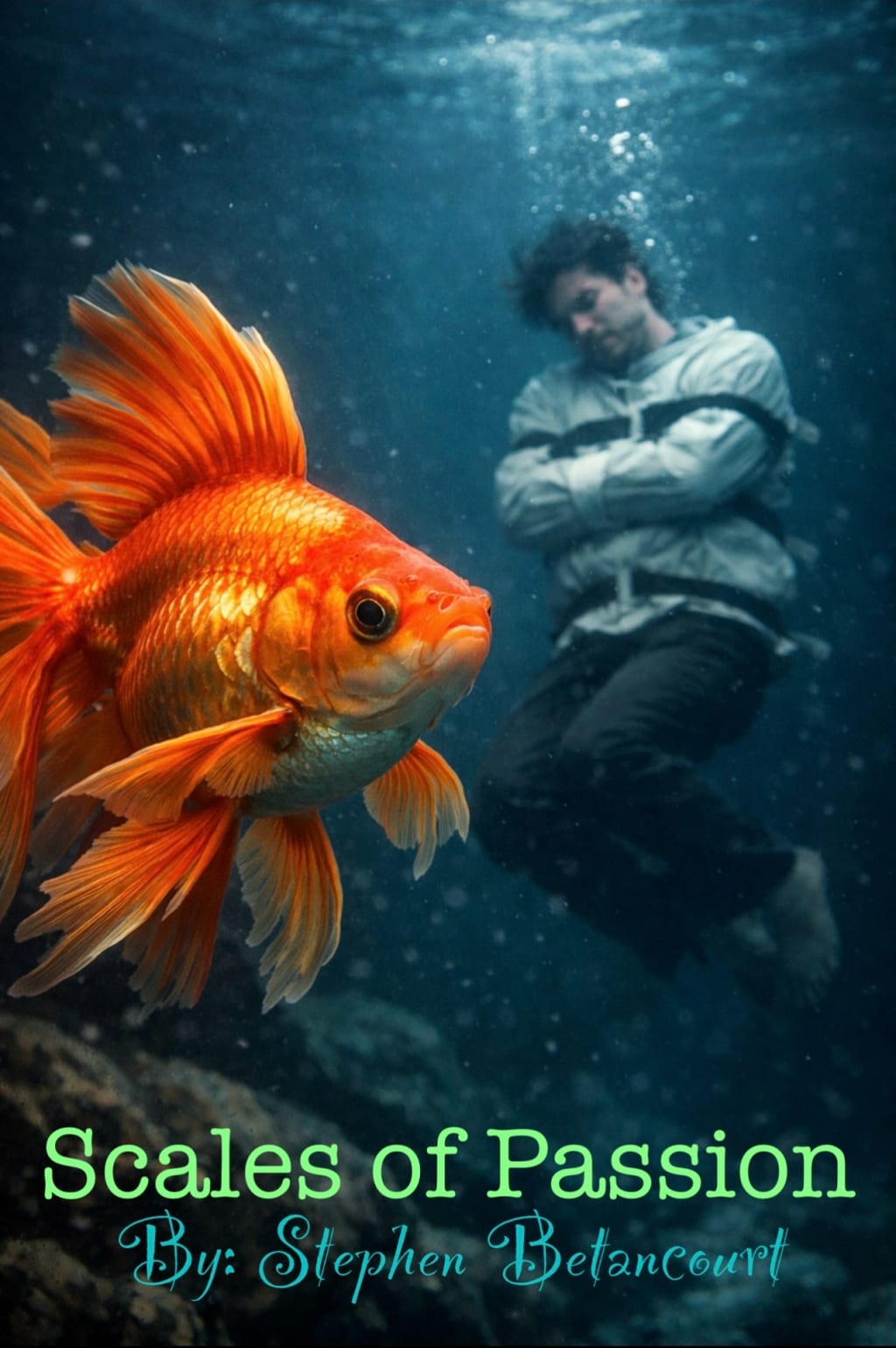
Desire always begins with a sound. Once again, those voices rising from memories of the past dictated an unreliable destiny, reminding him of episodes of dementia and other excessively problematic behaviors born of his solitude.
In Cuqui’s apartment, besides his collection of confiscated weapons and severed animal and human limbs displayed on glass shelves, there was an atmosphere that felt dangerous yet strangely domestic. The smell of Bolognese sauce drifted through the air; the clatter of lids and pots releasing thick steam sounded culinary and almost tender. In the small living room, beside what looked like military equipment resting on a desk stained with dried blood and strange crusted visors, a softly bubbling aquarium glowed under blue neon light.
That aquatic murmur left a metallic taste on the tongue, as if the air itself were electrified. Outside, cars passed, leaving red and white streaks across the wet asphalt; the low roar of a night bus vibrated the windows. The city breathed gasoline and salt. As he removed the pot from the stove and poured the thick meat sauce, he turned on some music, forced a flat smile across his face, chewed something with distaste, and for the first time his goldfish saw him dance.
Cuqui—police officer to the world, vigilante in the shadows—rested his forehead against the cold glass. The goldfish watched him without ceasing its dance. It was not orange but pale gold with greenish, fluorescent flashes beneath ultraviolet light he himself had installed after finding identical scales at crime scenes.
“You’re not normal…” he whispered with a tired smile.
The fish approached the glass, brushing it with almost intimate slowness. When he leaned down to see if it followed him, the small fish shot a stream of water onto his face. It leapt out and back in again, an amusing dance. Cuqui could not stop laughing.
The therapist had told him he needed company.
“Something that forces you to care,” she had said, crossing her legs with clinical precision. Her voice was soft, yet something vibrated beneath each word. “You live in constant tension, Cuqui. You need contact.”
She smelled of dry, slightly bitter perfume. Her lips, always outlined in dark red, curved when he avoided looking at her too long—especially since a week earlier he had seen her with a man who unfortunately turned out to be a criminal he had been forced to kill. He had left his therapist widowed and furious. She, unaware of his nocturnal activities, seemed to believe she herself could be the company she recommended. But Cuqui, serious and distant despite his attraction to her, sought companionship in a bar instead.
A week later he was seeing a jazz singer. They struggled playfully near the sea; she, with alcohol in her veins, lost consciousness and fell before he could react. He dove in after her, but she sank and vanished. In his pocket, a goldfish slipped inside. Back at his apartment, he removed his wet clothes; the fish flopped on the floor. He carefully placed it in a bucket of water.
“Tomorrow I’ll get you an aquarium.” The fish seemed to understand and quickly befriended him.
That night he slept in sadness, alone, electricity weighing in his body. He tried to remember the deceased woman’s face, justifying to himself that their struggle had satisfied them both—after all, she had chosen the isolated place and undressed first. Perhaps he failed to understand it had only been a game; in seeking sex, he made her slip, strike herself, and fall into the deep ocean.
Through the haze of heavy sleep, remorse attacked him.
“Calm down. I’m fine.”
The sound of water grew dense. Waves flooded his space; salt seized his mind. A crack. Then an explosion. He awoke, unable to return to sleep.
At the station the next morning, he was called in.
“Agent Cuqui. The bartender saw you leave with Lisa, the controversial singer.”
“And what is known about her?”
“Answer the question. I know you’re a solitary wolf, and there’s fiction in the bartender’s story. I’m more inclined to think you killed her over payment.”
“And how does my answer help the case? You already have yours.”
The commander studied his sad, serene face and sensed questioning him was useless.
“Better not return to that bar.”
“As you say, sir.”
Later, his partner mentioned Lisa had been reported missing, though the sergeant insisted on waiting forty-eight hours. The partner dismissed the bartender’s drunken account. Cuqui asked instead about fish food; he needed to care for something, as instructed.
He bought a beautiful aquarium, decorated it with lights, and installed his pet. For months he watched a bored fish while burying himself in work. He returned repeatedly to the place where he had last seen the singer. One day he photographed a strange reflection in the sea; another, he found blue scales on the concrete. He placed them beside the aquarium.
Then one evening the fish went wild.
The aquarium exploded.
Glass shattered across tile. Water spilled like a liquid tongue.
From the chaos emerged a body.
There were no clothes. No gesture of modesty. Her skin was coated in luminous film that dried to reveal micro-scales retracting slowly. Legs formed in visible muscular spasms, as if anatomy were rewriting itself in real time. The room smelled of open sea, iodine, salt.
She looked at him.
There was no shame in her nudity—only biology adapting to air. Her breathing quickened; her skin sought warmth. She approached him clumsily, learning gravity.
“What are you?” he asked.
“What you watched every night,” she answered.
She kissed him, tasting of sea.
He later left for work, planning to bring her clothes. Alone, she learned quickly. She walked through the apartment leaving saline footprints, submerged in the bathtub, and emerged when he returned from night patrol. Sometimes she donned a mask and took another revolver, dispensing her own brand of justice in the neighborhood. He confessed everything to his therapist; nothing changed.
Months passed.
Bodies began appearing by the sea, marked with curved bites and fluorescent scales reacting to heat under UV lamps. Internal Affairs assigned Samira to monitor him. She moved with marine grace, fabrics clinging as if restless in air.
One night on the beach she entered the water and transformed—subtle at first, density shifting, then unmistakable: a tail where legs had been.
Another siren emerged. Truth unfolded in violence and jealousy. Shots were fired; the malicious creature was taken, dying.
Days later, Samira’s body lay in the morgue.
The case was sealed in secret files.
The therapist listened with a restrained smile.
“Creatures who desire you,” she murmured. “And what do you desire, Cuqui? To be saved… or devoured?”
He signed his own commitment order.
The psychiatric hospital was white and metallic. Time dissolved beneath medication. He began to believe nothing had been real—until he saw a goldfish again in the therapist’s office. He felt nothing.
Later, he discovered corruption: his commander involved in drug trafficking, paying to keep him isolated. The therapist turned threatening. Chaos erupted one night as pipes burst; water flooded halls.
The princess rose from the plumbing. A sylph followed, wind and electricity embodied. The therapist collapsed, lungs ruptured by unseen force. The sylph freed Cuqui. They escaped amid sirens and gunfire.
On the coast, he met his partner one last time, denouncing the commander. Then the princess pulled him into the sea.
“The sea swallowed him,” read the report.
Three days later, Cuqui’s body washed ashore.
Marked by semicircular bites and long scratches—not defensive. Intense. His expression ambiguous.
The report cited psychiatric history.
In the hospital, a new therapist watched the news. When she turned off the screen, the princess’s face reflected behind her.
She laughed.
In her drawer lay a jar of fluorescent scales.
And beneath the ocean, silhouettes waited with inhuman patience.
The terror was not what they had done.
It was what they were still waiting to do.
About the Creator
Stephen Betancourt
poems have different melodies, which shapes their theme; they are meant to be read soft or in a strong voice but also as the reader please. SB will give poetry with endless themes just to soothe and warm the heart.
Keep reading
More stories from Stephen Betancourt and writers in Criminal and other communities.
The Bet
That night, Mariela’s dad stumbled into the house, tears streaking his face. He’d made a bet with his worst enemy—“the bastard”—about the outcome of the football club’s big game. According to the absurd bet, if his enemy lost, the loser’s wife would have to spend the entire day in her office serving coffee in an insanely awkward situation… wearing a short, low-cut dress.
By Stephen Betancourt2 months ago in Humans
The Story of Tameka Drummer
At 34 years old, Tameka Drummer was a mother of four simply trying to make her way home when a routine traffic stop in Alcorn County, Mississippi, altered the trajectory of her life forever. It was 2006 when police pulled her over for an expired license plate — a tag that was later found sitting in plain sight in the backseat. What happened next set off a chain of events that would leave her serving life in prison without the possibility of parole for less than two ounces of marijuana.
By Organic Products 2 days ago in Criminal
Goodbye, Mr. Duvall
It is turning out to be an interesting year. I was in the middle of teaching a class when a pop-up appeared on the screen announcing the death of Mr. Robert Seldon Duvall (yes, that was his full name). I was in the middle of a discussion on the obsession we have with winning when it comes to sports (the Winter Olympics was a theme), and I felt as though things were coming full circle. We had already lost Gene Hackman last year, and along with that titan, it feels though one particular golden age has closed off to be replaced by...?
By Kendall Defoe 6 days ago in Geeks




Comments
There are no comments for this story
Be the first to respond and start the conversation.