
When the Wind Knocked
A war veteran, a restless night, and the quiet invitation to move again

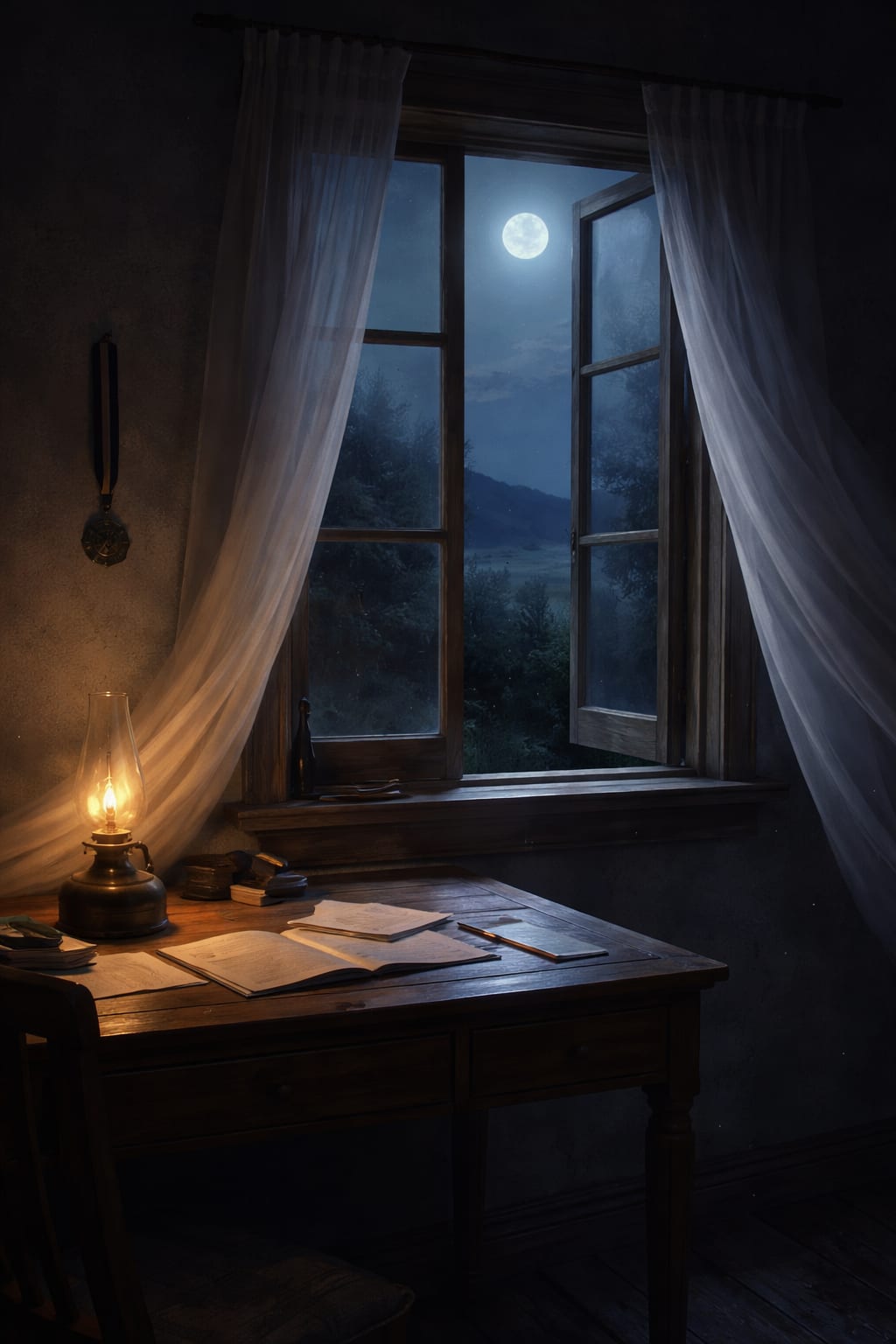
The wind had been knocking for three nights before I finally admitted that it was not weather.
It began as a murmur against the old glass, a careful tapping as though some hesitant traveler had lost their way and mistaken my window for a door. My house stood at the edge of the town, where the road thinned into gravel and then into nothing at all. Beyond it lay fields the color of rusted gold, and beyond those, hills that swallowed the horizon. The wind had always passed through there freely, dragging dust and forgotten leaves along its restless path. But this was different.
This felt deliberate.
It rapped meekly against my windowpane, not in fury but in inquiry. A patient rhythm. A question formed in air.
I lay awake listening to it and wondered what it wanted.
There is a particular kind of loneliness that makes a person sensitive to invitations. Mine had settled in after the war. I had come home with all my limbs, with a commendation pinned to my jacket and silence stitched into my mouth. Others had come home draped in flags. Others had not come home at all. I carried their names in my chest like stones.
Perhaps that is why the wind chose my window.
On the fourth night, I rose from bed and stood before it. The moon was thin and watchful. The glass quivered faintly beneath the wind’s touch.
“What is it?” I asked, though my voice did not travel far.
The wind pressed closer, slipping along the frame, whispering through the smallest cracks in the wood. It smelled of distant rain and something colder—like mountain snow untouched by footprints.
Should I answer it? Should I open the latch and let it inside?
I feared where it might ask me to go.
For the wind is not content with stillness. It does not knock merely to sit by the hearth. It calls.
I imagined it lifting me upward, heaven-bound, carrying me past the heavy clouds that brood above the hills. I saw myself rising beyond the weight of memory, beyond the ache in my bones and the grit of this small town. The wind would sweep me high, where the air thins and the world looks manageable, almost gentle.
But ascension is only one of its talents.
The wind also knows the underworlds.
I have walked through landscapes that felt like hell-scapes already—villages scorched to their foundations, streets where laughter had once lived reduced to rubble and smoke. The wind had been there too, hot and furious, stinging with ash. It had torn through broken doorways and lifted the cries of the wounded into a sky that did not answer.
Would it drag me back there? Back to the places I try not to revisit when sleep grows thin?
The glass shuddered as if in response.
Or perhaps it would ask something gentler of me.
Perhaps it would carry me across the northern glaciers I had only ever seen in photographs—vast blue plains that sing when they crack beneath the sun. I imagined standing there as the wind threaded itself through the ice, creating music older than language. I would listen, and maybe the music would untangle something inside me.
The wind is a singer, after all.
But it is also a mourner.
In the town square stands a willow tree beside the river, its branches sweeping the water like tired hands. I have seen the wind weep there, bending the willow low, drawing from it a sound like a long exhale. Grief recognizes grief. I have stood beneath those branches and felt my own sorrow stirred into motion.
Would the wind ask me to weep with it openly, rather than alone?
Or would it pull me south, across deserts where the earth lies bare and unapologetic beneath the sun? I could see it racing across dunes, shaping them into curves and crests overnight. In such a place, there is nothing to hide behind—no buildings, no trees, no memory-laden streets. Only movement and the relentless honesty of sand.
Would it ask me to dance there, to shed the armor I no longer needed?
A sharper knock jolted me from my thoughts.
I placed my palm against the glass. It was cold, and beneath it I felt the faintest pulse, as if the world itself breathed on the other side.
“Where?” I whispered. “Where would you have me go?”
The wind did not answer in words. It never does.
Instead, it slipped around the house, circling it like a patient creature. It hummed along the roof tiles and sighed beneath the eaves. It seemed almost playful now, less an invader and more a guest waiting to be acknowledged.
Mayhaps she seeks only company, I thought.
The wind has always struck me as feminine—not in fragility but in depth. She can be tender as a lullaby or fierce as a tempest. She can cradle a field of wheat into gentle waves or flatten it without remorse.
Perhaps she did not want to carry me anywhere dramatic. Perhaps she sought only an open port, a place to alight briefly like a crow upon a fencepost. Even the restless grow weary of wandering.
And yet, I knew her strength.
She could shatter the glass like nothing.
If she chose, she could fling open my window without permission, scatter my papers, overturn the quiet order of my small, carefully controlled life. She could remind me that walls are suggestions, not guarantees.
I unlatched the window.
It creaked open just enough to admit a thin ribbon of air. The wind slipped inside cautiously, brushing my face with cool fingers. The curtains stirred. A loose page on my desk fluttered, then settled.
The house inhaled.
For a moment, nothing catastrophic occurred. No command thundered in my ears. No invisible hand seized my collar and dragged me toward the horizon.
Instead, the wind lingered.
It moved through the room with quiet curiosity, tracing the edges of photographs, stirring the dust that clung to forgotten corners. It paused by the medal hanging on the wall, then drifted toward the bookshelf where old letters rested unopened.
I felt something loosen in my chest.
“You’ve been everywhere,” I said softly. “What do you want from me?”
The wind brushed against me again, and in that gentle contact, I understood.
It was not asking me to escape upward or descend into old battlefields. It was not demanding I trek across glaciers or deserts, nor compelling me to sing or weep or dance unless I chose to.
It was asking me to move.
Not geographically, but inwardly.
I had sealed my life like this window—latched tight against disruption. I had mistaken stillness for safety, isolation for healing. The wind had come not to carry me away but to remind me that stagnation is its own kind of peril.
Outside, the fields shifted in silver waves beneath the moon. The willow by the river swayed. Somewhere far off, a train horn echoed—a sound of departure and return entwined.
The wind tugged lightly at my sleeve.
Perhaps it was asking me to visit the families of those who had not returned. To speak the names I carried like stones and let them be shared. Perhaps it was urging me to sit beneath the willow and allow myself to weep where others could see. Perhaps it was inviting me to write, to let the music of glaciers and deserts and battlefields pour from my guarded mind into something that could be held.
Movement does not always require distance.
Sometimes it requires courage.
The wind swelled slightly, filling the room with its presence, then softened again. It did not demand. It waited.
“I’m afraid,” I admitted.
The confession felt heavier than any pack I had carried overseas.
The wind did not mock me for it. It simply remained—cool, steady, alive.
Fear, I realized, is a door like any other. It can be opened.
I widened the window.
This time the wind entered more boldly, sending the curtains into a pale dance. The house no longer felt like a bunker. It felt inhabited.
I closed my eyes and let it move around me. I felt its journey in the scent of pine and distant rain, in the faint salt that hinted at seas I had never seen. It had traveled across mountains and graves, across cities bright with laughter and valleys hollowed by loss. It had borne witness to everything and kept going.
Perhaps that was its lesson.
When I opened my eyes, the moon had shifted higher. The night seemed less oppressive, more expansive. The fields beyond my window were not an edge but an invitation.
The wind eased back toward the open pane, as though satisfied.
“Will you come again?” I asked.
It brushed my cheek in answer, then slipped out into the waiting dark.
I left the window open.
The wind is surely asking something; it raps gently on my old window. Should I ever deign to answer it again, I no longer fear where it might ask me to go.
For now, I understand.
It asks only that I do not remain still forever.
About the Creator
LUNA EDITH
Writer, storyteller, and lifelong learner. I share thoughts on life, creativity, and everything in between. Here to connect, inspire, and grow — one story at a time.
Keep reading
More stories from LUNA EDITH and writers in Confessions and other communities.
Lately, I'm empty
Lately, I feel an emptiness inside of me that doesn’t make any sense. I was fine a week ago and now I’m numb to the pain that I’ve been carrying around. Numb to the idea of me existing. I wish I could go to a place where I can hear happy positive thoughts and surround myself with joy. The medication I’m on doesn’t seem to work anymore. I still feel pain from existing, why am I here anyways? Merely to exist. I don’t feel like I’m making any differences being here.
By Cerina Galvan20 days ago in Confessions
Embrace the Spirit: A Journey to Connection and Empowerment
Sensing Spirit? Have you ever sensed the presence of souls or spirits surrounding you, their silent pleas echoing through the ether, beckoning for your assistance? In moments of such overwhelming energy, do you find yourself unsure of how to respond, yearning to connect with, yet also wishing to shield yourself from, the spirit world? Have you pondered the ways to cultivate this connection or even sought to sever ties with unwanted energies? If this resonates with you, allow me to offer you some enlightening guidance.
By Debbie's Reflection3 days ago in Confessions




Comments
There are no comments for this story
Be the first to respond and start the conversation.