
What in Me Refuses Silence
On Language, Chaos, and the Animal That Could Not Stop Asking.

On Earth, what seems earthly — a place and a being — appears logical. Yet what could it have sworn to remain, if even words eventually change? What seems like solid land may slide away; the earth itself may become none — not absent, but nonexistent in the way only believed things can become nonexistent.
It is strange that we do not always need a brush or a sheet of paper to stir something in us. We have long searched for reflections of ourselves even within language — and found, strangely, that language was searching within us at the same time.
A human being binds himself to words, to context, to meaning, as though they were enough to build his world. But is the limitation in language itself, or in the narrowness of the soul that uses it?
A precise mind moves in geometrical ways — connecting points, requiring both constants and variables to create meaning. Language does the same: it fixes something in order to move something else. This is its power and its quiet tragedy. Every word is a negotiation between what happened and what can be said.
There is a kind of egoism — subtle, nearly invisible — in the person who takes language not as a tool but as the only sign of truth. Who mistakes the map for the territory, the name for the thing. A language border can corner you in a rough and bottomless lack, shaping your inner life without your consent, making you believe the limit of your words is the limit of what exists.
What is the world to humans? It is neither merely physical nor biological nor madness — it is something closer to a demonstrated demand, a tired precondition of a lost soul, directed toward chaos by forces it cannot name or locate. Underwater waves. The grammar of things we did not choose.
Perhaps language was the first fracture. Or perhaps it was never so dramatic — nothing more than directions, desires, and pleasures, dressed in the costume of necessity.
I sink into something ship-shaped now, voices asking what the questions could have become and where they might have gone — how many more or fewer circles, heavy curse, heavenly blessing.
What precedes fear? What carries the first question before it becomes language?
Was it reason — or something more obscure, a silent pulse beneath thought, an unnamed identity of the soul? Was chaos there from the beginning, unable to remain chaos, forced into meaning because a confused creature cannot endure the weight of non-meaning?
Perhaps we could never define that origin — not until language surrendered, reducing vast impulses into cheap terms, compressing breath into narrow forms of thought.
And if chaos reshaped itself into meaning only because we could not survive without it —
then this was never philosophy. It was hunger. The organism that could not tolerate the open did not transcend — it panicked, built walls, and called them home.
And yet.
Why am I asking? What in me refuses silence?
Not reason — reason would accept the available answer and stop. Not instinct — instinct does not ask, it moves. Something else. Something that looks at the construction we have built for survival and cannot stop noticing that it is a construction. Cannot stop pressing against the walls. Cannot stop wondering what is on the other side of what we have agreed to call real.
That refusal is not a flaw in the human design. It is the design. The animal that could not stop asking became the animal that built everything. And destroyed everything. And asked again.
What in me refuses silence is me.
And that may be the only honest answer available — not comforting, perhaps, but its own kind of ground.
Work Sensation — Artist Statement
This work was not painted to depict collapse.
It was painted to depict construction under pressure.
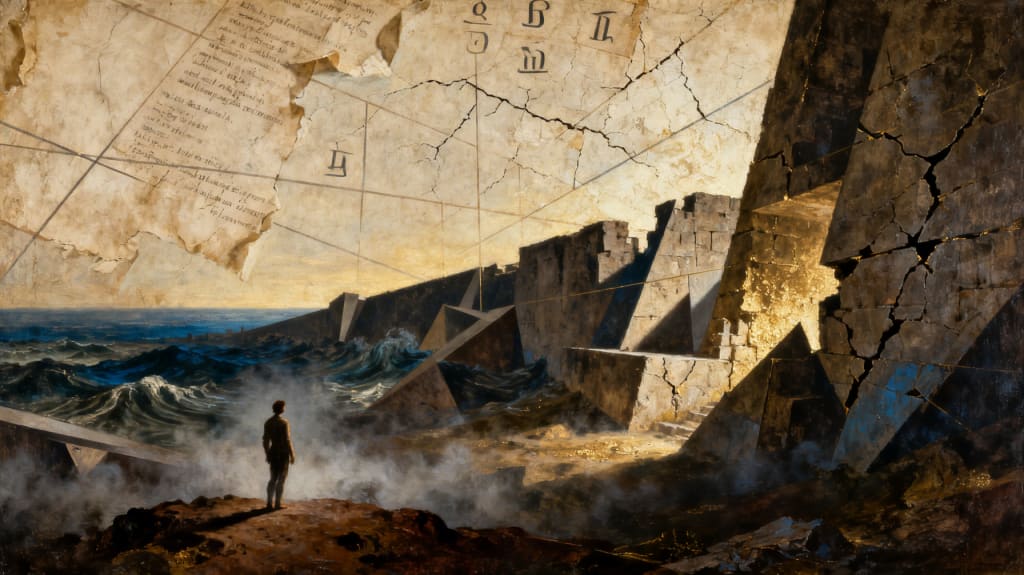
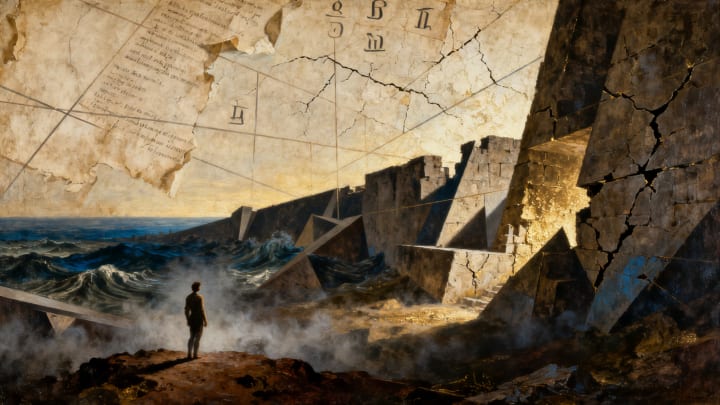
The figure is not a hero, nor a victim. He stands at the threshold between what appears stable and what is actively disintegrating. The earth beneath him seems solid, yet everything beyond it fractures into geometry. The architecture in the distance is not ruin — it is resistance. It is meaning attempting to organize chaos.
The sea represents what cannot be contained. It does not attack with intention; it simply exists in motion. The walls are human. The waves are not.
The sky, layered like torn parchment, carries traces of symbols and diagrams. It suggests that language and mathematics were not discoveries, but defenses. We did not describe the world — we built structures against it.
The golden light emerging from the fractures is not divine salvation. It is exposure. When meaning cracks, something shines through — not necessarily truth, but interiority.
The smallness of the human figure is deliberate. The scale emphasizes that the individual does not control the architecture he stands before. He inherits it. He questions it. He witnesses it.
This painting explores one central tension:
The organism that could not endure the open built walls and called them home.
The work does not ask whether those walls are false. It asks what happens when we realize they are constructed.
Stillness.
Pressure.
Geometry holding against water.
That is the sensation.
About the Creator
LUCCIAN LAYTH
L.LUCCIAN is a writer, poet and philosopher who delves into the unseen. He produces metaphysical contemplation that delineates the line between thinking and living. Inever write to tellsomethingaboutlife,but silences aremyway ofhearing it.
Keep reading
More stories from LUCCIAN LAYTH and writers in Confessions and other communities.
Letter III — On What Reorders Us Without Asking
Letter III — On What Reorders Us Without Asking The Void, beyond the 22nd century Aida, I am not writing to explain anything to you. Nor to convince. Nor to teach. I am writing because some encounters do not add ideas to us— they rearrange us. Most of our lives are built on a quiet assumption: that we are the center. That we read, choose, enter, and exit meanings at will. That texts stand before us, waiting to be interpreted. But there are words that do not stand before consciousness. They relocate it. The Qur'an does not position itself before your awareness. It repositions your awareness itself. It does not offer itself as an object of reflection, but acts as a force of gravity. You do not move around it untouched. You are moved. What I have learned slowly, unwillingly is that human beings do not live inside ideas. They live around centers. Every self revolves around something: a desire it cannot release, a fear it cannot face, an image it must protect, a future it keeps postponing itself toward, a past it secretly obeys. These centers shift. They compete. They collapse. And when consciousness expands—through thinking, ambition, imagination, abstraction, it often mistakes dispersion for growth. It believes it is becoming freer, while quietly losing its axis. Expansion without a center does not liberate. It fragments. There is a reason instability feels modern. Not because we think too little, but because we orbit too much.
By LUCCIAN LAYTH9 days ago in Confessions
Blessed 33
So I woke up on the morning of February 5, 2026 and guess what and you know what I realized? It’s my 33rd birthday. Do you know what that means? Yes, technically I’m getting old, but what I couldn’t have guessed was this would be one of the best days of my life.
By Joe Patterson9 days ago in Confessions
Word of the Day: 漬物
I am amazingly calm right now, I actually don't have anyone in my energy right now, it feels... blissful. I am making my pickled onions right now, I am about the roast my pumpkin from halloween, I think I am going to plant the seeds outside since I can. I mean, it is very pleasant. I know I need to still do my homework and such but since I have 5 pages of todo lists, I really have spare time to do stuff right now.
By Kayla McIntosh6 days ago in Confessions
Draft Deleting? Don't Do It!
Today, I had a little time. I decided that I would have a look at the drafts that I have on Vocal. This is part of a long-term wish to have everything I've written on paper rather than virtually. I've not looked at them for weeks and something drew me to them, just to browse and see what was there.
By Rachel Deeming2 days ago in Writers


Comments
There are no comments for this story
Be the first to respond and start the conversation.