Science
Why You Shouldn’t Fear Death
One thing I can say about you right now, is that you are going to die, and yes this is scary, that is why today i am going to use scientific principles to help you understand and cope with the inevitable ending of your life. Grade 7 was the first i ever processed the concept of dying. I remember freezing in my tracks and thinking, wait so, this is all just going to end? Mommy! I eventually agreed with my own brain to suppres this fear and just go through the motions of life. I put excessive energy into schoolwork, got pimples, started date girls, realizing I only wanted to to them about the Lizzie McGuire movie, so I started dating guys, but it wasn't until my brilliant high school teachers made me fall head over heals in love with science, that a healthy perspective on death began to emerge. Your body is controlled by genes that code for proteins that lead to the formation of neural impulses that make constantly search out for meaning in life. This was first shown in a slightly violent study in the 1960. Participants visualized videos of victims suffering electrical shocks. the participants watching the videos would harshly judge the victims of the shocks as bad people. Psychologists and bioligists began to posit that humans feel an inate impulse to create meaning. In this case if you had to watch someone get electrically shocked, then they must have deserved it. It is now understood that according to your biology, you and everyone else on the planet will constantly be looking for meaning to life, and to death. So according to science at least you know you're not alone in any attempt to explain your own death. Now lets zoom out . Look at the night sky and you see the milky way galaxy full of an estimated 100 billion stars. That is is just one galaxy, there this a billion other galaxies in our observable universe, which is only expanded and getting bigger. How can we matter in such an expansive universe? Well, put both of your firsts together like this. That is roughly the size of your brain. An organ that has evolved over millions of years to have 86 billion neurons and even Glial cells to support it. There are more cells in your brain than stars in the milky way galaxy. You have an incredibly biological machine tucked wonderfully into your skull right now, that is astonishingly capable of conceptualizing the very idea that our universe is huge, expanding and vast. Science essential proves you are exceptionally smart. Before you die, you have unique opportunity to live a complex and wonderful life. Like all other forms of life on earth, you are made of atoms and atoms and molecules smashing into one another, absorbing energy from your environment, but unique to you, in your amazing brain, is the ability to contemplate your actions, make decisions, and care. Now let's zoom in. As a science teacher I know you should all remember drawing the electron diagrams of the first 20 elements of the periodic table. This is part of most, worldwide, high school science curriculum's. If you don't remember doing that, then on behalf of all science teachers everywhere... clap clap Eyes on the board please? Thank you. Can we all pay more attention in class? These diagrams were meant to show you that everything in our known universe is made up of protons, electrons, and neutrons. Yes we can get even smaller into the realm of quarks, Bosons or neutrinos, in fact, the sun is constantly emitting neutrinos with 100 trillion of them passing through your body every second. But let's stay on topic, we're talking today about death. We'll save neutrinos for another day. These protons, neutrons and electrons are all governed by forces that help explain, well, everything. How you evolved how you move, and yes, most importantly, how your phone works (hello?) You can describe your whole life based on the positions , velocities, and orientations of all of these atoms in your body, and this is called kinetic theory. You can use the kinetic theory to explain how plants absorb energy from the sun through photosynthesis. We eats plants or animals that have eaten plants, in order to gain that energy. Our bodies use that energy to power the process of the special molecule a called ATP, which powers every part of your life. Muscle contraction, transporting molecules throughout the body, synthesizing DNA etc. And yes, ATP is synthesized in the mitochondria, making the mitochondria the powerhouse of the cell. Infact, to stay alive, you'll typically create and use your whole bodyweight inATP molecules in one day. But, this also means that according to the kinetic, theory, regardless of your religion or spirituality, dying means that life as we know it ends. As your body loses the capability of creating ATP, and you start to physically fall apart. And one study found that when given the option to essentially produce ATP forever and live for eternity, overwhelming people said no, they want to eventually die. The fact that death is looming is what makes life so special. And in a wonderful way, death is really the only thing that we all have in common. In many ways, death is the meaning of life. Also passionately learning about science offers the unique opportunity to grasp what science can't explain. And knowing what science doesn't know can bring clarity. Takes these 3 examples of Shawn Caroll's epic book, the big picture. 1 the universe is expanding, 2 humans and chimpanzees share a common anscestor, 3 we should live happier and longer lives. The first 2 statements are rooted in science. We use impericism, resoning and observation to explain them. The last statement is not rooted in science. Science doesn't involve doing experiments to decide if people should lead happier, longer lives. Science just observes the world and it doesn't say whether something is right or wrong. Another way of looking at this is through evolution. Evolution is an incredible process based on millions of years of change, adaptation, and impulses. It just follows the laws of nature, but can't explain how to live your life. You have the power to change your life. You have the power to care about others, and you have the power life love laugh, babe, and that is incredible. After you do inevitably die, you live on in the memories of others for the time being. And then, you'll be forgotten in the change and passing of life. There are this any atoms in your body which insanely amazing but, these little guys will eventually stop being you. And even though collectively they will no longer be you, it is comforting to know that they will remain on earth after you have left. Once gone, even if the whole human race vanishes, the universe will still be here doing its thing, moving along according to the laws of nature. But sticking to right now, according to science, we are all sharing this universe, sharing the same laws of nature and sharing the same task of creating meaning to what is happening around us. It is estimated that you have around 3 billion heat beats in a life time, so it is up to you to make them count. So, some scientific reasons to not fear death is 1, we humans are meaning making machines, we can choose to not make death a dreadful thing, and choose to live a meaningful life. 2, you might feel insignificant, but there lies within you more neural cells than stars in our universe. 3, eventually you will stop making ATP, but the fact that it ends, is what makes life so great. 4, science can't explain everything, so it us to you to choose to live your life to your fullest. And 5, eventually your atoms will atoms will stop being you, but you were made of will likely carry on for eternity. Science is a brilliant way to view the complexity of your life and help inform how you live it, while here, and thankfully, if you are still watching this, congratulations, you are alive, but again if there's one thing I can say about you right now, it is that you, yes you are going to die. I'm constantly on a quest to deal with my own fear of death and this book helped me with this video a lot, its called the picture by Shawn Carroll it is amazing, check it out. It talks about morality, consciousness, life, death, and all through the realm of science. We'll leave the link to get the book below and make sure you subscribe for more science videos, peace.
By TBH Agencia Exclusiva Colsanitas2 years ago in Chapters
What's Inside A Wasp's Nest | What's Inside?
This is a wasp next. In the wild, some of these nests are built underground using clay or mud. But you might be most familiar with the paper nests -- the ones built out of saliva and pulp, typically found attached to buildings or trees.
By TBH Agencia Exclusiva Colsanitas2 years ago in Chapters
The Art of Talking to Anyone: Unlocking the Power of Connection . AI-Generated.
In a world driven by connections, the ability to talk to anyone—be it a stranger at a café, a colleague in the office, or a potential friend at a party—is a skill that can open doors to new opportunities, enriching experiences, and lifelong relationships. Yet, for many, the act of socializing can feel like navigating a labyrinth, full of uncertainty and self-doubt. But what if I told you that mastering the art of conversation is not only achievable but can also become a source of joy?
By Raghul Sivaram2 years ago in Chapters
12 Ways to Make Life Better: A Guide to Thriving, Not Just Surviving . AI-Generated.
Life is a journey, often filled with unexpected twists and turns. While we can't control every circumstance, we can choose how we navigate through it. Making life better doesn't require grand gestures or monumental changes; it often starts with small, intentional actions that create ripples of positivity. Here are 12 ways to make life better—simple yet profound steps that can transform your everyday existence into something truly remarkable.
By Raghul Sivaram2 years ago in Chapters
Why Can’t We Power Our Homes From Lightning Strikes?
Have you ever watched a thunderstorm and wondered, “Why can’t we use all that lightning to power our homes?” It seems like a great idea. After all, lightning is powerful, striking the Earth around 8 million times a day. But there are several reasons why using lightning as a power source isn’t as simple as it sounds. Let’s explore why.
By Komal Ghotra2 years ago in Chapters
Is the future of solid-state batteries 3D printed?
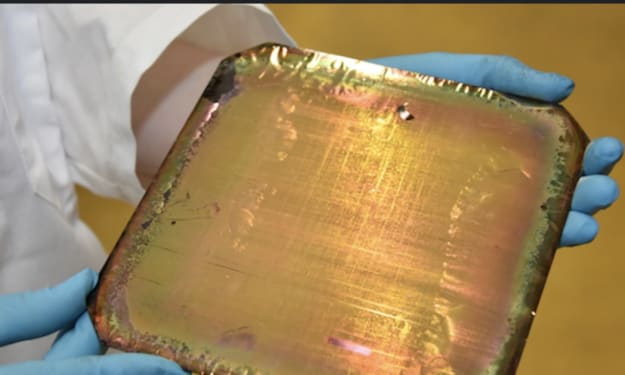
This may represent the future of rechargeable batteries. It offers enhanced power, improved safety, quicker charging times, and an extended lifespan. Theoretically, it could also be designed in any shape desired. Private enterprises and research institutions are competing to develop a battery that could eventually replace the ubiquitous lithium-ion variety. One company is pushing the boundaries further by exploring the concept of 3D printing batteries, thereby transforming our perception of their appearance. To understand the fundamentals, let us define what a battery is. A standard battery operates by converting chemical energy into electrical energy. It requires a positive terminal, known as the cathode, exemplified here by a zinc-coated nail, and a negative terminal, or anode, represented by a copper penny. Additionally, an electrolyte is necessary to connect these two components, which in this demonstration is provided by a potato. I will place one here and another here. The chemical reaction between each terminal and the potato facilitates the release of electrons from the anode, which then travel through the wire back to the cathode. This movement of electrons is what transforms the chemical reaction into electrical energy. Although the initial setup did not yield any results, adding a few more potatoes should enable the light to function. Thank you. These clips are quite challenging. Now, if we could have the lights, please. That was quite effective. This illustrates the basic principle behind any chemical battery. Lithium-ion batteries are among the most successful iterations of this technology. However, there is potential for enhancement, and startups are focusing on two critical aspects of the design: the electrolyte and the anode. Currently, nearly all commercially available batteries utilize a liquid electrolyte. We refer to them as lithium-ion batteries because the electrolyte is saturated with lithium ions that facilitate charge movement. While liquid electrolytes are excellent conductors, they are also volatile, especially when compromised or exposed to high temperatures. If you have been following the news, you may have encountered reports of incidents such as this.
By Caroline Mbabazi2 years ago in Chapters
Top 5 Science Books That Changed My Life
Science has always been a fascinating subject for me, and over the years, certain books have left an indelible mark on my understanding and appreciation of the world. Here are five science books that have profoundly impacted my life, each offering unique insights and opening my eyes to the wonders of the universe.
By Komal Ghotra2 years ago in Chapters
The Rise of Akua
In the year 2050, the world witnessed a technological renaissance, and Africa emerged as a hub for innovation. In the heart of Accra, Ghana, a team of brilliant scientists and engineers at the African Institute of Artificial Intelligence (AIAI) worked tirelessly to create a new generation of AI.
By Ashraf Balakasi2 years ago in Chapters
Toxoplasma: The Common Parasite That Causes Birth Defects
Toxoplasma gondii, commonly known as Toxoplasma, is a tiny parasite that can cause significant health problems, especially in pregnant women and their unborn babies. Despite its small size, Toxoplasma has a widespread presence and can lead to serious consequences. This article aims to explain what Toxoplasma is, how it spreads, and why it is particularly dangerous for pregnant women, all in simple and engaging language.
By Komal Ghotra2 years ago in Chapters