
Saudi Arabia’s Vast Oil Reserves: How Much Oil Does the Kingdom Really Have?
With one of the largest petroleum reserves on Earth, Saudi Arabia remains a central pillar of the global energy system and a powerful influence on international oil markets.

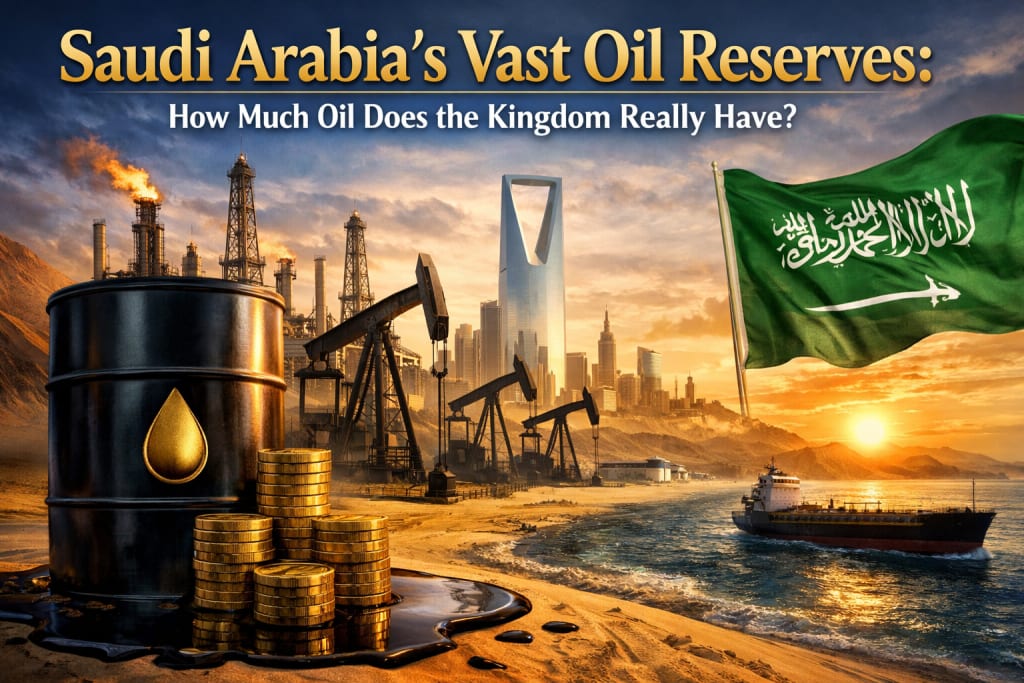
Saudi Arabia is widely known as one of the world’s most important oil-producing nations. For decades, the Kingdom has played a central role in shaping global energy markets through its vast petroleum resources and its ability to influence oil prices and supply. But exactly how much oil does Saudi Arabia actually have? The answer highlights why the country continues to be a major player in the global economy.
According to recent energy statistics, Saudi Arabia holds about 267 billion barrels of proven oil reserves, making it the second-largest holder of crude oil reserves in the world. These reserves represent roughly 15–17% of the total global oil supply, meaning that nearly one out of every six barrels of proven oil on Earth lies beneath Saudi soil. 
Proven reserves refer to the amount of oil that geological and engineering data show can be extracted economically using current technology and market conditions. In Saudi Arabia’s case, these reserves have been carefully documented through decades of exploration and production. The country’s vast desert landscape, particularly the Eastern Province near the Persian Gulf, contains some of the largest and most productive oil fields ever discovered. 
One of the most famous of these fields is the Ghawar oil field, the largest conventional oil field in the world. Ghawar alone is estimated to contain tens of billions of barrels of oil and has been producing crude oil since the 1950s. Along with other major fields such as Safaniya, Khurais, and Shaybah, it forms the backbone of Saudi Arabia’s massive petroleum industry. 
Saudi Arabia’s oil wealth began transforming the country in the 20th century. Commercial oil was first discovered in 1938 near the city of Dammam. Since then, the Kingdom has developed one of the most sophisticated oil industries in the world, largely operated by the national oil company Saudi Aramco. Today, Saudi Aramco is among the largest and most valuable energy companies globally.
At present production levels, Saudi Arabia produces roughly 10 to 11 million barrels of oil per day, making it one of the world’s top oil producers alongside the United States and Russia. 
This enormous output supplies energy to countries across Asia, Europe, and the Americas, making Saudi oil a crucial component of the global energy system.
Despite producing millions of barrels every day, Saudi Arabia still has enough reserves to continue producing oil for many decades. Analysts estimate that the Kingdom’s oil reserves could last more than 80 years at current production rates, although the exact timeline depends on future discoveries, technological improvements, and global demand for energy. 
Another key factor behind Saudi Arabia’s influence is the relatively low cost of extracting its oil. Unlike some countries where oil is trapped in difficult geological formations, much of Saudi Arabia’s crude is found in large conventional reservoirs that are easier and cheaper to develop. This allows the country to produce oil more efficiently than many other producers.
Saudi Arabia is also a leading member of the Organization of the Petroleum Exporting Countries, a group of oil-producing countries that coordinate policies to stabilize global oil markets. Through OPEC and its alliances with other producers, Saudi Arabia often adjusts its production levels to influence oil prices and maintain market stability.
In addition to crude oil, Saudi Arabia possesses significant reserves of natural gas and other hydrocarbons. These resources are increasingly important as the country diversifies its energy sector and invests in petrochemicals, hydrogen fuel, and renewable energy under its long-term economic transformation plan known as Vision 2030.
However, the global energy landscape is gradually changing. Climate concerns and the transition toward renewable energy sources such as solar and wind power are beginning to reshape the future of fossil fuels. Even so, experts believe oil will remain a vital energy source for decades, particularly for transportation, aviation, and industrial production.
For Saudi Arabia, its vast oil reserves remain both an economic lifeline and a strategic asset. Oil revenues fund much of the country’s infrastructure, development projects, and government programs. At the same time, the Kingdom is investing billions of dollars to diversify its economy so it will not rely solely on oil in the future.
In conclusion, Saudi Arabia’s estimated 267 billion barrels of proven oil reserves place it among the most resource-rich nations on Earth. These reserves have given the Kingdom enormous influence over global energy markets and will likely continue to shape international politics and economics for many years to come. 
Even as the world gradually transitions to cleaner energy, Saudi Arabia’s massive oil reserves ensure that it will remain a key player in the global energy system well into the future.
About the Creator
Irshad Abbasi
Ali ibn Abi Talib (RA) said 📚
“Knowledge is better than wealth, because knowledge protects you, while you have to protect wealth.
Keep reading
More stories from Irshad Abbasi and writers in Chapters and other communities.
Saudi Oil Story: From Crude Dependence to Economic Diversification
For decades, the global identity of Saudi Arabia has been inseparable from oil. The Kingdom sits on some of the largest petroleum reserves in the world, and for much of the 20th century its economy revolved almost entirely around crude oil production and exports. However, the Saudi economic story is no longer just about oil wells and pipelines. In recent years, the country has been steadily working to transform its economy, moving from heavy dependence on crude oil toward a more diversified and sustainable economic model.
By Irshad Abbasi about 11 hours ago in Chapters
Dox Thrash (1896–1965)
Dox Thrash and the invention of the carborundum printmaking process Dox Thrash was born in 1896 in the heart of rural Georgia, a place where creativity lived quietly in the corners of daily life. Long before he would become known for revolutionizing printmaking with the carborundum process, Thrash grew up surrounded by the textures and tones of the natural world—wood grain shimmering under sunlight, dusty roads blending into thick summer air, hand‑stitched quilts patterned with the stories of generations. These impressions would later fuel his artistic instincts, shaping a style that felt both grounded and luminous.
By TREYTON SCOTT7 days ago in Chapters
Hottest in the Office
Dear Rafi, You’re very distracting to work around. For the first second I saw you the other day, I thought you were some type of executive. It took a moment to realize no, you were just the new guy, dressed up for the job he wants. Be still, my heart.
By Gabriel Shamesa day ago in Pride



Comments
There are no comments for this story
Be the first to respond and start the conversation.