
Not Path, But Flow
A Philosophy of Impermanence, Movement, and the Collapse of Meaning

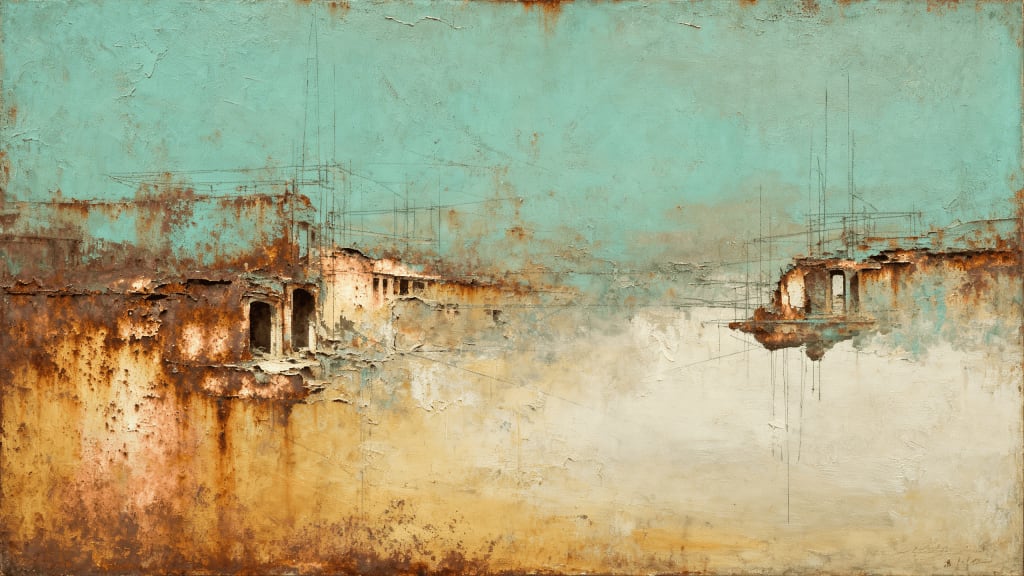
"We do not grant things meaning. We reshape them to accommodate our limited vision of them."
You've felt it before.
That moment when a decision you made six months ago — a decision that seemed right, stable, final — suddenly feels like a cage.. Not because circumstances changed. But because you did. Slowly. In the margins. Until one morning you wake up and the life you built feels like it was built by someone else.
That's not a crisis. That's crossing.
I was not searching for a theory. Theory is an elegant wall.
I was searching for a crack in the wall. A moment not built, but escaped. Not arriving because evidence accumulated, but because structure grew weary of itself.
Understanding does not move you. Conviction does not move you. Completion does not move you.
Movement begins when hidden equilibrium falters. When stability becomes a burden. When settledness reveals itself as deferred collapse.
There, no decision occurs. Only crossing.
Not path… but flow.
Yet flow is not a singular state. It has degrees.
Some instinctual—moving through hunger, habit, the hum of what everyone does. Some existential—watching yourself move while moving. Between these lie structural differences: subjective flow arising from individual consciousness, and collective flow coursing through norms and social architectures.
Both are flowing. But consciousness relates to each differently.
The Nine.
Not a number. Fullness feigning completion.
A circle nearly closing itself, yet tensing from within. Nine is the moment when something believes it has reached its apex, while standing at the edge of rebirth.
Not an ending. Excessive proximity to the ending.
And all excessive proximity is inversion.
Flow here is not dissolution. It is a movement of being that refuses solidification. When the path is taken as the final truth, it transforms from passage to wall. From experience to prison.
My philosophy is not meaning, but liberation from meaning's rigidity.
Meaning is not the enemy. But it becomes constrained when we forget it is temporary—a passing configuration of consciousness moving through one possibility among infinite possibilities.
And the Three…
Three is not a sum.
One sleeps in its certainty. Two face each other in the mirror. But three create disruption.
The third is the disturbance preventing duality from settling. Perception, hesitation, action—yet action is not a result, but a fracture in the relationship between the first two.
There are no elements. It is an angle that prevents the circle from closing.
These are uncertainties. Not to drown you in doubt, but to keep perception alive. Moving. Incapable of false settlement.
You are not asked to find the final answer, but to see what you built before, then witness its collapse without resistance.
Not nihilistic collapse. Transformation in the structure of seeing.
Here the story begins.
There was a woodcutter whose only task was felling giant cedar, then carving it. He was not merely cutting wood—he was reshaping the existence that stood before him. He made his life a ritual of demolition claiming to be creation.
He produced a thousand sculptures and named them. The name was his attempt to restore meaning to what lost its roots.
He had a son who asked him: It is wood. But it is not truly wood—it was a tree standing by itself, connected to earth, then severed.
The woodcutter said: I granted it another life.
The child said: Or did you not endure an existence not revolving around you, so you cut it then reshaped it to become subject to your meaning?
Then he asked: Why did you not sever your hand and reshape it as an axe? If value lies in utility, why did demolition not begin with yourself?
Here philosophy reveals itself:
We do not grant things meaning. We reshape them to accommodate our limited vision of them.
The woodcutter practices instinctual-social flow. He cuts because this is what woodcutters do. He carves because this is what gives wood "value." His consciousness is collective. He does not see the violence of his action. Does not see that he subjects being to his own logic.
The child sees from another flow. He witnesses structure. Sees action as action, not as "natural necessity." His consciousness has not yet been fully shaped by the collective.
So he can ask: Why?
The child stands in the margin.
As for the margin…
The margin is not seen. Not because it is distant, but because it does not ask to be seen.
The center is loud, clear, and legible. The margin is faint, yet it accumulates small deviations.
Their transformations begin. Not in the open, but in the silence that slows recovery.
Every decision was born from a small error left uncorrected in the margin.
This is a complete sample I can manipulate, because it is built on my ideas—and my ideas are not fixed possession, but pathways consciousness passes through. Pathways forming in the margin, not in consciousness's clamorous center.
It is a theory that demolishes ideas, yes—but demolishes them not to leave a void, but to return them to their original state: possibilities before solidification.
Creative destruction. Not against meaning, but against its ossification. Casting non-meaning upon meanings, not to negate them, but to free them from claiming eternity.
Perpetual kinetic act: merciful killing of parts of you.
Not as denial of self, but as clearing space for more expansive versions.
Birthing new life, not through addition, but through removal of what you assumed yourself to be.
Walking then walking. Rising then falling. Not an absurd cycle, but the rhythm of consciousness when it does not resist transformation.
When we create meaning, we do not discover cosmic truth. We build momentary stability within a cosmos that knows no constancy.
Here freedom reveals itself: to build without being imprisoned by what you built.
How do you make for the cosmos a prison that imprisons you within it, instead of flowing with it?
The prison is not in walls. It is in believing what you see now is the final structure.
Instinctual flow lives movement without seeing it.
It moves through hunger, desire, habit, what the collective dictates. Its consciousness is aggregated, shaped by others, by norms, by what is considered "natural."
It is a genuine flow. But blind to its own architecture.
Existential flow lives movement while witnessing it.
It does not deny instinct, but is not reduced to it. It sees action and the structure it reproduces. Its consciousness is individual-cosmic: seeing itself in direct relation with being, not solely through collective mediation.
Both are flowing.
The difference lies not in movement, but in consciousness's relation to it.
The beauty of things lies not in their complete comprehension, but in their capacity to be seen without subjugation to understanding.
The capacity for non-understanding is not ignorance. It is a form of zero observation, where the thing is permitted to be before being interpreted.
Perhaps everything granted meaning was stripped of its original root. Transformed into projections upon selves that did not inhabit the same fields.
Meaning then is not origin within us, but a trace of interaction.
The world when submerged in non-meaning was not deficient. We created meaning to settle within it.
And strangely, those projections returned to control us.
We created the capacity to imitate meanings, not experience them. So we closed entire zones of being because they cannot be understood, though they still pulse in the cosmos's echo.
Philosophy is not written. Philosophy seeps.
Not meaning. But erosion in meaning's solidity.
When meaning becomes stone, philosophy arrives as water. Not to shatter it, but to return it to sand.
Therefore I say: beatitude lies not in reaching meaning, nor in losing it, but in the capacity to pass through meaning without stopping at it.
To let it form. Use it. Then let it dissolve as the wave dissolves in the ocean that does not shape the wave to be ocean.
The philosophy of non-finality does not say: Do not build.
But says: Build knowing that building is wave, not shore.
Observe meaning as it forms. Live it. Then let it pass.
As the cosmos always passes.
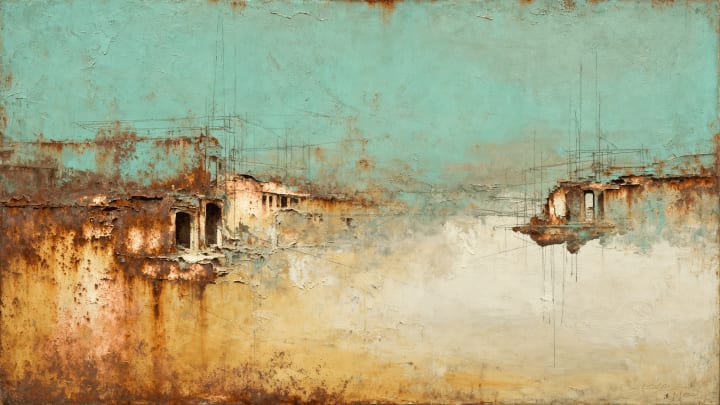
About the Artwork
Damian Ang
Where Stone Learns to Dissolve
This painting does not portray ruins.
It observes the moment before ruin becomes visible.
Oil on canvas becomes less a medium and more a field of erosion. Structure appears, but only partially—walls suspended in hesitation, openings that lead nowhere, foundations withdrawing into mist. Architecture does not collapse here; it loosens.
The upper plane carries oxidized turquoise—air that feels mineral, as if the sky itself has corroded. Below, warm earth and rust tones gather like memory settling into sediment. Between them is not a horizon, but tension: a quiet negotiation between solidity and disappearance.
The linework suggests construction, yet refuses completion. Grids hover without authority. Forms seem aware of their own impermanence. Stone does not shatter; it learns.
This work inhabits a threshold—
between geometry and breath,
between endurance and surrender,
between what stands and what understands that standing cannot last.
There is no drama of destruction.
Only the subtle education of matter.
Here, dissolution is not failure.
It is awareness.
About the Creator
LUCCIAN LAYTH
L.LUCCIAN is a writer, poet and philosopher who delves into the unseen. He produces metaphysical contemplation that delineates the line between thinking and living. Inever write to tellsomethingaboutlife,but silences aremyway ofhearing it.
Reader insights
Outstanding
Excellent work. Looking forward to reading more!
Top insights
Compelling and original writing
Creative use of language & vocab
Easy to read and follow
Well-structured & engaging content
Eye opening
Niche topic & fresh perspectives
Masterful proofreading
Zero grammar & spelling mistakes
On-point and relevant
Writing reflected the title & theme
Keep reading
More stories from LUCCIAN LAYTH and writers in Chapters and other communities.
CHAPTER I:The Well of Unspoken Melodies
At times, late into the night, just before dawn arrives, I find myself standing at the brink of the well behind my apartment, which is but the lame remains of a stone opening from which an unwelcome dampness and an inexplicable nostalgic odor egress. The woman I have fallen in love with exists in the silence of the well, although she has never visited, lived, or moved into this space. She could reside in the negative spaces: the interval between the drops of water, the shadow that hugs the bricks, the remembered laughter of a laugh I dreamed once. I have made a secret of her name even to myself.I met her in a jazz bar in Shinjuku, Tokyo, while the saxophone's vapid breath fogged the windows and the ice in my whiskey would freeze in time. She sat two barstools down from me and was reading from an old edition of The Wind-Up Bird Chronicle, her fingers slowly stroking the book's spine as if it were an artifact of divine significance. Her hair settled as a curtain of protection between us, and every time she turned a page, the sound rumbled like nearby thunder. I made myself order another drink that I didn't want, to remain comfortable to the warm silence while she had not left. She left before the set was over and left a hair clip, which was shaped like a small sparrow.I concealed it within my pocket, where it buzzed against my thigh like a caged cicada.The hairpin now rests upon my poor, sad desk next to an unwanted stack of letters that regretfully, I have never sent. Of an evening, when the pulse of the city becomes somewhat relaxed, I will press it to my ear and imagine I can hear something—a jazz standard played backward or a train running on tracks too far out of the imagination to fully comprehend. I write her about these oddities; “The well is deeper than it seems,” I scrawl once, and crumple the paper. The language fails. It lays claims to the canted shape of desire.The dreams started in October. I am trapped in a hotel with a winding labyrinth of a space; a corridor might break into the sky without stars, an elevator opening into a field of wheat, not a cloud, or an elevator. She is always there, just out of reach type of way; a shadow out of a window, and a voice, somewhere down a corridor. At one point, a cat, a black stray that seemed to be unchanged in my likeness was about to meet me like a time traveler. Flicking its tail like a pendulum, I made eye contact, finding my girl's reflection on the solid blackness of its iris. “You are chasing a ghost, you know,” it said, though it had no working mouth. “The question is, isn't that the point of the story, for you to chase a ghost?"
By LUCCIAN LAYTH11 months ago in Chapters
The Guardian Chapter V
Alexander left his Coming of Age ceremony with Cronos and the elders with as many new questions as he had answers for his old questions. Cronos had confirmed his suspicions were correct. Not only was there a link between the Beast Masters and the inhabitants of the Citadel, but it was the Citadel's fault that the Beast Masters existed in the first place. Instead of banishing the law breakers which allowed them to wreak havoc on the rest of humanity, the Citadel elders should have stripped them of their powers before they became too strong. Now Alexander would need to battle the Beast Masters and the Jikininki. It would be difficult for him to forgive the Citadel Elders because their poor decisions led to the deaths of his parents and more than half the planet's human population.
By Mark Gagnonabout 22 hours ago in Chapters
Super Bowl LX Recap: A Team Called Hawks
Sixty. The Super Bowl turned 60! Still amazes me that this was the sixtieth Super Bowl played in NFL history. It seems like yesterday that I watched Super Bowl XXVII, the first SB I ever watched. The QB who won Super Bowl XXVII has since called a few SBs, and will call next year's game, but that's another story. Super Bowl LX took place at Levi's Stadium in Santa Clara, California, the home stadium of the San Francisco 49ers. However, it was one of their division foes who represented the NFC, as the Seattle Seahawks faced off against the New England Patriots.
By Clyde E. Dawkins6 days ago in Unbalanced


Comments (1)
This is so thoughtfully and beautifully written. I feel the Nietzsche influence and maybe some Descartes?