
Mirror Selves Trilogy: The Architecture of the Formatted Human
Book Trilogy Review

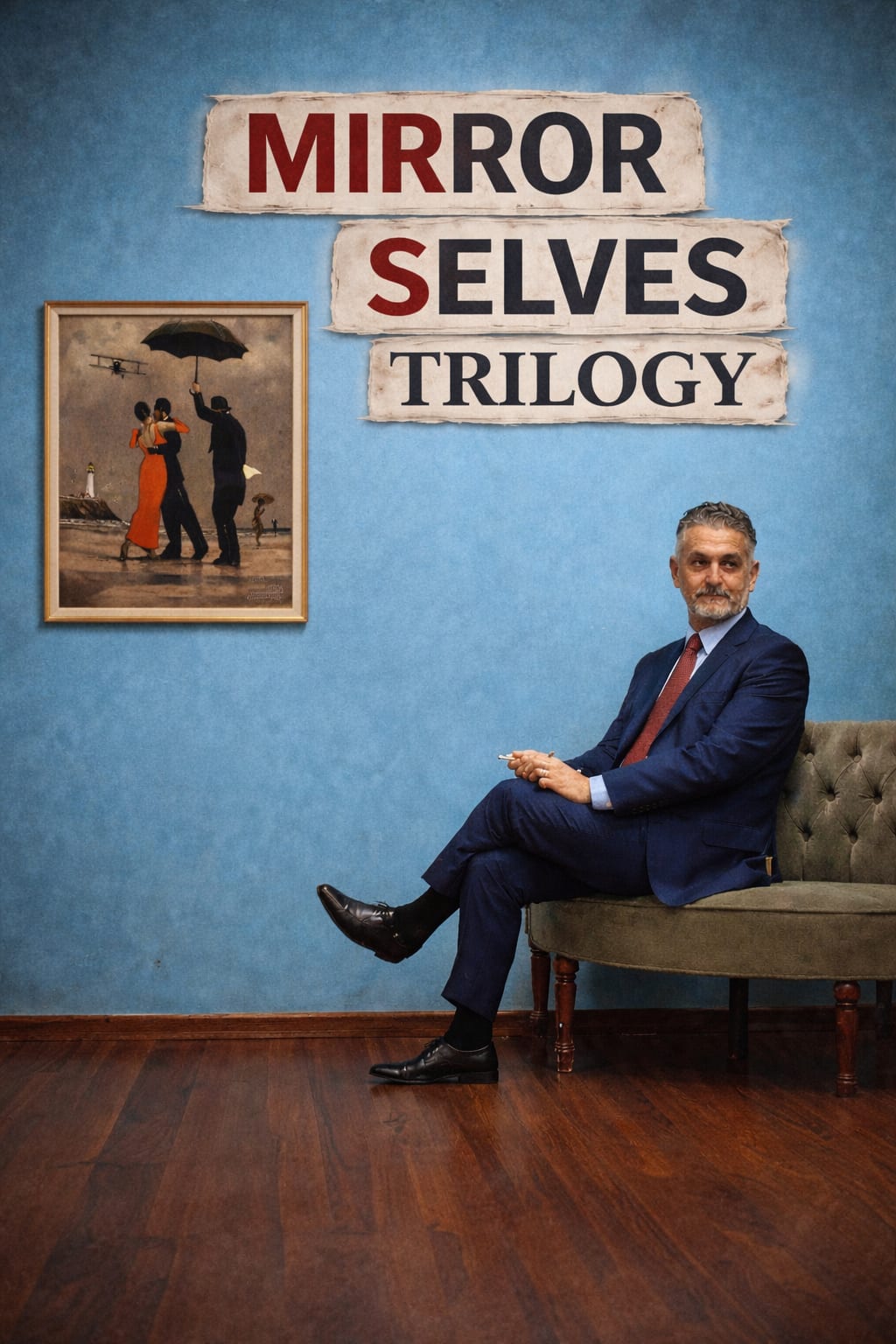
Mirror Selves Trilogy: The Architecture of the Formatted Human
The Mirror Selves Trilogy—Identity Industrial Complex, Copyrighting the Self, and The Shapes of the Self—offers one of the most systematic contemporary analyses of how identity has migrated from lived interiority to formatted visibility. Across its three volumes, Peter Ayolov develops a coherent theoretical architecture that traces the transformation of the self from a psychological and philosophical category into a political, economic, and technological construct. What begins as an inquiry into representation unfolds into a diagnosis of civilizational change: the shift from narrative selfhood to infrastructural identity, from subjectivity to profile, from history to circulation. At the core of the trilogy stands a simple but destabilizing claim: identity no longer precedes representation. It is formatted by it. The trilogy does not treat this as metaphor. It is not a cultural lament about social media narcissism or a nostalgic defense of authenticity. It is an ontological and political thesis. The human being, once imagined as a bearer of interior depth, now appears as a visible configuration inside systems of recognition. The mirror no longer reflects; it produces.
The first volume, Identity Industrial Complex, establishes the economic and structural framework of this transformation. Ayolov introduces the concept of the “identity industry” as the political economy of the human image. If industrial modernity mass-produced commodities, late digital capitalism mass-produces selves. Platforms, algorithms, biometric infrastructures, and visibility regimes convert likeness into asset. Identity becomes property—not only symbolically, but contractually and economically. Profiles, faces, gestures, and affective signals are captured, quantified, circulated, and monetized. The self enters a regime of extraction. Here Ayolov extends and radicalizes classical critiques of spectacle and simulation. Guy Debord described a society in which social relations are mediated by images. Jean Baudrillard described the hyperreal in which signs precede and displace the real. Ayolov pushes further: images do not merely mediate relations; they reorganize the ontology of personhood. The image is not a mask over the self. It is the condition of the self’s recognizability. Without formatting, there is no civic presence. Without visibility, no political countability. The strength of Identity Industrial Complex lies in its synthesis of media theory, political economy, and philosophical anthropology. Ayolov situates the contemporary identity regime within a longer genealogy of representation: from portraiture and photography to mass media, from bureaucratic identification to digital verification systems. He shows how recognition, once a moral and intersubjective category, becomes infrastructural. To be recognized is to be registered, searchable, ranked. Identity is no longer an existential question—Who am I?—but a system query—Can you be verified?
The second volume, Copyrighting the Self, deepens this analysis by examining the juridical and proprietary dimension of identity. If the first book describes identity as industrial production, the second describes it as legal enclosure. The self becomes a licensable asset. Biometric data, facial likeness, voice signatures, and personal brands become objects of contractual control. The modern subject, once framed as autonomous rights-bearer, now appears as intellectual property. Ayolov’s argument here is not merely descriptive but structural. Copyrighting the self is not a side effect of celebrity culture; it is a logical extension of a system in which representation generates value. Once likeness circulates independently of embodiment, the question of ownership becomes unavoidable. Who owns the image of a face? Who controls the simulation of a voice? Who authorizes the reproduction of a gesture? In a world of deepfakes and synthetic media, identity becomes a contested terrain. What distinguishes this volume is its refusal of both techno-optimism and moral panic. Ayolov does not argue that legal protections can simply restore authenticity, nor that simulation will inevitably destroy reality. Instead, he demonstrates that identity has entered a proprietary regime that fundamentally reshapes citizenship. The citizen becomes a rights-holder not only in political terms but in representational terms. Political struggle migrates into disputes over data, likeness, and visibility.
The public sphere becomes inseparable from intellectual property law. This juridical turn prepares the ground for the third volume, The Shapes of the Self, which can be read as the philosophical culmination of the trilogy. If the first book analyzes the industrialization of identity and the second its legal enclosure, the third analyzes its geometric configuration. Here Ayolov introduces the concept of the “shaped self” and the “geometric self”: identity structured by edges, templates, metrics, and repeatable patterns. Drawing on Žarko Paić’s analysis of video-centrism and Heidegger’s world-picture, Ayolov argues that we no longer inhabit a world interpreted through historical narrative but a world structured through images. The shift is not merely aesthetic. It is ontological. The world becomes scene. To exist is to appear within interface architectures that predefine what counts as presence. Profiles, biometric identifiers, algorithmic portraits are not representations of a prior self. They are primary modes of existence. The shaped self is not an accidental byproduct of digital life. It is the structural citizen of e-democracy. Political agency becomes inseparable from legibility. The subject must be formatted to be counted. Visibility replaces deliberation as the primary condition of influence. Equality mutates from equality of voice to equality of appearance—though even appearance remains unequally distributed through algorithmic hierarchies. In this volume Ayolov engages with Duchamp, Wolfe, Baudrillard, and Nancy to construct a multilayered theory of image ontology. Duchamp’s Readymade provides the logic of nomination: selection and framing generate meaning. In digital politics, the citizen becomes a Readymade—recognized through verification systems, profile architectures, and ranking protocols. Wolfe’s Painted Word clarifies how frames overpower content: platform design becomes more decisive than speech. Baudrillard explains how representation precedes substance: viral gestures substitute for policy. Nancy restores the dangerous dimension of the image: its capacity to gather intensity rather than merely circulate. What makes The Shapes of the Self compelling is its insistence that democracy itself is being reformatted. E-democracy does not simply digitize institutions. It transforms civic ontology. The political subject emerges not from interior conviction but from interface recognition. History, once binding through memory and accountability, risks dissolving into stream. The feed replaces narrative continuity. Responsibility becomes reaction.
Across the trilogy, a consistent conceptual thread emerges: the mirror as production mechanism. The mirror in early modernity stabilized the face; the digital mirror distributes it. The self is continuously externalized. It anticipates reception before action. It calibrates gesture for circulation. The subject lives under permanent exhibition. Yet Ayolov resists reduction to psychological critique. The mirror is not vanity; it is infrastructure. The trilogy’s theoretical ambition lies in its integration of aesthetics, political theory, media studies, and ontology. Ayolov refuses disciplinary isolation. Identity is not reducible to sociology, nor to philosophy, nor to law. It is a cross-sectional phenomenon. The industrial, the juridical, and the geometric dimensions interlock. The identity industrial complex produces images. Copyrighting the self encloses them. The shaped self stabilizes them as governable patterns. At the same time, the trilogy avoids simplistic dystopianism. Ayolov does not argue that authenticity has vanished or that agency is impossible. Rather, he insists that agency must now be understood within formatting regimes. The struggle for democracy becomes a struggle over formats: ownership of likeness, transparency of algorithms, rights to opacity, and the capacity to interrupt circulation. The trilogy does not call for the abolition of images. It calls for a politics of shape.
One of the most original contributions of the trilogy is its redefinition of recognition. In classical political philosophy, recognition concerned dignity, status, and mutual acknowledgment. In the mirror age, recognition becomes infrastructural: the capacity to be indexed, verified, and surfaced. The right to appear precedes the right to speak. This inversion destabilizes liberal assumptions about deliberation. If participation depends on formatting, then democratic equality depends on access to recognition architectures. The trilogy also contributes to debates on artificial intelligence and simulation. Deepfakes and generative models are not treated as anomalies but as intensifications of a longer trajectory. Once identity is primarily circulatory, simulation competes for existence. The question “Who spoke?” yields to “Which image won?” This does not imply that truth disappears. It implies that authenticity becomes procedural—verified through systems rather than guaranteed by presence. Stylistically, Ayolov’s writing combines conceptual rigor with rhetorical sharpness. His formulations—“identity as property,” “interface citizenship,” “geometric self”—function as analytical tools rather than slogans. The trilogy reads as an integrated system rather than three loosely connected essays. Each volume prepares the next. The architecture is cumulative.
If there is a tension in the work, it lies in its refusal of easy normative conclusions. Ayolov does not offer a blueprint for digital democracy. He offers a diagnosis of its ontological condition. Some readers may desire clearer prescriptions. Yet this restraint is arguably consistent with the project’s depth. Before proposing solutions, one must understand the terrain. In its totality, the Mirror Selves Trilogy can be read as a theory of the formatted human. It shows how identity migrates from interior depth to infrastructural surface, from narrative continuity to geometric shape. It reveals how political life becomes inseparable from visibility regimes. And it insists that the crisis of democracy is not merely institutional but ontological.
The trilogy’s final gesture is not despair but warning. Images without shape drift as pure circulation. When shape dissolves, identity loses anchor, history loses weight, and responsibility evaporates into stream. Yet shape is not nostalgia for essence. It is the fragile contour that binds image to body, event to memory, appearance to consequence. In an era obsessed with acceleration and novelty, Ayolov’s trilogy demands slowness of thought. It asks readers to see the mirror not as surface but as system. It invites reconsideration of what it means to be recognized, to be counted, to be present. And it leaves us with a decisive question: can democracy survive when citizenship is formatted, owned, and circulated as image?
The Mirror Selves Trilogy does not provide a comforting answer. It provides a framework within which the answer must be fought for.
About the Creator
Peter Ayolov
Peter Ayolov’s key contribution to media theory is the development of the "Propaganda 2.0" or the "manufacture of dissent" model, which he details in his 2024 book, The Economic Policy of Online Media: Manufacture of Dissent.
Keep reading
More stories from Peter Ayolov and writers in BookClub and other communities.
Peter Ayolov’s The Shapes of the Self: Identity and Recognition in Visual Space
Peter Ayolov’s The Shapes of the Self: Identity and Recognition in Visual Space (Book review) Peter Ayolov’s The Shapes of the Self: Identity and Recognition in Visual Space arrives not as an isolated philosophical meditation but as the culminating movement of the Mirror Selves Trilogy, following Identity Industrial Complex and Copyrighting the Self. If the first volume mapped the political economy of the human image and the second traced the juridical and proprietary capture of likeness, this final work undertakes the most ontological task of all: to ask what kind of self remains when the world itself has become image.
By Peter Ayolova day ago in BookClub
Book Review: Atmosphere by Taylor Jenkins Reid
I flipped the book over in my hands in the centre of the small airport book shop. Although I had heard promising reviews of Atmosphere by Taylor Jenkins Reid, I hesitated. The synopsis didn’t compel me - I wasn’t much of a space girly. In high school it made me cringe when my peers would talk about the stars.
By sleepy drafts25 days ago in BookClub
Belle of the Bayou
Bad move, cher. Not just the slip of her kitten heel on the rainy February cobblestones in the Fourth Ward. She got caught snooping. Detective Deleon clucked and strutted like a rooster in his rush to clear her from the scene, waving cigar smoke to and fro as he gesticulated amid the thick air of the speak easy. An experienced crime reporter, Marie knew better than to let the coppers catch her on the wrong side of the line, but curiosity had gotten the better of her.
By Maia Gadwall the metAlchemist6 days ago in Fiction



Comments
There are no comments for this story
Be the first to respond and start the conversation.